


 More than six in 10 Americans say their household finances have taken a hit from higher gas prices, according to a May Reuters/Ipsos poll that put Trump’s economic approval rating at just 30%, down several points since the beginning of the war.
Trump now faces mounting pressure from fellow Republicans who fear the economic pain caused by the war could spark voter backlash and cost the party control of the House of Representatives and possibly the Senate in November’s midterm elections.
Some White House officials have been poring over market data to gauge whether the national average gas price could climb to $5 a gallon.
OPEC Lowers 2026 Global Oil Demand Growth Forecast
Seven states have already surpassed that mark, according to AAA data.
“They feel like that’s their largest vulnerability right now: that specific cost — gas — not overall economic conditions,” said a political adviser to the White House. “The toughest thing, too, is that we made gas prices the Achilles’ heel for former President Joe Biden, and now it’s our own.”
White House spokeswoman Taylor Rogers said Trump and his energy team had anticipated the war’s disruptions to global energy markets and prepared a plan to mitigate the impact.
“The ability to supply both the United States and our allies with reliable, affordable, and secure energy has long been a key strategic objective of President Trump, and his successful efforts to unleash American oil and gas have achieved this objective,” Rogers said.
The administration’s concerns have deepened as U.S. oil and fuel exports have surged to record levels, driven by Asian and European buyers scrambling for supply.
That has drawn down U.S. inventories at a time when they typically rise, raising alarms among Wall Street analysts who warn the U.S. could face a crunch that sends gasoline, diesel, and jet fuel prices even higher this summer.
Energy prices have spiked since Iran cut off access to the Strait of Hormuz, a waterway that normally carries one-fifth of the world’s oil supplies.
Companies ranging from airlines to McDonald’s are seeing the effects, with the fast-food giant’s CEO saying last week that lower-income consumers were spending less.
U.S. airlines’ fuel expenses in March jumped 56% from February, according to Transportation Department data, squeezing carriers already operating on thin margins, including Spirit Airlines, the troubled budget carrier that shut down earlier in May.
Trump has called the increases “a small price to pay” for efforts to topple Iran’s regime and prevent Tehran from acquiring a nuclear weapon.
More than six in 10 Americans say their household finances have taken a hit from higher gas prices, according to a May Reuters/Ipsos poll that put Trump’s economic approval rating at just 30%, down several points since the beginning of the war.
Trump now faces mounting pressure from fellow Republicans who fear the economic pain caused by the war could spark voter backlash and cost the party control of the House of Representatives and possibly the Senate in November’s midterm elections.
Some White House officials have been poring over market data to gauge whether the national average gas price could climb to $5 a gallon.
OPEC Lowers 2026 Global Oil Demand Growth Forecast
Seven states have already surpassed that mark, according to AAA data.
“They feel like that’s their largest vulnerability right now: that specific cost — gas — not overall economic conditions,” said a political adviser to the White House. “The toughest thing, too, is that we made gas prices the Achilles’ heel for former President Joe Biden, and now it’s our own.”
White House spokeswoman Taylor Rogers said Trump and his energy team had anticipated the war’s disruptions to global energy markets and prepared a plan to mitigate the impact.
“The ability to supply both the United States and our allies with reliable, affordable, and secure energy has long been a key strategic objective of President Trump, and his successful efforts to unleash American oil and gas have achieved this objective,” Rogers said.
The administration’s concerns have deepened as U.S. oil and fuel exports have surged to record levels, driven by Asian and European buyers scrambling for supply.
That has drawn down U.S. inventories at a time when they typically rise, raising alarms among Wall Street analysts who warn the U.S. could face a crunch that sends gasoline, diesel, and jet fuel prices even higher this summer.
Energy prices have spiked since Iran cut off access to the Strait of Hormuz, a waterway that normally carries one-fifth of the world’s oil supplies.
Companies ranging from airlines to McDonald’s are seeing the effects, with the fast-food giant’s CEO saying last week that lower-income consumers were spending less.
U.S. airlines’ fuel expenses in March jumped 56% from February, according to Transportation Department data, squeezing carriers already operating on thin margins, including Spirit Airlines, the troubled budget carrier that shut down earlier in May.
Trump has called the increases “a small price to pay” for efforts to topple Iran’s regime and prevent Tehran from acquiring a nuclear weapon. Trending Now
[/tdc_zone]
LATEST ARTICLES
Trump Faces Pressure As Gas Prices Surge Amid Iran Conflict
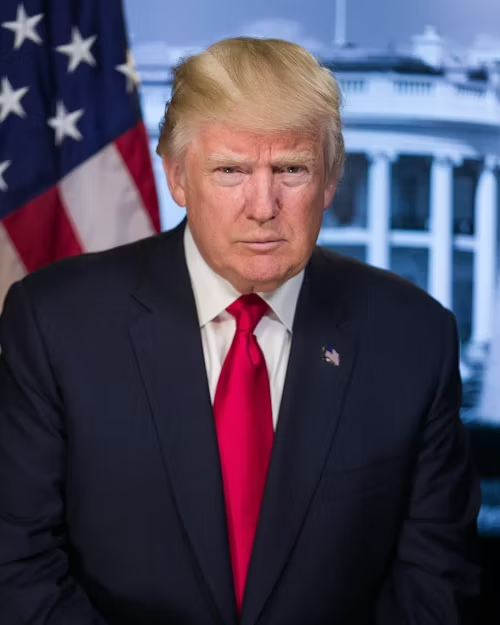
The U.S. government is scrambling to contain the economic and political fallout from the war with Iran, Reuters reported, citing three people familiar with White House discussions, as hopes for a quick resolution fade.
U.S. President Donald Trump this week backed suspending the federal gas tax, a step that would knock 18 cents a gallon off motor fuel prices, which are currently averaging more than $4.50 a gallon nationwide.
According to the Reuters report, there is a consensus among some White House officials that, with prices up 50% since the start of the war, Trump needs “a visible consumer relief move now.”
Historically, $4-per-gallon gasoline has been a level that triggers public backlash and economic anxiety.
That has been evident since the war began, as consumer sentiment recently dipped to a record low and U.S. consumer inflation surged to 3.8% in April, the highest level in nearly three years.
More than six in 10 Americans say their household finances have taken a hit from higher gas prices, according to a May Reuters/Ipsos poll that put Trump’s economic approval rating at just 30%, down several points since the beginning of the war.
Trump now faces mounting pressure from fellow Republicans who fear the economic pain caused by the war could spark voter backlash and cost the party control of the House of Representatives and possibly the Senate in November’s midterm elections.
Some White House officials have been poring over market data to gauge whether the national average gas price could climb to $5 a gallon.
OPEC Lowers 2026 Global Oil Demand Growth Forecast
Seven states have already surpassed that mark, according to AAA data.
“They feel like that’s their largest vulnerability right now: that specific cost — gas — not overall economic conditions,” said a political adviser to the White House. “The toughest thing, too, is that we made gas prices the Achilles’ heel for former President Joe Biden, and now it’s our own.”
White House spokeswoman Taylor Rogers said Trump and his energy team had anticipated the war’s disruptions to global energy markets and prepared a plan to mitigate the impact.
“The ability to supply both the United States and our allies with reliable, affordable, and secure energy has long been a key strategic objective of President Trump, and his successful efforts to unleash American oil and gas have achieved this objective,” Rogers said.
The administration’s concerns have deepened as U.S. oil and fuel exports have surged to record levels, driven by Asian and European buyers scrambling for supply.
That has drawn down U.S. inventories at a time when they typically rise, raising alarms among Wall Street analysts who warn the U.S. could face a crunch that sends gasoline, diesel, and jet fuel prices even higher this summer.
Energy prices have spiked since Iran cut off access to the Strait of Hormuz, a waterway that normally carries one-fifth of the world’s oil supplies.
Companies ranging from airlines to McDonald’s are seeing the effects, with the fast-food giant’s CEO saying last week that lower-income consumers were spending less.
U.S. airlines’ fuel expenses in March jumped 56% from February, according to Transportation Department data, squeezing carriers already operating on thin margins, including Spirit Airlines, the troubled budget carrier that shut down earlier in May.
Trump has called the increases “a small price to pay” for efforts to topple Iran’s regime and prevent Tehran from acquiring a nuclear weapon.
More than six in 10 Americans say their household finances have taken a hit from higher gas prices, according to a May Reuters/Ipsos poll that put Trump’s economic approval rating at just 30%, down several points since the beginning of the war.
Trump now faces mounting pressure from fellow Republicans who fear the economic pain caused by the war could spark voter backlash and cost the party control of the House of Representatives and possibly the Senate in November’s midterm elections.
Some White House officials have been poring over market data to gauge whether the national average gas price could climb to $5 a gallon.
OPEC Lowers 2026 Global Oil Demand Growth Forecast
Seven states have already surpassed that mark, according to AAA data.
“They feel like that’s their largest vulnerability right now: that specific cost — gas — not overall economic conditions,” said a political adviser to the White House. “The toughest thing, too, is that we made gas prices the Achilles’ heel for former President Joe Biden, and now it’s our own.”
White House spokeswoman Taylor Rogers said Trump and his energy team had anticipated the war’s disruptions to global energy markets and prepared a plan to mitigate the impact.
“The ability to supply both the United States and our allies with reliable, affordable, and secure energy has long been a key strategic objective of President Trump, and his successful efforts to unleash American oil and gas have achieved this objective,” Rogers said.
The administration’s concerns have deepened as U.S. oil and fuel exports have surged to record levels, driven by Asian and European buyers scrambling for supply.
That has drawn down U.S. inventories at a time when they typically rise, raising alarms among Wall Street analysts who warn the U.S. could face a crunch that sends gasoline, diesel, and jet fuel prices even higher this summer.
Energy prices have spiked since Iran cut off access to the Strait of Hormuz, a waterway that normally carries one-fifth of the world’s oil supplies.
Companies ranging from airlines to McDonald’s are seeing the effects, with the fast-food giant’s CEO saying last week that lower-income consumers were spending less.
U.S. airlines’ fuel expenses in March jumped 56% from February, according to Transportation Department data, squeezing carriers already operating on thin margins, including Spirit Airlines, the troubled budget carrier that shut down earlier in May.
Trump has called the increases “a small price to pay” for efforts to topple Iran’s regime and prevent Tehran from acquiring a nuclear weapon. Ghana: One By One, GOIL PLC Counts Its Blessings

Ghana’s largest indigenous oil marketing company, GOIL PLC, has been making significant strides in the energy sector through stronger controls, renewed discipline, improved liquidity, competitive pricing, restored staff morale, and the modernization of its stations.
Below is an article by the Corporate Affairs Department of GOIL PLC. highlighting its recent achievements.
A Story of Leadership, Discipline, Renewal and Restoration
GOIL was still respected. Its name still carried history. Its colours still inspired confidence across Ghana. But behind the familiar brand was a business under strain.
The Early Signs of Decline
The company that had once stood comfortably as market leader was gradually losing ground. Products were not consistently available at several outlets because supplier indebtedness had tightened supply lines. Where products existed, GOIL was often unable to compete aggressively at the pumps. Annual financing costs had risen to approximately GH¢130 million, draining resources that should have gone into growth, infrastructure and operational renewal. Several stations, the very face of the brand, had fallen into a dilapidated state. Staff morale was low. Discipline had weakened. Across parts of the organisation, systems and controls were either inadequate or absent.
The governance gap
For a listed company of GOIL’s stature, there was no comprehensive Audit Charter to strengthen internal controls across the business. There was also no robust Procurement Manual to guide procurement decisions and enforce consistency, transparency and accountability. In any modern institution, such gaps create fertile grounds for inefficiency, weak controls and potential corruption. Left unaddressed, they threaten not only profitability, but institutional credibility itself.
The implication was clear: without decisive intervention, GOIL risked slowly surrendering both its market leadership and the trust that generations of Ghanaians had placed in the brand.
But leadership is tested not when the seas are calm, but when the tides begin to turn.
The new leadership chose action over excuses.
Leadership understood from the beginning that restoring GOIL would require more than rhetoric. It would demand discipline, sacrifice, difficult decisions and a clear moral commitment to rebuilding the institution from within. One by one, the rebuilding began.
Governance as the Starting Point
The Board and Management moved swiftly to develop and approve a comprehensive Audit Charter and Procurement Manual to strengthen accountability, reinforce controls and streamline procurement processes across the Group. These were not merely administrative documents; they were statements of intent. They signaled a new culture, one rooted in transparency, discipline and institutional responsibility.
Financial Restructuring and Recovery
The company’s debt exposure to suppliers constrained operations and weakened competitiveness. Management therefore, engaged financial institutions and strategic partners to refinance key obligations and create breathing space for the business. This intervention eased liquidity pressures, restored confidence among suppliers and repositioned GOIL to source products competitively again. Financing was no longer treated merely as a treasury function; it became a strategic instrument for recovery.
Restoring Commercial Competitiveness
Management aggressively pursued more competitive product sourcing strategies. Once product availability improved and pricing became competitive again, customers responded. Volumes began to rise. Confidence returned to the stations. The market could once again feel the presence of GOIL.
Cultural and human transformation
No turnaround succeeds without people. Management therefore worked closely with the Senior Staff Association and the Union to reorient staff around discipline, teamwork, professionalism and customer service. A new sense of purpose slowly began to emerge across the organisation. Staff who once felt disconnected from the company’s mission began to rediscover pride in the GOIL brand.
Physical Transformation Across the Network
The state of many GOIL stations reflected the broader decline the company had experienced. Leadership therefore initiated the first major wave of station rehabilitation and renovation works. Contractors were engaged to begin modernising selected outlets, restoring not just buildings, but confidence and brand identity.
The Results Begin to Emerge
In 2025, GOIL had slipped behind Star Oil in market share despite its proud history. Yet by Q1 2026, GOIL had reclaimed market leadership with 256.8 million litres and 12.23% market share. In April 2026 alone, GOIL recorded over 108 million litres in sales, the highest monthly sales volume in the company’s history and the strongest performance among all Oil Marketing Companies in Ghana.
Ghana: NPA Announces 268 Fuel Stations For 24-Hour Operations In Four Regions
Even more remarkable was the pace of the recovery. While the overall market grew by 16.6% year-on-year in Q1 2026, GOIL grew by 35.8%.
That growth did not come from chance.
It came from leadership that confronted reality honestly.
It came from governance reforms that strengthened accountability.
It came from financial discipline that restored stability.
It came from commercial courage that returned competitiveness.
It came from staff who chose to believe again.
And it came from a collective refusal to allow a great Ghanaian institution to decline quietly.
Today, GOIL counts its blessings one by one.
Stronger controls.
Renewed discipline.
Improved liquidity.
Competitive pricing.
Restored staff morale.
Modernising stations.
Recovered market leadership
But above all, GOIL counts the blessing of renewed purpose.
The journey is still ongoing. The work is not finished. But the direction is clear. GOIL is once again rising, not merely as a company chasing volumes, but as a disciplined national institution rebuilding trust, restoring pride and delivering Good Energy to Ghana.
Source: Corporate Affairs, GOIL PLC
Nigeria:Ex-Power Minister Saleh Mamman Sentenced To 75 Years For ₦33.8Bn Fraud

Nigeria’s former Minister for Power, Saleh Mamman, has been sentenced to 75 years in prison in absentia over a N33.8 billion money laundering and fraud case brought by the Economic and Financial Crimes Commission (EFCC).
The Federal High Court in Abuja, presided over by Justice James Omotosho, delivered the judgment on Wednesday, May 13, 2026.
The court convicted Mamman on all 12 counts filed against him by the anti-graft agency, holding that the prosecution proved its case beyond a reasonable doubt.
Justice Omotosho ordered that the prison terms run consecutively rather than concurrently, resulting in a total jail term of 75 years.
South Africa: Eskom Partners Energy Vault To Deploy Grid-Scale Gravity Energy Storage Systems
The judge sentenced the former minister to seven years’ imprisonment each on counts 1, 2, 3, 6, 7, 8, 9, 10, 11, and 12, without an option of a fine.
He also sentenced him to three years’ imprisonment on count four, with an option of a N10 million fine, and two years’ imprisonment on count five, without an option of a fine.
The judge held that Mamman’s absence in court during the judgment and sentencing proceedings was a deliberate attempt to frustrate the administration of justice.
Relying on provisions of the Administration of Criminal Justice Act, 2015, the court agreed with EFCC counsel Rotimi Oyedepo (SAN) that sentencing could validly proceed despite the defendant’s absence.
Justice Omotosho subsequently ordered all security agencies, including Interpol, to arrest Mamman wherever he is found and hand him over to the Nigerian Correctional Service to begin serving his sentence.
The court ruled that the jail term would commence from the date of his arrest.
The judge also ordered the final forfeiture of recovered funds, foreign currencies, and properties linked to the convict, including properties traced to him in Abuja.
He further directed Mamman to refund the outstanding balance from the N22 billion the prosecution established was diverted from funds meant for the Mambilla and Zungeru hydroelectric power projects.
Mamman, who served under former President Muhammadu Buhari, was initially arraigned in July 2024 on allegations bordering on conspiracy and money laundering involving N33.8 billion in a suit marked FHC/ABJ/CR/273/2024.
Justice Omotosho had, on May 7, convicted the former minister in absentia after holding that the EFCC established his culpability beyond reasonable doubt and subsequently issued a warrant for his arrest.
Source:https://energynewsafrica.com
Russia’s Oil Revenues Surge $6.3 Billion As High Prices Offset Production Losses
Russia’s oil export revenues have continued to rise despite lower production thanks to high oil prices.
According to the International Energy Agency (IEA) monthly market report for May, Russia’s oil export revenues clocked in at $19.18 billion in April, good for a modest $180 million increase from March but a massive jump of $6.28 billion compared to April 2025.
The increase in oil revenues came despite total output falling by 460,000 bpd to 8.8 million bpd, while total exports declined by 90,000 bpd to an average of 7.03 million bpd.
The ongoing Iran war and the subsequent closure of the Strait of Hormuz severely choked global energy supplies, sending global benchmarks skyrocketing and pushing Russian Urals crude closer to open-market prices.
Meanwhile, the Trump administration issued a temporary sanctions waiver that allowed global buyers to take delivery of Russian oil cargoes in a bid to stabilize energy prices during geopolitical disruptions.
While the initial waiver expired on April 11, Washington extended this relief for another 30 days through May 16 in a bid to manage volatile energy prices, despite initial indications that it would not be renewed.
That said, Russia’s energy sector continues to face major challenges stemming from the war in Ukraine. Ongoing Ukrainian drone attacks have repeatedly targeted major Russian refineries and Baltic ports like Primorsk and Ust-Luga, destroying processing capacity and severely restricting Russia’s refined product output.
By April 2026, drone attacks reduced Russia’s total oil output by roughly 460,000 barrels per day (bpd) compared to 2025, with refined product exports falling by roughly 200,000 bpd.
However, Russia has managed to offset losses through a 36% surge in pipeline exports, aided by the late-April resumption of the southern Druzhba pipeline to Hungary and Slovakia.
The resumption allowed Hungary and Slovakia–both exempt from EU bans–to resume receiving approximately 175,000–200,000 barrels per day of Russian oil, offsetting earlier dips in their import volumes following a January 2026 drone strike by Ukraine that halted flows through the southern Druzhba branch.
OPEC Lowers 2026 Global Oil Demand Growth Forecast
Summary
-
OPEC has lowered its forecast for global oil demand growth in 2026 due to geopolitical tensions linked to the Iran war, while slightly raising its outlook for 2027.
-
The closure of the Strait of Hormuz has disrupted oil flows, reduced output, and contributed to higher fuel prices and supply constraints globally.
-
Despite the downgrade for 2026, OPEC expects demand to remain resilient overall, supported by steady global economic growth and a projected rebound in consumption.
German Cabinet Agrees to Replace Green-Friendly Heating Law

Summary
New law drops mandatory renewables, allows households to keep existing boilers Industry federation welcomes move as a boost for investment and construction Greens’ Katherina Droege criticizes the change as abandoning climate targets The German government agreed on Wednesday to scrap a contentious heating law and introduce measures to boost long-term power generation capacity, as it pledged to push ahead with a package of reforms aimed at reviving the struggling economy. India’s PM Modi Cuts Convoy Size By 50% To Save Fuel Amid West Asia Crisis Economy Minister Katherina Reiche said replacing the 2023 law, which required new building heating systems to use at least 65% renewable energy, would make it easier for companies to invest in construction and building restoration. Source: Reuters.comSouth Africa: Eskom Partners Energy Vault To Deploy Grid-Scale Gravity Energy Storage Systems

South Africa’s state-owned electricity utility Eskom has signed a Strategic Development Agreement with Energy Vault Holdings, Inc. to deploy a long-duration Gravity Energy Storage System (GESS) at its power stations.
The companies announced plans to deploy the first gravity storage system at the Hendrina Power Station in Mpumalanga Province, South Africa, with the intention to license, co-develop, and collaborate on the deployment of up to 4GWh of long-duration energy storage across the 16 member states of the Southern African Development Community (SADC).
The partnership is expected to significantly advance regional efforts to transition away from coal while leveraging advanced material science technology for the economic re-use of waste coal ash within the energy storage medium.
The initiative is also aimed at improving grid reliability, creating jobs, and supporting local economic development.
Eskom said the first GESS plant will be built at its Hendrina Power Station in Mpumalanga, one of the utility’s oldest operating stations.
The system is expected to provide 25MW of capacity with four hours of storage, equivalent to 100MWh, and is designed to be fully scalable up to 4GW. The landmark agreement establishes a long-term partnership between the two companies to accelerate the decarbonization of Southern Africa’s power sector.
Under the terms of the agreement, Energy Vault will provide Eskom with its latest EVx 2.0™ GESS technology system and associated equipment, along with on-site engineering, project management, and localized training support.
The partnership intends to license, co-develop, and collaborate on the deployment of up to 4GWh of GESS storage, with significant potential across the 16-member SADC region by 2035.
Energy Vault’s EVx 2.0™ GESS platform incorporates major advancements over the previous EVx design, particularly in software orchestration, mechanical operation, energy efficiency, construction automation, and construction tooling.
These enhancements enable a system capable of scaling to multi-gigawatt energy storage capacity to support increasing renewable energy penetration.
The EVx 2.0 design also features improved material science technology for the economic re-use of ash from coal combustion as the storage medium in the blocks, which may weigh up to 25–30 tons each.
Commenting on the partnership, Robert Piconi said: “This landmark agreement with Eskom represents a transformational milestone for Energy Vault and for Africa’s energy future.
“By combining our breakthrough EVx 2.0 platform with Eskom’s extensive power generation, grid expertise, and regional reach, we are not only advancing long-duration storage at unprecedented scale but also pioneering a new model for sustainable industrial development.
“This partnership will create local jobs, establish resilient supply chains, and demonstrate how gravity energy storage can accelerate Africa’s transition from coal dependency to energy independence and security — while delivering reliable, affordable power to communities that need it most.”
Liberia: LEC, Thames Electricals Limited Sign $6 Million Deal To Establish Liberia’s First Electrical Manufacturing Plant
Dan Marokane emphasized that the collaboration directly supports Eskom’s Just Energy Transition Partnership (JETP) initiative, which focuses on achieving a sustainable and equitable transition away from coal while ensuring grid reliability, job creation, and local economic development.
He said Eskom will drive a just and inclusive energy transition by intensifying the repowering and repurposing of coal power stations while exploring clean coal technologies and solutions that use technology as a strategic enabler to improve efficiencies and lower electricity costs.
According to him, Eskom’s partnership with Energy Vault and its innovative gravity storage technology will play a pivotal role in achieving the utility’s Just Energy Transition goals.
Southern Africa is undergoing a significant transformation in its energy landscape, with governments and utilities across the SADC region working to expand access to reliable, affordable, and sustainable electricity.
“Today, 56% of the SADC region’s population has access to electricity, up from just 36% a decade ago, reflecting the impact of coordinated regional efforts and investment in infrastructure. Coal remains the dominant source of power generation, contributing over 80% of South Africa’s electricity supply in 2024, but the region is actively diversifying its energy mix. Utility-scale energy storage technologies are set to play a key role in integrating renewables, strengthening national grid resilience, and improving grid reliability — while also unlocking new opportunities for industrial growth, job creation, and community development,” Marokane concluded.
India’s PM Modi Cuts Convoy Size By 50% To Save Fuel Amid West Asia Crisis

Indian Prime Minister Narendra Modi has reduced his convoy by 50% as part of wider austerity and fuel-saving measures amid the US-Iran war, ANI reported on Wednesday, citing sources.
The Special Protection Group (SPG), the elite unit responsible for the Prime Minister’s security, has been directed to reduce the size of PM Modi’s convoy without compromising mandatory security protocols.
Modi has also called for greater use of electric vehicles (EVs) in the convoy, while making it clear that no new vehicles should be purchased to avoid additional expenditure.
IEA Launches Tracker To Monitor Policy Responses To Energy Market Impacts Of Middle East Conflict
The downsizing of the Prime Minister’s convoy was implemented during his recent domestic visits.
Earlier this week, Modi made seven major appeals — described as austerity measures — aimed at cushioning India from the economic uncertainties arising from the prolonged West Asia war.
These included conserving petrol and diesel by using public transport and metro services, avoiding the purchase of gold for a year, and restricting foreign travel to conserve foreign exchange reserves.
Several BJP leaders, including Delhi Chief Minister Rekha Gupta, backed Modi’s call to save fuel.
In a post on social media platform X, she wrote:“In internalizing this important appeal of Honourable Prime Minister ji, a decision has been taken to limit the number of vehicles for departmental work. I and all my Cabinet colleagues, all MLAs of the Bharatiya Janata Party, public representatives, officers of the Delhi government, and all departments will also use the minimum number of vehicles as required and prioritize carpooling and public transport.”
On May 12, the opposition Congress party in Madhya Pradesh criticized the BJP after some of its leaders, newly appointed to state corporations, arrived in large convoys despite Modi’s appeal to reduce fuel consumption.
The state government recently made political appointments to various corporations and boards.
https://energynewsafrica.com/tanzania-samia-cuts-convoy-orders-officials-to-follow-by-bus-due-to-rising-fuel-costs/
Saubhagya Singh Thakur, who was appointed chairman of the Madhya Pradesh Textbook Corporation, arrived in Bhopal from Ujjain on Monday with supporters to assume office.
Videos of his convoy, consisting of several vehicles, later went viral.
Similarly, Rakesh Singh Jadon, newly appointed Vice President of the Khadi Village Industries Board, also arrived with a large convoy from Vidisha.
State Congress President Jitu Patwari said: “PM Modi should first follow his own message and ensure that BJP leaders also follow it. Crores of rupees worth of petrol and diesel were spent on his roadshow yesterday. Forty chartered planes are being sent for BJP leaders and chief ministers to attend the swearing-in ceremony in Assam. Why is the Prime Minister’s message only for the public?”
He added that the war in West Asia has caused greater economic harm to India than to Iran and the United States, noting that the Indian rupee continues to weaken against the US dollar.
He blamed the Union government for the situation.
Liberia: LEC, Thames Electricals Limited Sign $6 Million Deal To Establish Liberia’s First Electrical Manufacturing Plant

Strategic agreement positions Liberia as an emerging manufacturing hub for transformers, conductors, switchgear, and smart meters, following bilateral discussions between the Presidents of Liberia and Kenya.
The Liberia Electricity Corporation (LEC) and Thames Electricals Limited, an international electrical engineering and manufacturing company based in Kenya, have signed a Memorandum of Understanding (MoU) to establish Liberia’s first major manufacturing and refurbishment facility for electrical infrastructure products.
The agreement, signed in Nairobi on Tuesday, May 12, 2026, in the presence of the President of the Republic of Liberia, Mr. Joseph Nyuma Boakai, is expected to mobilize funds for a multi-million-dollar private-sector investment.
The project is also expected to create hundreds of skilled Liberian jobs while reducing the country’s dependence on imported electrical equipment.
Mr. Mohammed M. Sherif, Managing Director and Chief Executive Officer of the Liberia Electricity Corporation, signed on behalf of LEC, while Mr. Nilesh Jasani, Chief Executive Officer of Thames Electricals Limited, signed on behalf of his company.
The MoU followed a bilateral meeting between His Excellency President Boakai and His Excellency Dr. William Samoei Ruto, President of the Republic of Kenya, during which the two Heads of State discussed the broader strategic partnership between Liberia and Kenya across multiple sectors, including the manufacturing of electrical materials and infrastructure.
The signing ceremony took place on the sidelines of the Africa Forward Summit in Nairobi.
Kenya And France Sign 11 Deals On Energy, Trade And Infrastructure
The facility, to be developed by a dedicated Liberian special-purpose vehicle, will manufacture and refurbish electrical infrastructure products that support national grid expansion, including distribution transformers, overhead and underground conductors, switchgear, smart meters, and related ancillary equipment.
Indicative annual production volumes are expected to grow from US$4 million–US$6 million in Year 1 of operations to US$16 million–US$25 million by Year 5, positioning Liberia as a competitive source not only for domestic consumption but also for the wider ECOWAS, Mano River Union, and AfCFTA markets.
The project is directly aligned with Liberia’s ARREST Agenda under the leadership of President Boakai, the National Energy Compact under the World Bank–African Development Bank Mission 300 initiative, and the Liberia Electricity Corporation’s Strategic Plan 2025–2030.
The plan targets the expansion of generation capacity to 200 MW, growth of the customer base to more than 600,000 connections, and reduction of system losses to below 15 per cent by 2030.
Commenting on the agreement, President of the Republic of Liberia, His Excellency Joseph Nyuma Boakai, Sr., said:
“This agreement is more than a commercial transaction. It is a statement of confidence in Liberia’s future, a vote for Liberian workers and engineers, and a step forward in our drive to industrialize our economy and modernize our energy sector. We thank our brother nation Kenya and Thames Electricals for choosing Liberia as a partner in building African industrial capability.”
Mr. Mohammed M. Sherif, Managing Director and Chief Executive Officer of the Liberia Electricity Corporation, said: “For too long, Liberia has imported the very equipment that builds and maintains its national grid. With this partnership, that begins to change. We will manufacture our own transformers, conductors, and smart meters here in Liberia, by Liberians, for Liberia and for our region. This project supports every pillar of LEC’s Strategic Plan — lower losses, more connections, stronger collections, and a power sector that serves national development. We are deeply grateful to His Excellency the President for his leadership in making it possible.”
Mr. Nilesh Jasani, Chief Executive Officer of Thames Electricals Limited, added: “Thames Electricals is honoured to partner with the Liberia Electricity Corporation and the Government of Liberia on a project of this strategic significance. We see in Liberia a market of real opportunity, leadership of real ambition, and a partner of real capability. Our commitment is not only to invest capital, but also to transfer technology, build skills, and develop local supply chains — so that what we build together stands the test of time.”
Construction of the facility is expected to commence within months, with commercial operations targeted to begin by early 2027
QatarEnergy, TotalEnergies, ConocoPhillips Join Forces For Oil Exploration Offshore Syria

QatarEnergy has signed a memorandum of understanding (MoU) with TotalEnergies, ConocoPhillips, and the Syrian Petroleum Company to cooperate in oil and gas exploration offshore the Syrian Arab Republic.
The agreement covers a technical review by the partners to evaluate the potential of Block 3, offshore Syria, and sets the framework for further technical and commercial discussions, the company said in a statement on Tuesday, May 12, 2016. Saad Sherida Al-Kaabi, Minister of State for Energy Affairs and President and CEO of QatarEnergy, was present during the signing at QatarEnergy’s headquarters. The event was attended by senior executives from QatarEnergy, TotalEnergies, ConocoPhillips, and the Syrian Petroleum Company. Commenting on the signing, H.E. Minister Al-Kaabi said:”This agreement reflects QatarEnergy’s continued international growth strategy and its efforts to explore upstream oil and gas business development opportunities in the region and globally.” He added: “We are pleased to partner with the Syrian Petroleum Company to explore potential opportunities that can support growth and prosperity for the people of the Syrian Arab Republic. We look forward to working closely with our international partners, TotalEnergies and ConocoPhillips, as well as other relevant stakeholders, to assess this opportunity.” Block 3 lies in the Levantine Basin in the eastern Mediterranean, offshore the Syrian city of Latakia, with water depths ranging from 100 to 1,700 meters.Ghana: NPA Announces 268 Fuel Stations For 24-Hour Operations In Four Regions

Ghana’s downstream petroleum regulator, the National Petroleum Authority (NPA), has announced the selection of 268 fuel stations across four regions, as well as eight depots and two refineries, for the pilot implementation of 24-hour operations in the downstream petroleum sector.
The Authority named the selected facilities as BOST Depots in Kumasi, Accra Plains Depot (APD) near Kpone Barrier, Tema Tank Farm, TFC, Vana Energy in Tema, Quantum Terminals in Tema, Ghanstock Depot in Takoradi, Zen Terminals in Takoradi, Tema Oil Refinery, and Sentuo Oil Refinery.
Chief Executive Officer of the National Petroleum Authority, Godwin Edudzi Tameklo, disclosed this during the launch of the pilot programme in Accra on Tuesday, May 12, 2026.
The selected fuel stations which will operate 24-hour are located in the Greater Accra, Ashanti, Western, and Northern regions.
According to the regulator, the phased approach will enable the Authority to test systems, refine operational models, and ensure that the transition is efficient, safe, and sustainable.
Central to this effort, he said, will be the deployment of modern technology for real-time monitoring and the introduction of a structured workforce system.
“Let me emphasize that safety and security will remain paramount. We will continue to work closely with institutions such as the National Security Secretariat, Ghana Police Service, Ghana National Fire Service, and other relevant agencies to ensure that all participating facilities operate under the highest safety and security standards,” he said.
He further announced that the Inspector General of Police, Christian Tetteh Yohuno, has pledged his support for the introduction of 24-hour operations in the downstream petroleum sector.
Edudzi Tameklo stated that operating a 24-hour petroleum sector requires top-notch security, hence the support from the Police.
“What it means is that you need to strengthen your security arrangements. IGP Christian Tetteh Yohuno has fully pledged his support for the rollout of this initiative,” he said.
 Godwin Edudzi Tameklo noted that the downstream petroleum sector remains a cornerstone of Ghana’s economy, fueling transportation, powering industries, supporting commerce, and underpinning nearly every aspect of modern life.
However, he added that, for many years, operations within this critical sector have largely been limited to specific working hours, resulting in inefficiencies in the supply chain and missed economic opportunities.
Ghana: Expert Proposes Fuel Tax To Fund Nuclear Power Development
“The vision that we are implementing today represents a bold and forward-looking response by H.E. John Dramani Mahama to these challenges. The goal is to stimulate productivity, enhance service delivery, and create sustainable employment opportunities,” he said.
“Let me emphasize that as we transition to 24-hour operations, safety and security will remain non-negotiable. The National Security Secretariat, the Ghana Police Service, the Ghana National Fire Service, and the Ghana Ambulance Service will play critical roles in providing the necessary security and emergency services to ensure the safety of workers and infrastructure.”
Godwin Edudzi Tameklo noted that the downstream petroleum sector remains a cornerstone of Ghana’s economy, fueling transportation, powering industries, supporting commerce, and underpinning nearly every aspect of modern life.
However, he added that, for many years, operations within this critical sector have largely been limited to specific working hours, resulting in inefficiencies in the supply chain and missed economic opportunities.
Ghana: Expert Proposes Fuel Tax To Fund Nuclear Power Development
“The vision that we are implementing today represents a bold and forward-looking response by H.E. John Dramani Mahama to these challenges. The goal is to stimulate productivity, enhance service delivery, and create sustainable employment opportunities,” he said.
“Let me emphasize that as we transition to 24-hour operations, safety and security will remain non-negotiable. The National Security Secretariat, the Ghana Police Service, the Ghana National Fire Service, and the Ghana Ambulance Service will play critical roles in providing the necessary security and emergency services to ensure the safety of workers and infrastructure.”
 Presidential Advisor on the government’s 24-Hour Economy initiative, Goosie Tanoh, also indicated that the rollout of the pilot programme in the downstream petroleum industry is expected to unlock productivity and support increased economic output.
Source: https://energynewsafrica.com
Presidential Advisor on the government’s 24-Hour Economy initiative, Goosie Tanoh, also indicated that the rollout of the pilot programme in the downstream petroleum industry is expected to unlock productivity and support increased economic output.
Source: https://energynewsafrica.com
Godwin Edudzi Tameklo noted that the downstream petroleum sector remains a cornerstone of Ghana’s economy, fueling transportation, powering industries, supporting commerce, and underpinning nearly every aspect of modern life.
However, he added that, for many years, operations within this critical sector have largely been limited to specific working hours, resulting in inefficiencies in the supply chain and missed economic opportunities.
Ghana: Expert Proposes Fuel Tax To Fund Nuclear Power Development
“The vision that we are implementing today represents a bold and forward-looking response by H.E. John Dramani Mahama to these challenges. The goal is to stimulate productivity, enhance service delivery, and create sustainable employment opportunities,” he said.
“Let me emphasize that as we transition to 24-hour operations, safety and security will remain non-negotiable. The National Security Secretariat, the Ghana Police Service, the Ghana National Fire Service, and the Ghana Ambulance Service will play critical roles in providing the necessary security and emergency services to ensure the safety of workers and infrastructure.”
Presidential Advisor on the government’s 24-Hour Economy initiative, Goosie Tanoh, also indicated that the rollout of the pilot programme in the downstream petroleum industry is expected to unlock productivity and support increased economic output.
Source: https://energynewsafrica.com Kenya Courts Convict 13 People For Vandalising Power Infrastructure

Kenya Power has secured convictions against 13 individuals for vandalising the company’s electricity infrastructure, resulting in losses worth millions of shillings across several parts of the country.
The convictions were secured separately in three different courts in the East African nation.
A statement by the power firm on Monday, May 11, 2026, indicated that the court rulings occurred over a three-month period from March to May 2026. This highlights the severity of electricity vandalism under the Energy Act, 2019. More than 10 cases remain pending in Kenyan courts.
For instance, in Eldoret, the Chief Magistrate’s Court convicted three men on May 6 for vandalism and theft of energy equipment.
Ernest Kemboi and Amos Swahili were sentenced to 10 years’ imprisonment for each count, while Isaack Maiyo was fined Ksh 5 million or 10 years in default.
Two other accused, Victor Ndayaa and Juliah Mburu, are still before the court, with a mention set for May 25, 2026.
In Machakos County, Kithimani Law Court handed two men 10-year jail terms or a fine of Ksh 5 million each after convicting them of vandalizing a Kenya Power transformer worth more than Ksh 850,000.
The ruling found Stanley Mutia Nyamai, alias Stano, and Daniel Kamau Wambui, alias Hunter, guilty under Section 169 of the Energy Act for vandalism of energy installations and infrastructure.
Exhibits linked to the crime—including transformer laminations, coils, bolts, Kenya Power overalls, and approximately 140 litres of transformer oil—were found at the convicts’ premises.
In Vihiga County, Luanda Magistrates Court sentenced Martin Mutuku Mbiti and Joseph Imbaya Orubi to five years in prison each for vandalizing energy structures, contrary to Section 169(1)(b) of the Energy Act No.1 of 2019.
Nigeria: NISO Urges Gencos To Integrate Plants Into SCADA For Improved Grid Stability
Commenting on the court’s rulings, Kenya Power Managing Director and CEO, Dr. Eng. Joseph Siror, said: “These convictions send a strong message that vandalism has no place in our society.
It is a serious crime punishable by law. Vandalism affects essential services, communities, and businesses, and this is something we must stop. As a company, we will continue working with communities and law enforcement agencies to ensure a safe and reliable power supply to our customers.”
Kenya And France Sign 11 Deals On Energy, Trade And Infrastructure
“In carrying out this campaign, we also want to thank the communities working with us to create awareness on anti-vandalism. Together, let’s protect our installations because when we shine, everyone shines,” added Dr. Siror.
Additional convictions between March and April include that of Richard Mureithi, who was sentenced by Siakago Court to 10 years imprisonment or a fine of Ksh 5 million on the first count, and Ksh 2 million or 2 years imprisonment on the second count.
Source: https://energynewsafrica.com
Kenya And France Sign 11 Deals On Energy, Trade And Infrastructure

Kenya and France have signed 11 agreements aimed at strengthening cooperation in energy, transport, digital infrastructure and trade.
Kenyan President William Ruto and his French counterpart witnessed the signing of the agreements at State House, Nairobi, following bilateral talks ahead of the Africa Forward Summit. Ruto said Kenya is also seeking to benefit from French expertise in nuclear energy as the country pursues its target of generating 10,000 megawatts of electricity. Egypt, APPO Discuss African Energy Integration, Trans-Saharan Gas Pipeline And African Energy Bank The President added that Kenya and France discussed improving air connectivity to support trade, tourism and investment. Emmanuel Macron said France remains committed to expanding investment and partnerships across Africa, as well as supporting reforms in the international financial system.Egypt, APPO Discuss African Energy Integration, Trans-Saharan Gas Pipeline And African Energy Bank

Egypt and the African Petroleum Producers Organization (APPO) have agreed to deepen cooperation in oil and gas development, with a focus on African energy integration, the Trans-Saharan Gas Pipeline, and the African Energy Bank.
Egypt’s Minister for Petroleum and Mineral Resources, Eng. Karim Badawi, and the Secretary-General of APPO, Eng. Farid Ghezali, discussed ways to strengthen joint cooperation between Egypt and the organisation, and to support broader Egyptian-African integration in the fields of oil, gas, and energy.
During the meeting held in Cairo on Monday, May 11, 2026, Minister Badawi also reaffirmed Egypt’s full support for the Trans-Saharan Gas Pipeline, as well as the participation of Egypt’s national oil companies (NOCs) in upcoming forums and training programmes.
Oil Tankers Go Dark To Exit The Strait Of Hormuz
The Minister proposed that APPO organise a ministerial meeting and a meeting of NOC CEOs in El Alamein, Egypt, on the sidelines of the Alamein Africa Forum, scheduled for June 25–27, following the annual Afreximbank meeting planned for June 21–24, 2026.Badawi highlighted the importance of collaboration in addressing challenges facing Africa’s energy sector, particularly in mobilising financing for infrastructure projects.
He stressed that the continent has vast resources and significant opportunities that require deeper cooperation and knowledge sharing among member states.
The meeting reviewed the latest updates on the African Energy Bank, a flagship initiative of the organisation. The two sides exchanged views on the implementation steps for the bank’s launch and its future role in financing oil and gas projects across Africa.
Discussions also covered strengthening regional cooperation through training centres and capacity-building programmes, leveraging Egyptian expertise to support skills development and the transfer of technical know-how across Africa.
The Minister affirmed that Egypt has a strong base of national companies specialising in oil and gas infrastructure projects, including Enppi, Petrojet, IPR, and other Egyptian and international drilling companies, which have successfully executed major projects inside and outside Egypt.
On his part, Eng. Farid Ghezali expressed appreciation for Egypt’s role in supporting APPO’s activities, praising its advanced infrastructure and internationally recognised companies. He noted that the organisation looks forward to expanding cooperation with Egypt and other member countries, particularly in training and capacity building.
Source: https://energynewsafrica.com