


-
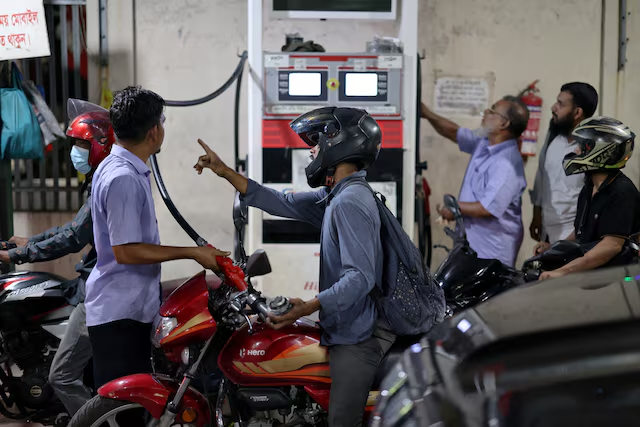
Bangladesh has increased petrol and kerosene prices by 5 taka per litre.
-
The new prices took effect on June 1, 2026.
-
Petrol now sells at 140 taka (US$1.15) per litre.
-
Kerosene now sells at 135 taka (US$1.10) per litre.
-
Diesel prices remain unchanged at 115 taka (US$0.94) per litre.
Bangladesh Raises Fuel Prices For Second Time In Six Weeks
Ghana:Motorists To Pay More For Petrol From June 1 As Prices Near GH¢16 Per Litre

Motorists in Ghana are expected to pay more for fuel as prices are projected to increase from the first pricing window beginning Monday, June 1, 2026.
Petrol, kerosene, and LPG prices are expected to rise at the pumps, while diesel prices are set to decline marginally.
For this pricing window, the petrol price floor has been pegged at GH¢15.20 per litre, representing an increase of GH¢0.60 from the GH¢14.60 per litre recorded during the second pricing window of May.
LPG will also witness an upward adjustment, with the price floor rising to GH¢13.48 per kilogram from GH¢13.16 per kilogram in the previous window, marking an increase of GH¢0.32.
Diesel, however, is expected to record a slight decline. The price floor for diesel has been set at GH¢15.49 per litre, down by GH¢0.32 from the GH¢15.81 per litre recorded during the second pricing window of May.
The price floor represents the minimum threshold at which Oil Marketing Companies (OMCs) and LPG Marketing Companies (LPGMCs) can retail petroleum products.
Despite the increase in the petrol price floor, the Chamber of Oil Marketing Companies (COMAC) is projecting pump prices for petrol to rise by between 4.20% and 6.20%.
This could result in petrol selling at as much as GH¢15.92 per litre at the pumps.
LPG prices could also increase by up to 2.24%.
Diesel, however, is expected to decline by between 1.65% and 2.00%.
These projections are based on oil marketing companies that purchase petroleum products on credit from Bulk Oil Distribution Companies (BDCs).
According to the Chamber of Oil Marketing Companies (COMAC), the price movements are attributable to lower global petroleum prices and continued government-industry interventions.
The Gambia: Power Crisis Deepens As Gambia Loses 60MW Of Imported Electricity

Power outages in The Gambia, particularly across the Greater Banjul Area (GBA) and the West Coast Region (WCR), have intensified following a reduction of up to 60 megawatts in imported electricity, officials said.
Authorities say the reduction is due to technical issues and fuel shortages affecting generation facilities within the regional power network, as well as constraints on domestic backup generation.
The West African nation’s electricity supply relies heavily on imports through the OMVG/WAPP regional power network, with local generation serving primarily as backup during periods of peak demand or supply interruptions.
In a statement issued on Saturday, the National Water and Electricity Company (NAWEC) confirmed that electricity imports had been reduced by up to 60 megawatts because of technical problems and fuel shortages affecting generation facilities within the regional network.
“This has significantly impacted the country’s main source of power,” the company said.
NAWEC described the situation as particularly challenging because domestic backup systems, which are intended to mitigate such disruptions, are not yet fully available at the required capacity. The company cited ongoing maintenance, delays in critical works at key facilities, and operational constraints linked to high fuel costs.
As a result, the country is currently facing a power shortfall exceeding 50 percent of electricity demand.
Many communities are now experiencing daily, synchronized power outages, with some areas enduring blackouts lasting more than 10 hours.
The situation has sparked widespread complaints from citizens, with some accusing NAWEC’s leadership and the government of failing to deliver on promises to ensure a reliable and uninterrupted electricity supply.
According to NAWEC, the utility and its regional partners are working to stabilize the situation by accelerating the restoration of backup generation capacity, engaging suppliers to restore and increase electricity imports, and continuously monitoring system performance.
Ghana To Add 3,000 MW Of Power Capacity By 2030
The company said it expects a gradual return to normal electricity supply by mid-June 2026, subject to the timely restoration of regional imports and the completion of ongoing maintenance works.
NAWEC stressed that the crisis is temporary and reflects a convergence of regional and operational challenges rather than a structural failure of the national electricity system.
The utility acknowledged the inconvenience caused and expressed regret over the impact on households and businesses.
It assured the public that every effort is being made to restore normal electricity supply as quickly as possible while safeguarding essential services.
NAWEC said it remains committed to transparency and will continue to provide regular updates as the situation evolves.
Ghana: TOR Managing Director Edmond Kombat Honoured For Transformative Leadership At Ghana CEOs Summit

The Managing Director of the Tema Oil Refinery (TOR), Ghana’s premier oil refinery, Mr. Edmond Kombat Esq., has been recognised for his transformative leadership at the state-owned refinery during the 10th Ghana CEOs Summit, held at the Kempinski Hotel in Accra.
The award, presented by the Ghana CEOs Network in partnership with the University of Ghana, PwC, Ernst & Young, Deloitte, the Ghana Investment Promotion Centre (GIPC), and Margins Group, cited Mr. Kombat’s “exceptional leadership, strategic vision, and unwavering commitment to advancing operational excellence and transformation at TOR in support of Ghana’s petroleum and energy sector.”
The recognition comes on the back of a significant operational milestone for the refinery, which recently took delivery of approximately one million barrels of Bonga crude oil aboard the MT Cap Felix in Tema.
The shipment, purchased from Shell and supplied through TOR’s tolling partner, Fujairah/Triangle Commodities Trading (TCT), forms part of broader efforts to revitalise the refinery’s operations and ensure a steady supply of petroleum products to the Ghanaian market.
President John Dramani Mahama attended the event as Special Guest of Honour and delivered the keynote address.
Mr. Kombat assumed office approximately one year ago and has since spearheaded efforts to revive the refinery, which had been burdened by significant debt and had remained largely idle for more than six years.
It will be recalled that this portal first reported in late December 2025 that TOR had resumed crude oil refining operations following extensive maintenance works.
Established in 1963, Tema Oil Refinery (TOR) is Ghana’s only oil refinery and plays a critical role in the country’s downstream petroleum sector.
Over the years, the refinery has faced several operational challenges, including intermittent shutdowns resulting from maintenance constraints, financing difficulties, and crude oil supply shortages.
Since assuming office, the new management team has pursued a revitalisation agenda aimed at restoring full operational capacity, improving efficiency, and repositioning TOR as a commercially viable refinery.
The resumption of crude imports and refining activities forms part of ongoing efforts to stabilise domestic fuel supplies and strengthen Ghana’s energy security.Ship Attacks Continue In Strait Of Hormuz Despite Peace Talks, Says Chevron CEO

Several vessels transiting the Strait of Hormuz have been attacked in recent days, highlighting the “very real” risks facing shipowners in the Persian Gulf, regardless of whether a peace agreement is reached, Chevron Corp. Chief Executive Officer Mike Wirth said, according to Bloomberg.
“There has still been kinetic activity this week, some of which has been reported in the media and some of which has not,” Wirth said during an interview on Bloomberg TV on Friday.
“We see the risks in that environment as still being very real.”
Asked to clarify what had not yet been reported, Wirth said several ships had been attacked.
“There have been vessels in transit that have suffered attacks,” he said. “They may not occur every day, but there have been multiple incidents.”
Chevron would not consider paying a toll to move ships through the Strait of Hormuz, Wirth said. The company currently has six vessels under charter operating in the Persian Gulf waterway, meaning they are owned by third parties.
Global Oil Investment Set To Fall Below $500bn In 2026 – IEAAccording to Wirth, it is the shipowners who will decide whether to transit the strait.
This means that shipowners and their insurers must be confident that passage is safe before oil flows can return to normal, regardless of whether the United States and Iran reach a peace agreement in the coming days.
They must also be willing to send vessels back through the strait for trade to resume fully, Wirth said.
“Shipowners have to be comfortable sending vessels back after having ships trapped for months and crews stranded for months,” he said. “They may or may not be willing to move all of their vessels back in.”Norway Presses EU To Lift Arctic Oil And Gas Drilling Moratorium

Norway is putting pressure on the European Union to remove a moratorium on new oil and gas drilling in the Arctic, where almost two-thirds of its petroleum resources are located, Bloomberg has reported.
According to Bloomberg, Norwegian politicians, civil servants, and environmental and industry lobbyists are increasingly visiting Brussels to influence EU institutions as the bloc prepares to unveil a new Arctic policy by the end of September.
Norway, which is not a member of the EU, is Western Europe’s largest exporter of oil and gas, with production from the Norwegian Continental Shelf meeting roughly 30% of EU and UK gas demand.
“Norway is very active and good at making its voice heard,” the EU’s Special Envoy for the Arctic, Claude Veron-Reville, said in an interview in Brussels on Wednesday, as reported by Bloomberg. “Norway knows very well how to intervene; they are very well organized and very present,” she added.
So far this year, 11 Norwegian ministers have visited Brussels on matters ranging from the Arctic and trade to energy and space.
The blockade of the Strait of Hormuz has given Norway fresh arguments to persuade Brussels to drop the moratorium on new Arctic drilling, as the EU becomes increasingly dependent on Norwegian gas exports.
At the heart of the debate are climate and environmental concerns.
Critics argue that the Arctic region, which is warming three to four times faster than the global average, is particularly vulnerable to exploration activities and that additional drilling could undermine efforts to transition away from fossil fuels.
Critics also contend that a short-term energy crisis is not a sufficient reason to open the Arctic to new drilling.
The EU’s ban on new drilling, introduced in 2021, is consistent with the bloc’s climate obligations, Veron-Reville said, adding that any decision to remove it ultimately rests with EU member states.
The EU defines the Arctic as the region north of the Arctic Circle.
Norway disputes the implications of that definition for drilling activities.
“There are no climate arguments for treating oil and gas produced north and south of a certain line differently,” Norway’s Foreign Minister, Espen Barth Eide, told Bloomberg.
BP Removes Chairman Albert Manifold Over ‘Serious Conduct Issues’Eide said Norway’s policy is also to refrain from drilling “up in the icy wasteland” because of environmental concerns, but noted that the country has a substantial population and active petroleum operations in the Arctic.
Norway’s Arctic drilling activities are concentrated in the Barents Sea, which lies north of the country’s northernmost coastline.
Norway has also argued that warmer Gulf Stream waters make conditions there comparable to those further south on the continental shelf—a consequence of climate change driven largely by emissions from the fossil fuel industry.
Although Norway’s oil and gas production is expected to decline in the years ahead, the country recently opened 70 new blocks for exploration in the North Sea, Norwegian Sea, and Barents Sea. According to an estimate by WWF, it takes about 18 years from the discovery of an oil and gas field to the start of production in the Barents Sea.
Investors are taking notice.
A number of asset managers joined academics and climate groups in an open letter to the European Commission on Wednesday, defending the moratorium and urging the EU to “maintain and reinforce” protections against new fossil fuel infrastructure north of the Arctic Circle.
The coalition warned that expanded Arctic drilling risks “irreversible environmental damage,” could expose Europe to heightened security threats, and may lock in fossil fuel dependence beyond the EU’s 2050 net-zero target.
Financial-sector signatories include Nordea Asset Management, Norway’s largest pension company KLP, Danish pension providers Sampension, AkademikerPension, and Velliv, as well as lenders Triodos Bank and Cultura Bank.Ghana: NPA Reaffirms Commitment To Combating Illicit Fuel Smuggling Along Coastline

Ghana’s downstream petroleum regulator, the National Petroleum Authority (NPA), has reiterated its commitment to ending illegal fuel smuggling and trading along the country’s coastal areas.
Godwin Kudzo Tameklo Esq., Chief Executive of the petroleum regulatory body, made the remarks during a working visit to the Eastern Naval Command (ENC) in Tema on Tuesday, May 26, 2026, following the arrest and destruction of eight specially modified canoes, known as “dinghies”, as part of ongoing collaboration between the two institutions to combat illegal fuel operations.
He was accompanied by the NPA’s Deputy Chief Executive in charge of Technical Operations, Dr. Sheila Addo, and other senior officials of the Authority.
Speaking during the visit, Mr. Tameklo applauded the Eastern Naval Command, the Ghana Ports and Harbours Authority (GPHA), and other maritime law enforcement agencies for their efforts in combating smuggling and other illicit fuel-related activities.
“The National Petroleum Authority commends the Eastern Naval Command (ENC) for its relentless efforts in combating smuggling and other illicit fuel activities, which have led to the arrest and subsequent destruction of these eight dinghies today,” Mr. Tameklo said.
“We believe that the destruction of the dinghies, as carried out at the Western Naval Command on May 15, 2026, and the exercise conducted today, will serve as a strong deterrent to illegal fuel operators who exploit our maritime space for illicit activities.”
 Mr. Tameklo also assured stakeholders of the NPA’s commitment to supporting joint operations, intelligence-sharing, and stakeholder coordination with security agencies to protect and safeguard the downstream petroleum sector.
“We want to encourage the Navy, GPHA, and other maritime law enforcement agencies to continue these arrests. We stand ready to support and partner with you to sanitize the sector and stem the tide of illegal transfers of petroleum products and other illicit fuel-related activities in the country,” he added.
For his part, the Flag Officer Commanding (FOC), Commodore Solomon Asiedu-Larbi, expressed the Navy’s readiness to continue collaborating with the NPA to prevent such illegal activities along Ghana’s coastline.
“We look forward to further collaboration with the NPA to curb these illegal activities on the high seas. We are ever ready to support you, and we also conduct our own intelligence operations. Whenever we make arrests, we will bring them to your attention,” he said.
The latest operation underscores the growing resolve of the National Petroleum Authority and the Ghana Navy to clamp down on illegal fuel bunkering and smuggling activities along the country’s coastline.
The NPA is confident that the decisive actions taken through these operations will serve as a strong deterrent to individuals and groups engaged in illicit fuel smuggling and related illegal activities.
Mr. Tameklo also assured stakeholders of the NPA’s commitment to supporting joint operations, intelligence-sharing, and stakeholder coordination with security agencies to protect and safeguard the downstream petroleum sector.
“We want to encourage the Navy, GPHA, and other maritime law enforcement agencies to continue these arrests. We stand ready to support and partner with you to sanitize the sector and stem the tide of illegal transfers of petroleum products and other illicit fuel-related activities in the country,” he added.
For his part, the Flag Officer Commanding (FOC), Commodore Solomon Asiedu-Larbi, expressed the Navy’s readiness to continue collaborating with the NPA to prevent such illegal activities along Ghana’s coastline.
“We look forward to further collaboration with the NPA to curb these illegal activities on the high seas. We are ever ready to support you, and we also conduct our own intelligence operations. Whenever we make arrests, we will bring them to your attention,” he said.
The latest operation underscores the growing resolve of the National Petroleum Authority and the Ghana Navy to clamp down on illegal fuel bunkering and smuggling activities along the country’s coastline.
The NPA is confident that the decisive actions taken through these operations will serve as a strong deterrent to individuals and groups engaged in illicit fuel smuggling and related illegal activities.

Mr. Tameklo also assured stakeholders of the NPA’s commitment to supporting joint operations, intelligence-sharing, and stakeholder coordination with security agencies to protect and safeguard the downstream petroleum sector.
“We want to encourage the Navy, GPHA, and other maritime law enforcement agencies to continue these arrests. We stand ready to support and partner with you to sanitize the sector and stem the tide of illegal transfers of petroleum products and other illicit fuel-related activities in the country,” he added.
For his part, the Flag Officer Commanding (FOC), Commodore Solomon Asiedu-Larbi, expressed the Navy’s readiness to continue collaborating with the NPA to prevent such illegal activities along Ghana’s coastline.
“We look forward to further collaboration with the NPA to curb these illegal activities on the high seas. We are ever ready to support you, and we also conduct our own intelligence operations. Whenever we make arrests, we will bring them to your attention,” he said.
The latest operation underscores the growing resolve of the National Petroleum Authority and the Ghana Navy to clamp down on illegal fuel bunkering and smuggling activities along the country’s coastline.
The NPA is confident that the decisive actions taken through these operations will serve as a strong deterrent to individuals and groups engaged in illicit fuel smuggling and related illegal activities.
Kenya: Ruto Appoints Kello Harsama As Petroleum PS After Fuel Stock Scandal Fallout

Kenya’s President, William Samoei Ruto, has appointed Mr. Kello Harsama as the new Principal Secretary (PS) for Petroleum, following the recent resignation of Liban Mohamed from the position.
Harsama, who previously served at the State Department for ASALs and Regional Development, assumes the role with immediate effect.
“His Excellency the President has this afternoon, pursuant to Article 155(4) of the Constitution, effected reassignments within the rank of Principal Secretaries,” a statement issued by the Presidency on Thursday read in part.
“The reassignments are intended to fill the vacancy arising from the resignation of the immediate former Principal Secretary for the State Department for Petroleum and to ensure continuity in the administration and coordination of government functions within the affected State Departments.”
Ghana: Energy Minister Visits FPSO John Evans Atta Mills And Noble Venturer Offshore Facilities
It will be recalled that on April 4, former Petroleum PS Liban Mohamed resigned from his position alongside Energy and Petroleum Regulatory Authority (EPRA) Managing Director Daniel Kiptoo and Kenya Pipeline Company PLC Managing Director Joe Sang.
The three stepped down following a scandal in the ministry, in which they were implicated in the alleged manipulation of fuel stock data, leading to the irregular procurement of substandard emergency fuel shipments.
The manipulation was reportedly aimed at exploiting soaring global fuel prices and public anxiety, creating a misleading impression of an imminent fuel shortage.
Vivo Energy Ghana PLC Signs MoU With Applied Technology Institute To Advance Technical Apprenticeship

Vivo Energy Ghana PLC (VEGH), the exclusive distributor and marketer of Shell-branded fuels and lubricants in Ghana, has signed a Memorandum of Understanding (MoU) with the Applied Technology Institute (ATI) to collaborate on a technical apprenticeship initiative under its Mechanic Advocacy Programme.
The initiative aims to develop the next generation of certified automotive professionals.
The partnership seeks to equip young mechanics in the informal sector with industry-relevant technical expertise through a structured apprenticeship framework that combines classroom instruction with practical, hands-on training.
The initiative is designed to enhance employability, promote professionalism, and foster a strong culture of safety and technical excellence within the automotive industry.
Norway Presses EU To Lift Arctic Oil And Gas Drilling Moratorium
Speaking at the signing ceremony at Vivo Energy Ghana’s head office in Accra, Mr. Christian Li, Managing Director of Vivo Energy Ghana, expressed appreciation to ATI for aligning with the company’s commitment to empowering young professionals through skills development.
“I would like to sincerely thank the Applied Technology Institute for partnering with us in our shared vision to develop the next generation of skilled professionals,” he stated.
He emphasised the importance of technical competence and safety consciousness in the rapidly evolving automotive and lubricants industry.
“The automotive and lubricants industry continues to evolve rapidly, creating a growing demand for highly skilled professionals equipped with strong technical capabilities and a firm commitment to safety,” he added.
 Representing ATI, Ing. Emmanuel Kotey Ashie, Principal of the Applied Technology Institute, spoke on the importance of the collaboration and the shared commitment to bridging the gap between academic learning and industry practice.
“Through this collaboration, our students and employees will benefit from practical training, industrial exposure, innovation, and skills development aligned with current industry demands. We believe this partnership will strengthen the connection between academic learning and the professional world,” he said.
Also addressing participants at the signing ceremony, Kerim Kermen, Vice President, Central Lubricants and Commercial, Vivo Energy Group, noted that the partnership aligns with both national development priorities and the broader strategic direction of the lubricants business.
Former ATI students, who are now working at various Vivo Energy Ghana retail outlets and lube bays, shared their experiences and testimonies during the ceremony, highlighting how the initiative equipped them with practical skills, industry exposure, and professional experience that have contributed to their career development.
Beyond employment opportunities, the programme is also designed to promote entrepreneurship, economic empowerment, job creation, and community development.
Graduates will acquire the technical and business skills needed to establish their own automotive workshops, operate lubricant service centres, or serve as distributors and retailers of Shell lubricants.
The partnership reflects Vivo Energy Ghana’s vision to be Africa’s leading and most respected energy business by investing in youth empowerment, creating opportunities, transforming lives, and supporting sustainable national development.
Representing ATI, Ing. Emmanuel Kotey Ashie, Principal of the Applied Technology Institute, spoke on the importance of the collaboration and the shared commitment to bridging the gap between academic learning and industry practice.
“Through this collaboration, our students and employees will benefit from practical training, industrial exposure, innovation, and skills development aligned with current industry demands. We believe this partnership will strengthen the connection between academic learning and the professional world,” he said.
Also addressing participants at the signing ceremony, Kerim Kermen, Vice President, Central Lubricants and Commercial, Vivo Energy Group, noted that the partnership aligns with both national development priorities and the broader strategic direction of the lubricants business.
Former ATI students, who are now working at various Vivo Energy Ghana retail outlets and lube bays, shared their experiences and testimonies during the ceremony, highlighting how the initiative equipped them with practical skills, industry exposure, and professional experience that have contributed to their career development.
Beyond employment opportunities, the programme is also designed to promote entrepreneurship, economic empowerment, job creation, and community development.
Graduates will acquire the technical and business skills needed to establish their own automotive workshops, operate lubricant service centres, or serve as distributors and retailers of Shell lubricants.
The partnership reflects Vivo Energy Ghana’s vision to be Africa’s leading and most respected energy business by investing in youth empowerment, creating opportunities, transforming lives, and supporting sustainable national development.
Representing ATI, Ing. Emmanuel Kotey Ashie, Principal of the Applied Technology Institute, spoke on the importance of the collaboration and the shared commitment to bridging the gap between academic learning and industry practice.
“Through this collaboration, our students and employees will benefit from practical training, industrial exposure, innovation, and skills development aligned with current industry demands. We believe this partnership will strengthen the connection between academic learning and the professional world,” he said.
Also addressing participants at the signing ceremony, Kerim Kermen, Vice President, Central Lubricants and Commercial, Vivo Energy Group, noted that the partnership aligns with both national development priorities and the broader strategic direction of the lubricants business.
Former ATI students, who are now working at various Vivo Energy Ghana retail outlets and lube bays, shared their experiences and testimonies during the ceremony, highlighting how the initiative equipped them with practical skills, industry exposure, and professional experience that have contributed to their career development.
Beyond employment opportunities, the programme is also designed to promote entrepreneurship, economic empowerment, job creation, and community development.
Graduates will acquire the technical and business skills needed to establish their own automotive workshops, operate lubricant service centres, or serve as distributors and retailers of Shell lubricants.
The partnership reflects Vivo Energy Ghana’s vision to be Africa’s leading and most respected energy business by investing in youth empowerment, creating opportunities, transforming lives, and supporting sustainable national development. Ghana: Energy Minister Visits FPSO John Evans Atta Mills And Noble Venturer Offshore Facilities

Ghana’s Minister for Energy and Green Transition, Dr. John Abdulai Jinapor, has paid a working visit to the Floating Production Storage and Offloading (FPSO) John Evans Atta Mills, which serves the TEN Fields, as well as the Noble Venturer, the vessel handling offshore rig operations.
The minister’s visit on Thursday provided an important opportunity to engage directly with the technical teams and partners working tirelessly to sustain and increase production levels.
The TEN Fields remain one of Ghana’s most strategic offshore assets, playing a critical role not only in strengthening the country’s oil and gas sector but also in supporting power generation.
In a post on Facebook, Dr. Jinapor stated that he was particularly impressed by the professionalism, dedication, and commitment demonstrated by the workforce and partners on site.
“The FPSO and rig teams continue to maintain one of the highest levels of safety adherence in the industry, reflecting a strong culture of operational excellence, discipline, and care for personnel and the environment,” he said.
He further encouraged all partners to remain focused, innovative, and collaborative as they work together to unlock greater value from Ghana’s petroleum resources.
“I also assured them of government’s commitment to creating the right environment for sustained investment and operational improvements that will enhance oil production and maximize benefits for the people of Ghana,” he added.
Touching on gas supply from the TEN Fields for power generation, Minister Jinapor said reliable gas supply from the operations continues to contribute significantly to stable electricity generation for industries, businesses, and households across the country.


Ghana: ECG To Complete Major Network Upgrade In Greater Kumasi By June 5

The Electricity Company of Ghana (ECG) has announced that the ongoing upgrade of key sub-transmission lines from KNUST Primary Substation to Kaase Primary Substation, and from Kaase to Ridge Bulk Supply Point in Kumasi, is expected to be completed by 5 June 2026.
This was stated by Dr. Charles Nii Ayiku Ayiku, APR, General Manager of External Communications at ECG, in a statement released on Friday, May 29, 2026.
According to the statement, the project involves upgrading existing 265 sqmm conductors to 400 sqmm conductors and replacing weak cables to enhance power transfer capacity and improve the reliability and stability of electricity supply across the Greater Kumasi area.
Upon completion, the project is expected to improve power supply reliability and voltage quality, and strengthen electricity supply to Kaase, Kuntenase, Sewua, Bekwai, and surrounding communities.
The project will also reinforce the sub-transmission link between the Kumasi 1 (K1) and Kumasi 2 (K2) Bulk Supply Points, improving overall network resilience within the Ashanti Region.
ECG sincerely apologizes for any inconvenience caused to customers and residents during the execution of this important project and assures the public that these temporary challenges are necessary to strengthen and secure a more reliable electricity supply for the region.
Kenya Power Employee And Accomplice Arrested For Soliciting Bribe To Reconnect Electricity

Two people, including an employee of the Kenya Power and Lighting Company (KPLC), have been arrested for allegedly soliciting a bribe from a customer whose electricity had been disconnected, in exchange for reconnecting them to the national grid.
The Ethics and Anti-Corruption Commission (EACC) of Kenya confirmed the arrest in a statement released on Friday, May 29.
The arrests followed a complaint filed on May 28, in which the suspects were implicated for seeking a bribe to restore a disconnected electricity connection.
“The Ethics and Anti-Corruption Commission (EACC) has arrested a Kenya Power employee and an accomplice for allegedly soliciting and receiving a bribe to reconnect electricity to a residential property,” the statement read in part.
“The arrest followed a complaint lodged with the Commission on 28th May 2026 by a resident whose electricity had been disconnected two days earlier.”
According to preliminary investigations, the suspect, Gerald Nyaoke, a technician attached to the Kenya Power Donholm Office, allegedly demanded KSh 30,000 from the complainant in exchange for restoring the power supply.
Following the complaint, EACC detectives initiated an operation that monitored and documented interactions between the complainant and the suspects.
This investigation culminated in their arrest after the alleged bribe exchange. Currently, the suspects are at the Integrity Centre for further processing and investigations.
In its statement, EACC reaffirmed its mandate to combat corruption, urging members of the public to report any incidents of bribery.
“EACC reiterates its commitment to combating corruption and calls upon members of the public to continue reporting cases of bribery and abuse of office,” the Commission stated.
According to a report by tuko.co.ke, a few weeks ago, another Kenya Power employee, Kennedy Wambani Oduor, attached to the Mbale-Vihiga office, was charged with bribery.
He was accused of soliciting a KSh 20,000 bribe from God’s Vision for Africa. The issue reportedly stemmed from a 2022 case in which Vision for Africa had reported a defunct electricity pole near its premises.
For a month, the company did not take action, prompting the organization to hire a private contractor to address the issue. Wambani allegedly became agitated over this replacement and threatened to disconnect the premises’ power supply unless he was paid a bribe of KSh 50,000.
“Despite several reports made to KPLC, no action was taken, prompting the organization to replace the rotten pole through a private contractor to avert the risk of electric shock and fire. Investigations established that Wambani allegedly became agitated over the replacement and threatened to disconnect the organisation’s power supply unless he was paid a bribe of KSh 50,000,” EACC said.
Global Oil Investment Set To Fall Below $500bn In 2026 – IEA

Global investments in oil projects are due to fall for the third year in a row, as the supply shock from the Middle East conflict shifts priorities toward new trade routes and alternative energy sources.
According to the International Energy Agency’s annual World Energy Investment report published Thursday, spending on oil projects is set to drop below $500 billion in 2026 despite rising crude oil prices.
Oil markets have been in turmoil since the US-Israeli war on Iran effectively closed the Strait of Hormuz, through which a fifth of the world’s seaborne crude was shipped. The disruption has caused price spikes and supply shortages in several parts of the world, forcing companies and countries to rethink their energy investment strategies.
“We are in the midst of the largest energy security crisis the world has ever faced — and I believe this will reshape investment strategies globally,” IEA Executive Director Fatih Birol said in a statement. “We are already seeing intensified efforts by both producer and consumer countries to diversify trade routes and energy sources.”
Overall energy investments are expected to rise slightly to $3.4 trillion in 2026, with most of the spending directed toward power grids, storage, low-emissions fuels, nuclear energy, renewables, and electrification. Key fuel importers are now looking for domestic energy resources, mainly renewables, nuclear, and coal.
Gas spending is projected to rise to $330 billion, the highest level in a decade, supported by a wave of new liquefied natural gas export projects, mainly in the US and Qatar, the Paris-based agency said in its first full-year estimates for 2026.
In the Middle East, the war has cut export income and sparked a search for new export routes, as confidence in the reliability of the Strait of Hormuz has been “profoundly shaken.” In addition, the tens of billions of dollars required to repair facilities “could reduce outward capital flows, which have been a growing source of financing for infrastructure and energy projects in other regions.”
Birol has previously warned that the world is losing 14 million barrels of oil per day because of the war. Earlier this month, he said the IEA was ready to take further action after members agreed in March to release 400 million barrels from emergency reserves into the market in the biggest-ever discharge.
Ghana: GOIL PLC Commends Ghana Police Over Arrest Of Robbery Suspects At Kwafokrom Station

Ghana’s indigenous petroleum downstream giant, GOIL PLC, has commended the Ghana Police Service for the swift arrest of two suspects involved in last Sunday’s robbery attack on its Kwafokrom Filling Station near Nsawam in the Eastern Region.
The robbers reportedly shot a fuel attendant and a security officer at the station, made away with provisions from the station’s mart, and fled with sales proceeds amounting to GH¢13,000.
Following the incident, the Eastern South Regional Police Command launched a manhunt for the suspects, leading to the arrest of two of them.
A third suspect, who remains on the run, is currently being pursued by the police.
In a brief statement issued by GOIL PLC, the company expressed appreciation to the Ghana Police Service for its professionalism and swift action leading to the arrests.
GOIL also assured customers, dealers, and stakeholders of its continued commitment to safety and security across its operations nationwide.
Meanwhile, the Inspector-General of the Ghana Police Service has promoted five officers for their efforts in apprehending two robbery suspects.
The officers are Chief Inspector Eric Otoo, Chief Inspector Emmanuel Otu, General Sergeant Philip Amoah, Policewoman Constable Victoria Asiedu, and Policewoman Constable Rosemond A. Frimpong.
As part of the reward, Chief Inspectors Eric Otoo and Emmanuel Otu have been granted direct entry into the Police Academy, while General Sergeant Philip Amoah, Policewoman Constable Victoria Asiedu, and Policewoman Constable Rosemond A. Frimpong have all been promoted to their next ranks.
The officers were recognised for their professionalism, dedication, and swift response, which led to the arrest of two suspects linked to the robbery attack at the filling station.