


Ghana: Power Cut In Parts Of The Country Due To System Disturbance–GRIDCo

Ghana’s power transmission company, GRIDCo, has attributed the power outage being experienced in parts of the country to a system disturbance that occurred at about 14:41 GMT on Thursday.
The system disturbances affected power supply in Accra, Western and the Northern parts of the country.
A statement issued by Dzifa Bampoh, Manager, of Corporate Communications at GRIDCo, said the system disturbances caused the Accra Central-Achimota lines to trip and caused other transmission lines and generating stations at Aboadze, Kumasi and Tema to also trip.
The statement said efforts are underway to restore power to the affected areas.
Parts of the company’s statement on the disturbance read: “The Ghana Grid Company Limited (GRIDCo) wishes to inform the public that the Ghana power system experienced a disturbance which led to the interruption of power supply to some consumers in Accra, Western and the Northern parts of the country.”
Source: https://energynewsafrica.com
Zambia: Off-Grid Energy Leader ENGIE Energy Access Launches 15 Solar Mini-Grids In Zambia, Targets 60 By 2025

ENGIE Energy Access, Africa’s leading Pay-As-You-Go (PAYGO) and mini-grid solutions
provider, has officially commenced the construction of 15 solar mini-grids in Zambia’s Eastern Province.
This initiative is a crucial part of the transformative Increase Access to Electricity and Renewable Energy Production (IAEREP) programme, funded by the 11th European Development Fund and the European Union.
By expanding the adoption of off-grid energy solutions in Zambia, ENGIE Energy Access will provide reliable electricity to underserved families and small businesses, creating economic
growth and increasing socio-economic welfare in local communities.
MySol Grid Zambia, a unit of ENGIE Energy Access, is responsible for constructing, owning, operating, and maintaining these mini-grids. This ensures that residential, commercial, and
productive-use customers have access to dependable and renewable power along with value adding services.
“We are excited to announce this significant milestone, which brings ENGIE Energy Access closer to achieving its goal of operating 60 mini-grids across five provinces in Zambia.
“This project supports several United Nations Sustainable Development Goals, particularly SDG 7, by delivering affordable, reliable, and sustainable clean energy to 40,000 people living in rural areas.
“Our work is an important element of the national electrification plans, and we are committed to collaborating with the authorities to expand energy access and promote sustainable development in Zambia,” said Gillian-Alexandre Huart, CEO of ENGIE Energy Access.
The first sites in this groundbreaking project include: Lusinde, Kandongwa, Nyimba Mwana, Chidiwa, Chataika, Kanyanga, Petulo, Kasamba, Chidiwa, Mphole, Mung’omba, Kalambana,
Mtore, Kondwelani, Lunga, and Luamphande and are scheduled to be operational by the end of 2024.
In 2023, MySol Grid Zambia signed a USD 7.5 million debt facility with Facility for Energy Inclusion (FEI), managed by Cygnum Capital.
This funding will provide the company with the necessary resources and flexibility to construct a total of 60 mini-grids under the IAEREP programme.
This is a significant step for the mini-grid sector, with these assets having attracted non-recourse longterm financing.
ENGIE Energy Access established its presence in Zambia in 2017. It currently has over 250
employees, 650 independent sales agents, and more than 60 points of presence across the
country.
The compant has sold over 300,000 shs kits and has 1 minigrid operational in Chitandika
Source: https://energynewsafrica.com
Carlyle Group Plans Significant Investments In Egypt’s Oil And Gas

Investment firm Carlyle Group plans to make significant investments in Egypt’s oil and gas industry to boost domestic production and turn Egypt into an energy hub in the Mediterranean.
Executives from Carlyle met this week in Egypt with Egyptian Minister of Petroleum and Mineral Resources, Tarek El Molla, to discuss the investment firm’s plans for Egypt and the Mediterranean after Carlyle announced an acquisition of assets in the region last week.
Carlyle said a week ago that it had agreed to acquire a portfolio of gas-weighted exploration and production (E&P) assets in Italy, Egypt, and Croatia from Energean plc, a London-based company focused on developing resources in the Mediterranean.
The deal is expected to deliver to Carlyle a diversified portfolio of strategic gas-weighted assets with expected production equivalent to 47,000 barrels of oil per day and operations across Italy, Egypt, and Croatia.
The assets are well-advanced and large-scale developments in markets that are supportive of new gas development. The portfolio which Carlyle is buying includes interests in Cassiopea, Italy’s largest gas field in terms of reserves, and Abu Qir, one of the largest gas-producing hubs in Egypt.
“We look forward to supporting the transformation of these assets into a scalable E&P platform in the Mediterranean through the execution of near-term developments, unlocking organic growth opportunities, M&A, and accelerating the delivery of existing decarbonisation plans,” said Bob Maguire, Co-Head of Carlyle International Energy Partners.
During the meeting with Egyptian officials this week, Carlyle’s representatives said that the North African country provides attractive investment opportunities, and Carlyle intends to use advanced technologies for deepwater exploration activities.
Carlyle plans to boost production of oil and gas in Egypt and turn it into a hub for receiving and distributing the group’s production in the Mediterranean.
Egypt, for its part, is currently looking to import in the coming months the highest number of LNG cargoes in years as it looks to ease the strain on its grid and industry amid energy shortages that have led to rolling blackouts this summer.
Source: Oilprice.com
The Gambia: Power Cuts Will End In Two Years Under My Leadership–Saidy

The Managing Director of the National Water and Electricity of The Gambia, Galo Saidy, has declared his resolve to end power cuts in the West African nation in two years.
Galo Saidy replaced Nani Jawura who was elevated to the position of Minister for Petroleum and Energy in a recent shake-up by President Adama Barrow.
Speaking to the press last week, Saidy said: “My vision is that in two years, NAWEC will be one of the best utilities in the sub-region which is going to reach out to everybody,” he said, adding that they expect that power cuts would end in two years.
He continued that effective service delivery of NAWEC would also reflect on the nation’s economy.
He acknowledged the challenges faced by NAWEC regarding power cuts and water shortages, stating that their expectation as an institution is that in two years, the problems of frequent power cuts and water shortages will be 100 per cent resolved.
Mr Saidy relates the current challenges to rapid development and urbanisation, saying it has created high demand for both electricity and water supply.
He noted that NAWEC could do better in ensuring the sustainability of the nation’s electricity and water supply to satisfy the nation, adding that there are projects put in place towards achieving that goal.
The Gambia’s power generation capacity currently stands at 123.8 Megawatts.
Source: https://energynewsafrica.com
Russian Court Fines Italy’s UniCredit $480M Over Failed Gas Project

A court in Russia has ordered Italian UniCredit to pay nearly $480 million over a sidelined joint venture gas project with Gazprom and Germany’s Linde for which the Italian bank was a guarantor before Western sanctions caused the project to collapse.
The project planned to build a gas processing plant in Russia through a joint venture called RusChemAlliance, which is 50% owned by Gazprom.
UniCredit served as the lending guarantor for the construction of the plant, Reuters reported on Wednesday.
Last month, a Russian court ordered the seizure of Russia-based accounts belonging to UniCredit, as well as all shares in UniCredit Leasing and Unicredit Garant, both of which are subsidiaries of UniCredit’s Russian arm, according to Reuters.
Earlier in May, the European Central Bank (ECB) sent letters to major lenders, including UniCredit, calling on them to reduce Russia’s exposure.
“Every single bank in Europe that has any kind of exposure to Russia, has likely received the letter,” Bloomberg quoted UniCredit Chief Executive Officer Andrea Orcel as saying at the time, adding that the bank’s strategy was to cut Russia exposure to zero by the end of 2025.
As of early May, Bloomberg reported that UniCredit had cut its cross-border exposure by 91%.
Moscow’s retaliation against UniCredit for the aborted gas project comes as the European Union launches new sanctions targeting Russian liquified natural gas (LNG) imports.
On Monday, EU countries adopted the 14th sanctions package against Russia, including a ban on LNG trans-shipments and ship-switching off European ports, and greenlighting the ability for Sweden and FInland to cancel existing Russia LNG contracts.
According to Reuters, those LNG trans-shipments only account for around 10% of the total Russian LNG exports, suggesting the impact may be dulled.
The EU failed to push through a package that would serve as an outright ban on Russian LNG imports, but it does ban new investment in LNG projects that are currently being constructed in Russia.
Source: Oilprice.com
Liberia: World Bank Commits $45 Million To Boost Renewable Energy Penetration

The World Bank Group has announced the approval of a second disbursement of $45 million for Liberia’s Renewable Energy Solar Power Intervention Project (RESPITE).
This signifies a major step forward in Liberia’s renewable energy efforts.
The money will be used to finance the first 20-megawatt solar PV project and the expansion of the Mount Coffee hydropower plant, increasing its capacity from 88 megawatts to 129 megawatts.
The total budget for the project stands at $96 million.
In a meeting with Vice President Jeremiah Koung, Mr. Ashish Khanna, Practice Manager for West and Central Africa at the World Bank Group, praised President Boakai’s visionary leadership in prioritizing energy as a catalyst for economic growth and development.
“Liberia has made tremendous progress in the energy sector and remains the only country in sub-Saharan Africa that has reduced distribution losses by 30%, with over half a million new connections to households,” Mr. Khanna noted.
He emphasized that Liberia’s recent achievements in the energy sector position the country favorably to attract private sector investments.
Vice President Koung expressed gratitude to the World Bank Group for its ongoing efforts to address Liberia’s energy crisis.
“I want to thank the World Bank for all the support to Liberia, especially in helping us solve our electricity challenges.Your continuous support will help our country increase access to electricity,” he said.
VP Koung called for immediate interventions to mitigate electricity outages as the dry season approaches.
He reaffirmed the Government of Liberia’s commitment to work with the World Bank Group to transform the lives of Liberians.
Source: https://energynewsafrica.com
Ghana: CBOD Welcomes Directive On A Single Unified Measurement System

The Chamber of Bulk Oil Distributors’ (CBOD) has welcomed the Ministry of Energy’s directive mandating all entities involved in revenue assurance measurements within the oil and gas sector to comply with the new standard.
This standard was primarily developed collaboratively by the Ghana Standards Authority (GSA) with the Ministry of Trade and Industry and other stakeholders.
According to the CBOD, it believes that a single unified measurement system certified by the GSA is sufficient to ensure accurate and reliable data.
It emphasised the importance of a streamlined and well-regulated oil and gas sector.
It therefore advocated for a system where the private sector plays a more prominent role in managing specific aspects with the government maintaining an overarching regulatory framework and enforcing standards.
“The Chamber proposes a standardized approach, where meters mandated by the GSA could be installed by either the Depot, the National Petroleum Authority (NPA), or the Ghana Revenue Authority.
“The GSA would be responsible for the regular calibration of the meters. This system aligns with international best practices, where standard authorities handle meter calibration, eliminating the need for duplication by several entities, which comes at a cost to the consumer”, it said
“The role of the GSA in ensuring and maintaining standards is in the best interest of the state. All regulations within the sector should ultimately serve the national interest and be subject to state/regulatory oversight”, it added.
The Chamber acknowledged GRA’s quest to ensure revenue assurance for government.
Nevertheless, it said any institution, whether private or public, mandated to undertake that on government’s behalf, should do so in compliance with standards set by both the GSA and the Ministry of Trade Industry to ensure a transparent and efficient measurement system within the oil and gas sector
It welcomed initiatives by the Ministry of Energy to lead further dialogue with relevant stakeholders and to ensure a transparent and efficient measurement system within the oil and gas sector.
Source: https://energynewsafrica.com
Nigeria: Fire Outbreak Occurs At Dangote Refinery
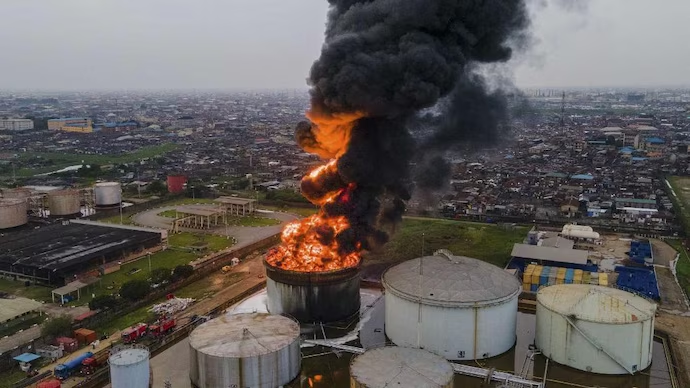
Fire outbreak has occurred at Africa’s largest crude oil refinery in Lagos, Nigeria, on Wednesday.
The fire outbreak occurred at an effluent treatment plant at the refinery, the company said in a brief statement without stating the cause.
The company said the minor fire was swiftly contained.
“There is no cause for alarm as the refinery is operating and there is no recorded injury or body harm to all our staff on duty,” Anthony Chiejina, Group Chief Branding & Communications Officer for Dangote Industries Limited, said.
Source: https://energynewsafrica.com
Morocco: Chariot To Partner With Vivo Energy To Commercialise Loukos Licence

Chariot Ltd has has signed a heads of terms agreement with Vivo Energy Ltd.
The Africa-focused transitional energy group said the agreement relates to future natural gas offtake from the Loukos onshore licence in Morocco, in which Chariot holds a 75% interest as operator.
Chariot will sell volumes of up to 3 million standard cubic feet per day to the midstream business under a long-term gas sales agreement from the potential future production from Loukos.
In addition, Vivo will design, fund, construct, and operate a CNG plant and virtual distribution network to transport the gas across Morocco.
This midstream CNG business would be operated through a special purpose vehicle in which Chariot can acquire 49% interest.
Chariot Morocco Managing Director Pierre Raillard said: ‘This agreement sets out a path where we can look to rapidly commercialise future production from Loukos, potentially unlocking the development of pre-existing gas discoveries as well as the OBA-1 well and enabling organic growth through future exploration.
‘It will also leverage our gas production to support Vivo’s wider development of CNG virtual pipeline infrastructure and, as part of a potential midstream partnership.’
Chariot shares were up 2.2% to 7.55 each in London on Monday afternoon.
Source: Natural Gas World
Kenya: ATIDI Supports Globeleq’s 35 MW Menengai Geothermal Project With RLSF Cover

The African Trade & Investment Development Insurance (ATIDI) and Globeleq Africa Limited, have jointly announced the former’s support for the 35 MW Globeleq Menengai Geothermal Project with liquidity cover via the Regional Liquidity Support Facility (RLSF).
RLSF, a joint initiative of ATIDI, the KfW Development Bank and the Norwegian Agency for Development Cooperation (Norad), is a credit enhancement instrument available to renewable energy Independent Power Producers (IPPs) that sell the electricity generated by their projects to state-owned power utilities.
RLSF is offered in ATIDI member countries that sign the RLSF Memorandum
of Understanding.
The project, the first to be considered for RLSF cover in Kenya, is valued at USD117 million with financing being provided by the African Development Bank (AfDB), the Eastern and
Southern African Development Bank (TDB), the Finish Fund for Industrial Cooperation
(Finnfund), and equity from the project owners, Globeleq.
The proposed RLSF policy will cover the risk of payment default by the national utility, Kenya Power & Lighting Company (KPLC) and Geothermal Development Corporation (GDC) – a government-owned company formed to accelerate the development of geothermal resources in Kenya.
Steam will be supplied to the project by GDC under the terms of a 25-year power implementation and steam supply agreement, whilst the electricity generated will be sold exclusively to KPLC under a power purchase agreement for the same duration.
The Project Company also benefits from a Letter of Support from the Government of Kenya.
Kenya, the host country of ATIDI’s headquarters, became the tenth ATIDI member state to
sign the RLSF MoU after Benin, Burundi, Côte d’Ivoire, Ghana, Madagascar, Malawi, Togo, Uganda and Zambia.
To date, RLSF policies have been approved in support of seven (7) renewable energy projects in Burundi, Malawi, Uganda and now in Kenya; enabling total financing of USD 323.7 million and a total installed electricity generation capacity of 171.3 MW, courtesy of USD 20.6 million worth of cover under the RLSF portfolio – achieving an impressive leverage or mobilization ratio of 16 times.
Kenya’s power sector benefits from an active private sector and boasts abundant renewable
energy resources with hydro, wind, and geothermal projects dominating its energy mix.
Furthermore, the Government of Kenya has outlined ambitious plans to increase the country’s electricity generation capacity from 3,078 MW in 2023 to 5,000 MW by 2030.
Geothermal projects are therefore expected to play a significant role in achieving this target and in advancing the nation’s renewable energy goals.
Thanks in part to ATIDI’s RLSF initiative which ensures the stability and the viability of
renewable energy projects, Kenya is on its way to meeting its goal of transitioning to 100 percent clean energy by 2030.
Manuel Moses, CEO of ATIDI commented: “We are proud to collaborate with Globeleq, KPLC, GDC, and the Government of Kenya on this transformative project. This partnership, coming so soon after the signing of the RLSF
“MoU in February 2024, underscores our commitment to fostering sustainable development
and promoting renewable energy solutions across Kenya and the region.
“Together, we are driving positive change and advancing Kenya’s energy transition. Given Globeleq’s huge and growing portfolio of renewable energy projects across the continent, we look forward to building on this partnership.”
Commenting Mr. Jonathan Hoffman, Interim CEO, said: “The Regional Liquidity Support Facility is a critically important product that gives companies the comfort around payment from customers that they need in order to invest in major renewable power projects in Africa such as our Menengai geothermal project in Kenya.
“This imaginative product from ATIDI, KfW and Norad provides critical liquidity support against payment default allowing companies like Globeleq to invest with confidence.
“I congratulate ATIDI on today’s signing ceremony at aef and look forward to continuing to work with them and their partners on future energy projects.”
Source: https://energynewsafrica.com
Russian Oil And Gas Revenues Surge By 50% In June

Russia’s oil and gas revenues for June are projected to increase by over 50% year-on-year, reaching $9.4 billion, according to new Reuters calculations.
This surge comes after a reduction in refinery subsidies, highlighting Russia’s resilience in the face of Western sanctions aimed at its energy sector.
The redirection of oil exports to India and China has played a crucial role in maintaining financial inflows, essential for a budget under pressure from increased defense spending.
Despite the ongoing conflict in Ukraine and subsequent economic sanctions, Russia’s ability to adapt its export strategies has been pivotal.
The projected increase in June revenues, up from 794 billion rubles in May and 529 billion rubles in June 2023, underscores the robustness of Russia’s energy sector.
The Finance Ministry’s anticipated report on July 3 will provide detailed insights into these financial trends.
The 2024 federal budget anticipates oil and gas revenues to rise by 21% from 2023, following a year marked by lower oil prices and reduced gas exports.
Despite the economic strains, Russia has continued to sustain its defense expenditures, resulting in consecutive annual budget deficits of over 3 trillion rubles, approximately 2% of GDP.
These deficits have been managed through internal borrowing and the National Wealth Fund.
President Vladimir Putin has emphasized the country’s economic growth, which stood at 3.6% in 2023 after a 1.2% contraction in 2022.
However, local economists caution that this growth is driven largely by increased production in the defense sector, which offers limited benefits to the broader population.
As Russia navigates its economic challenges, the resilience of its oil and gas sector remains a critical factor in its financial stability.
Source: Oilprice.com
Nigeria: Lagos High Court Restrains Ikeja Electric, NERC From Applying New Tarif

A High Court in Lagos in the Federal Republic of Nigeria has restrained Ikeja Electric Plc and the Nigerian Electricity Regulatory Commission (NERC) from applying, administering or implementing the purported tariff stipulated in the 2024 Supplementary Order on tariff increase on “Bank A” Feeders.
The court presided over by Justice Chukwujekwu Aneke on Tuesday held that the tariff comprised those published by Ikeja Electric on April 4, 2024 and/May 2024 Supplementary Order on Tariff Increase on “Band A”, published on May 6, 2024 on a firm, Rida National Plastics Limited.
The presiding judge made the interim injunction after hearing an ex-parte application filed by Rida National Plastics’ lawyer, Dr. Kemi Pinheiro SAN.
The judge ruled that the order subsists pending Ikeja Electric and NERC’s full compliance with Section 51 of the Electricity Act, 2023 and the hearing and determination of the Motion on Notice for Interlocutory Injunction.
Rida National Plastics is the plaintiff/applicant while Ikeja Electric Plc and NERC are the 1st and 2nd defendants/respondent in the suit marked FHC/L/CS/1051/2024.
Justice Aneke also temporarily restrained the 1st & 2nd defendants from imposing the payment of the sum of N20 million on the plaintiff being the balance payable on the purported electricity bill dated 4th of May 2024 calculated on the basis of the April 2024 Supplementary Order on Tariff Increase on “Band A” Feeders and/or the May 2024 Supplementary Order On Tariff Increase on “Band A”.
In addition, the Interim Injunction also restrained Ikeja Electric and NERC “from intimidating and threatening to disconnect or actually disconnecting” Rida National Plastics’ electricity supply for non-compliance with the purported tariff.
He adjourned the suit till July 9, 2024 “for hearing of the motion on notice filed contemporaneously with the instant ex-parte application.”
Source: https://energynewsafrica.com
Niger: Military Junta Revokes Mining Licence Of French Nuclear Fuel Producer

Niger has revoked the operating licence that was issued to Orano, a French firm, to explore uranium at the Imouraren uranium mine, one of the world’s largest uranium deposits, amid rising tensions between France and Niger’s ruling junta.
The decision was taken on Monday, 24th June 2024, according to a top journalist in the West African nation who spoke to this portal.
The Nigerien government had warned of the revocation if work had not begun by June 19, which Orano claims to have complied with.
The company, which has been in Niger since 1971, said it is open to dialogue with the government but maintained that it reserves the right to contest the decision in national or international courts.
Niger, a key uranium supplier to Europe, has turned against France since the junta took power in July last year, favouring ties with Russia and Iran.
Source: https://energynewsafrica.com
Ghana: It Is Illegal To Move Our Meters To A New Location—ECG

The Electricity Company of Ghana (ECG) has cautioned the public against moving the company’s meters from one geographical area to another.
According to the ECG, it is illegal to change the location of a meter per PURC (Consumer Service) Regulations, 2020 (LI2413).
Section 4 (e) of the LI2413 states that a customer shall “not change the location of a meter.
“Any customer who flouts the above regulation is liable for imposition of a fine determined by the Public Utilities Regulatory Commission (PURC) under section 44(d) of the LI2413.”
Speaking during a recent media training programme for selected journalists in Accra, the capital of Ghana, the Director of Communications, William Boateng, explained that when a prospective applicant applies for a meter, a Geocode is assigned to the meter, showing the area where the meter will be fixed.
He said information on the applicant’s Ghana Card is entered into the ECG’s system.
According to William Boateng, the meter is for a specific location and is not transferrable without their knowledge.
He said if for some reason a customer is relocating to another area, the customer has to inform ECG.
He said if the customer removes the meter to his or her new location, it will be considered illegal.
“So come to us for us to discuss. If it is possible, we will let you know,” Mr Boateng advised.
Source: https://energynewsafrica.com