The Ghana National Gas Company Limited has announced the successful completion of maintenance work on its Atuabo Gas Processing Plant ahead of schedule.
The gas plant was shut down on August 16, 2025, for mandatory maintenance work, and the exercise was expected to be completed by August 30, 2025.
However, the exercise was completed ahead of schedule.
The gas plant supplies about 100 mmscf of natural gas for electricity generation in West Africa.
With the successful maintenance work, supply is expected to stay around 120 mmscf.
During the exercise, Minister for Energy and Green Transition John Abdulai Jinapor and the Board of Ghana Gas, led by Mr. Totobi Quakyi, visited the site to inspect the ongoing work.
At a recent media engagement, it was revealed that the engineers worked day and night to ensure timely completion and resumption of gas supply.
The Chief Executive Officer of Ghana National Gas Company, Judith Adjobah Blay, who was present in the Western Region throughout the exercise, expressed delight over the incident-free completion and revealed that production will be ramped up in the coming days.
Source: https://energynewsafrica.com
Mitsubishi Corporation is dropping plans to develop three offshore wind projects in Japan amid unexpected changes and rising challenges in the market, the Japanese conglomerate said on Wednesday.
In February this year, Mitsubishi said it is reviewing its business plans for Japanese offshore wind power generation projects “due to material changes in the macroeconomic environment.”
In December 2021, Mitsubishi won in a Japanese auction projects in three Japanese sea areas.
“However, in the wake of the pandemic and the Ukraine crisis, the business environment for offshore wind power has significantly changed and is continuing to change worldwide due to factors such as inflation, the depreciation of the yen, tight supply chains, and rising interest rates,” the Japanese corporation said in February 2025.
As a result of the review of the business plans for these projects due to unexpected changes in the business environment, Mitsubishi today announced it had decided not to proceed with their development.
Since Mitsubishi was selected as the operator of the projects in December 2021, the business environment for offshore wind power “has significantly changed worldwide due to factors such as tight supply chains, inflation, exchange rates, and rising interest rates.”
Mitsubishi sought to adapt to these changes by examining various options including reassessment of costs, project schedule, and revenue.
“However, after discussions among the partners, we have determined that establishing a viable business plan is not feasible given the current conditions,” the corporation said.
Mitsubishi’s decision to abandon the projects in Japan comes amid rising headwinds to offshore wind development worldwide.
Ørsted, the world’s biggest offshore wind project developer, warned in May of a continued challenging environment for the industry with mounting near-term headwinds globally.
The challenges piled for Ørsted last week after the U.S. Department of the Interior’s Bureau of Ocean Energy Management (BOEM) issued on Friday a stop-work order for the Revolution Wind project offshore the U.S. East Coast.
The project is 80% complete with all offshore foundations installed and 45 out of 65 wind turbines installed. But the Revolution Wind joint venture of Ørsted and Global Infrastructure Partner’s Skyborn Renewables is complying with the order and is taking appropriate steps to stop offshore activities, the Danish company said.
Source: Oilprice.com
Nigeria has nearly eliminated crude oil theft from its pipelines following recent coordinated efforts by the country’s defense and intelligence agencies, the Group Chief Executive Officer of state-owned NNPC Ltd, Bayo Ojulari, has revealed.
According to Ojulari, security has been significantly improved, particularly in the Niger Delta region, where most of the country’s oil infrastructure is located.
“Today, I can proudly report that our pipeline and terminal receipts are attaining close to 100%,” Ojulari stated at a regional security forum in Abuja on Monday.
He emphasized that the country’s defense and intelligence agencies played a key role in the achievement, noting that crude oil theft is not merely a local issue but involves “sophisticated international syndicates” exploiting weaknesses in national and regional security frameworks.
Three years ago, as little as 30% of oil sent through some pipelines reached Nigeria’s export terminals, costing the government billions in lost revenue and leading to deferred investment.
With security now improved, Nigeria’s overall oil output is rising.
As the country seeks to fast-track approvals for new projects, the national oil regulator projected at an oil conference last week that production could exceed 2.5 million barrels per day by next year.
Nigeria last approached that level of production in 2005, before militancy in the Niger Delta reduced output to around 1 million barrels per day by 2016.
In 2021, Nigeria began contracting private security firms to support national security agencies in safeguarding pipeline infrastructure.
Source: https://energynewsafrica.com
The Association of VRA Technician Engineers (AVRATE) held its 2025 Biennial National Delegates Congress, with discussions focusing on energy sustainability, workforce development, and strategic collaboration.
Under the theme “Securing a Sustainable Future: VRA and AVRATE in Partnership,” the two-day congress brought together members from the Volta River Authority (VRA), the Northern Electricity Distribution Company (NEDCo), senior management, and key stakeholders from Ghana’s energy sector.
Addressing the gathering, Mr. Richard Yamoah, AVRATE National Chairman and Chief Technician Engineer at VRA, reiterated the Association’s commitment to partnering with VRA and NEDCo in advancing the Authority’s corporate mission.
He emphasized AVRATE’s role in national energy projects, sustainable employment, and operational excellence.
In his keynote address, Eng. Henry Kojo Boateng, National President of the Institution of Engineering and Technology (IET), Ghana, called for robust protection of Ghana’s energy infrastructure.
He urged greater investment in renewable energy technologies such as solar and wind, as well as stronger collaboration between government, management, and engineering professionals to ensure long-term sustainability.
Mr. Edward Ekow Obeng-Kenzo, Acting Chief Executive of VRA and Special Guest of Honour, applauded AVRATE’s significant contributions to VRA’s achievements, particularly highlighting the successful execution of the Anwomaso Thermal Plant project.
He described the congress theme as a reflection of unity, innovation, and a shared commitment to a sustainable energy future.
“With new capacity expansion projects ahead,” he stated, “AVRATE’s continued expertise, teamwork, and stakeholder engagement will be critical to our success.”
He also called for bold leadership to safeguard VRA’s legacy and ensure affordable, reliable energy for generations to come.
Other notable contributions came from senior VRA officials, including Mr. Samuel Fletcher, Deputy Chief Executive (Services); Ing. John Okine Yamoah, Acting Managing Director of NEDCo; and Mr. Dominic Ofosuhene, Director of Human Resources.
Solidarity messages were delivered by the Society of VRA Engineers (SOVRAE), the Senior Staff Association (SSA), and the Technician Engineers Association of GRIDCo (TEAG).
The second day of the congress focused on governance and capacity-building initiatives. Delegates adopted reports from the 2022 congress, reviewed the 2022–2025 financial statements, and engaged in open discussions on transparency and accountability.
The congress concluded with the dissolution of the outgoing National Executive Council, the election of new leaders, and their formal swearing-in—signifying a renewed phase in AVRATE’s leadership and direction.
The 2025 AVRATE National Delegates Congress reaffirmed the shared commitment of technical professionals and management to champion sustainable energy development, innovative partnerships, and a resilient future for Ghana’s power sector.
Source: https://energynewsafrica.com
Nigeria would like to see Brazil’s Petrobras return to its oil fields after a five-year absence, Nigerian media reported, citing a statement by President Bola Tinubu.
Tinubu is on a two-day visit to Brazil, where he said that “We have the largest gas repository. I don’t see why Petrobras shouldn’t return as a partner in Nigeria as soon as possible,” adding that “I appreciate President Lula’s promise that this will be done quickly,” as quoted by The Sun.
In comments on the Nigerian president’s invitation, the African Chamber of Commerce noted the Brazilian state oil major’s expertise in deepwater oil and gas exploration that would be beneficial for the West African oil producer, highlighting specifically Nigeria’s natural gas potential, estimated at 210 trillion cu ft of untapped resources.
Petrobras had a presence in Nigeria from the late 1990s to until about five years ago, when it sold its operations there to focus on oil and gas growth at home. Now, the Brazilian company is eyeing international expansion once again, and Nigeria is on its short list.
Earlier this year, Nigeria’s foreign minister said that Petrobras was keen to return to the country and develop its deepwater oil and gas resources. “Petrobras is no longer active in Nigeria, but they are very keen on coming back to Nigeria. They said they want frontier acreage in deep waters,” Stanley Knwocha said in May.
Petrobras plans to spend $111 billion in the five years between 2025 and 2029, with $77 billion of this total earmarked for oil and gas exploration and production activities, the company said at the end of last year.
The new spending figure is $10 billion higher than an earlier version of the investment plan, where exploration and production spending was set at $73 billion. Most of this will be spent at home, but part of the total will be used to fund Petrobras’s international expansion.
Source: Oilprice.com
AMEA Power, one of the fastest-growing renewable energy companies in the region, welcomed a high-level delegation from South Africa to its offices to explore and potential collaboration.
The delegation included representatives from South Africa’s Independent Power Producer Office (IPPO), the National Energy Regulator of South Africa (NERSA), the Department of Electricity and Energy (DEE), the National Transmission Company of South Africa (NTCSA), Eskom—South Africa’s utility company—as well as Egypt’s Ministry of Electricity and Renewable Energy.
The visit, organized by the Danish Energy Agency, featured tours of renewable energy projects across the country, including AMEA Power’s operational 500MW solar PV plant with Egypt’s first utility-scale 300MWh battery energy storage system in Aswan Governorate, and its 500MW wind power plant in Ras Ghareb.
The visit also created opportunities for technical discussions on large-scale solar PV and wind projects. AMEA Power’s team highlighted the technologies, safety standards, and community development and investment programs embedded within the projects.
Hussain Al Nowais, Chairman of AMEA Power, said: “We are honored to welcome our colleagues from South Africa and the Danish Energy Agency to our projects in Egypt.
“These exchanges are vital for strengthening international partnerships and advancing the global transition to clean energy. By sharing insights from our projects, we aim to support the growth of sustainable energy markets worldwide.”
Source: https://energynewsafrica.com
Togo has launched the operational phase of its Urban Centers Electrical Network Extension Project (PERECUT) in the Centrale Region, local media Togo First reported.
The project will be implemented across five prefectures: Blitta, Sotouboua, Tchamba, Mô, and Tchaoudjo.
The works include the construction of 290.2 kilometers of low-voltage (LV) power lines, 21.1 kilometers of medium-voltage (MV) lines, and the installation of 36 transformer substations.
PERECUT also entails connecting new customers to the grid, upgrading existing subscribers to improved networks, and installing prepaid meters.
In addition, the project will provide streetlights to enhance public lighting in targeted communities.
Aboulaye Abbas, Chief of Staff to the Minister of Mines and Energy, explained that the initial focus is on expanding the existing grid into new peri-urban neighborhoods.
“Other projects are underway to electrify areas still without coverage,” he added.
This regional phase is part of a broader national plan to build 1,681 km of LV lines, 200 km of MV lines, and 371 transformer substations.
The project, costing CFA46 billion, is funded by the French Development Agency (AFD), Germany’s KfW, and the European Union (EU).
PERECUT aims to significantly improve electricity access in Togo’s interior cities and contribute directly to the country’s target of achieving universal electricity coverage by 2030.
Source: https://energynewsafrica.com
The West African Gas Pipeline Company (WAPCo) has appointed Mr. Abiodun Bodunrin as its new Managing Director, effective August 1, 2025.
His appointment follows the end of the tenure of Ms. Michelle Burkett.
Ms. Burkett, who took over as MD on January 1, 2023, led WAPCo with distinction and purpose.
During her tenure, the company achieved several key milestones, including surpassing 12 million workforce hours worked safely over 11 years, delivering record gas volumes, successfully executing multiple critical projects, and significantly improving system reliability.
WAPCo expressed confidence in Mr. Bodunrin’s leadership and stated that it looks forward to continued progress under his guidance.
Since assuming office, Mr. Bodunrin has paid courtesy visits to key stakeholders, including Nigeria’s Minister of State for Petroleum Resources (Gas), Hon. Ekperikpe Ekpo, and Ghana’s Minister for Energy and Green Transition, Hon. John Abdulai Jinapor. During these visits, he introduced himself and shared his strategic vision for the company.
In his meeting with Hon. Ekperikpe Ekpo, Mr. Bodunrin requested the minister’s support in achieving his goal of enhancing WAPCo’s operational performance. He stated that his top priority would be “ensuring a reliable and uninterrupted gas supply from Nigeria for onward distribution to regional consumers.”
Minister Ekpo assured Mr. Bodunrin of the Federal Government’s support, expressing confidence in his ability to excel in the role.
During his visit to Ghana, Mr. Bodunrin thanked Minister Jinapor for his pivotal role in coordinating engagements with key stakeholders, which enabled the smooth and safe execution of WAPCo’s offshore pipeline inspection project earlier this year.
He also appreciated the Minister’s efforts in ensuring that Ghanaian customers adhered to agreed payment plans—an intervention that significantly contributed to WAPCo’s operational success.
Minister Jinapor welcomed Mr. Bodunrin to Ghana and expressed optimism for continued collaboration between the Ministry and WAPCo.
Mr Abiodun Bodunrin (right) with Hon. Ekperikpe Ekpo(middle), Nigeria’s Minister of State for Petroleum Resources and Ms Michelle Burkett, immediate past Managing Director of WAPCo.
He highlighted Ghana’s growing demand for natural gas and the country’s interest in accessing increased volumes from the east.
He expressed hope that WAPCo would work with stakeholders to expand the pipeline’s capacity.
Mr. Bodunrin, known informally as “Abbey,” responded positively, stating that the Minister’s aspirations align with WAPCo’s expansion objectives.
He revealed that technical feasibility studies are currently underway to maximize pipeline utilization—particularly at the Tema Regulating and Metering Station.
About WAPCo
West African Gas Pipeline Company Limited (WAPCo) is a limited liability company that owns and operates the West African Gas Pipeline (WAGP). WAPCo transports natural gas from sources in Nigeria and Ghana to customers in Benin, Togo, and Ghana in a safe, responsible, and reliable manner—creating value for a diverse range of stakeholders.
Source: https://energynewsafrica.com
PetroChina on Tuesday proposed to take over three natural gas storage facilities from its controlling shareholder, state-owned China National Petroleum Corporation, in a deal worth 40.02 billion Chinese yuan ($5.59 billion).
The deal comes as PetroChina looks to ensure stable operation and high-quality development of its natural gas industrial chain.
The transaction is estimated to add 10.97 billion cubic metres of working gas storage capacity to the company’s portfolio.
PetroChina is riding the country’s increasing reliance on natural gas, a lower-emission fuel viewed as a key bridge in its shift to greener energy.
The largest Chinese oil and gas firm posted a 5.4% decline in first-half net income earlier in the day.
However, the company’s gas segment reported 18.6 billion yuan in earnings, which was higher than the amount logged in the same period a year ago.
PetroChina expects Chinese oil demand to continue facing competition from alternative energy. However, it projects natural gas demand to recover and grow rapidly.
Source: Reuters.com
Stakeholders in Ghana’s petroleum downstream sector convened on Monday to review the draft National Petroleum Authority (NPA) Bill, 2024, with the goal of finalizing it for submission to Cabinet before it proceeds to Parliament for deliberation and approval.
The stakeholder meeting, held at the National Petroleum Authority’s conference room, was facilitated by the Ministry of Energy and Green Transition.
Participants included representatives from the Energy Commission (technical regulator for electricity and natural gas), the Chamber of Oil Marketing Companies (COMAC), the Chamber of Bulk Oil Distributors (CBOD), the Civil Society Platform on Oil and Gas, the Africa Centre for Energy Policy (ACEP), the Chamber of Petroleum Consumers Ghana (COPEC), the Institute for Energy Policies and Research (INSTEPR), the Centre for Environmental Management and Sustainable Energy (CEMSE), the Tanker Owners Association, among others.
Delivering the welcome address, Acting Chief Executive Officer of the NPA, Lawyer Godwin Kudzo Tameklo, noted that the current NPA Act (Act 691), which was enacted in 2005, no longer adequately addresses the evolving needs and challenges of the rapidly growing downstream petroleum sector.
This, he said, makes the creation of a new comprehensive legal framework imperative.
He called on participants to contribute objectively and constructively to the reshaping of the bill, which aims to enhance local content participation in the downstream petroleum sector.
“We have some of the finest minds in the petroleum downstream industry gathered here — experts, practitioners, and regulators — to help shape the sector’s regulations for the next 20 years,” he stated.
Mr. Tameklo urged attendees to set aside personal or sectional interests and work together to craft legislation that will improve regulation across the sector.
Godwin Edudzi Tameklo Esq., Chief Executive Officer of National Petroleum Authority,NPA.
“This is the main reason we are here today — to address today’s issues while shaping the future of the NPA’s regulatory framework,” he added.
Minister for Energy and Green Transition, Hon. John Abdulai Jinapor, emphasized that the stakeholder forum reflects the government’s commitment to transparency, reform, and inclusiveness, as the nation moves toward a more robust and efficient petroleum downstream sector.
Hon. John Abdulai Jinapor, Minister for Energy and Green Transition, Republic of Ghana.
According to him, the review of the NPA Act (Act 691) has come at a crucial time, in response to increasing global calls for energy sustainability and security.
He stressed the need to enhance the regulatory framework of Ghana’s downstream petroleum industry, positioning it to thrive in a competitive and sustainable environment.
Hon. Jinapor further emphasized that this exercise is not only about strengthening regulations but also about ensuring alignment with Ghana’s broader energy transition agenda.
“The revised Act must incorporate the integration of cleaner and alternative fuels, as well as mechanisms that encourage private investment in low-carbon solutions,” he concluded.
Source: https://energynewsafrica.com
The Nigerian National Petroleum Company Limited (NNPC) and five other upstream gas suppliers have signed 20-year Gas Supply Agreements (GSAs) with Nigeria Liquefied Natural Gas Limited (NLNG) for the delivery of 1.29 billion standard cubic feet of feed gas per day.
The agreements, which include options for extension, were signed last Friday at the NNPC Towers in Abuja.
Parties to the agreements include NLNG, NNPC, and partners from the SNEPCo-Sunlink HI Project, TEPNG-AMNI JV IMA Project, NNPCL-First E&P JV, SNG-NGML, Oando-NNPC E&P, and the TEPNG JV Ubeta.
The 1.29 billion standard cubic feet per day (bscf/d) of feedgas will be gradually scaled up over time.
According to NNPC, the agreements were signed by NLNG and the following entities: Amni International Petroleum Development Company Limited, Sunlink Energies and Resources Limited, First Exploration & Petroleum Development Company Limited, SNEPCo, NNPC Gas Marketing Limited, NNPC E&P Limited, Shell Nigeria Gas Solutions Limited, Oando Group, and Aradel Holdings.
NLNG stated that these agreements mark a significant boost in feed gas availability, strengthening its capacity to fulfill commercial obligations and aligning with the Federal Government’s Decade of Gas initiative. This initiative places natural gas at the heart of Nigeria’s industrialisation and energy transition agenda.
NLNG’s Managing Director and Chief Executive Officer, Philip Mshelbila, described the development as the result of sustained efforts by shareholders and stakeholders to address persistent gas supply challenges.
He noted that NLNG’s operations in recent years have been hampered by pipeline disruptions, including vandalism and sabotage, which have affected upstream gas availability.
“NLNG recognises the challenges that the consequent insufficiency of gas supply has caused to its long-term buyers, customers, shareholders, and the wider Nigerian economy. With the new GSAs, NLNG is optimistic about a sustainable gas supply for the future. We remain grateful for the continued support of our buyers and stakeholders, and we look forward to a successful future together,” Mshelbila said.
“We could not have achieved this without the deliberate and concerted efforts of our shareholders and stakeholders in Nigeria’s energy sector. These agreements are a turning point in NLNG’s journey, restoring supply reliability and ensuring we remain firmly on the path of growth and expansion.”
The Group Chief Executive Officer of NNPC Ltd, Bayo Ojulari, commended NLNG’s shareholders and the Federal Government for their long-term commitment to value delivery despite industry challenges over the years.
He described the agreements as a significant step toward value creation and sustainable gas supply.
“These GSAs have opened up opportunities for industry growth both locally and internationally. They are built on collaboration, synergies, and shared opportunities. We must leverage economies of scale and share both risks and opportunities to achieve the goals of Mr. President’s Decade of Gas vision,” Ojulari stated.
He also praised the enabling environment and private sector support promoted by President Bola Tinubu.
“It is important to commend the President’s tremendous efforts, including the issuance of Executive Orders aimed at promoting gas development and easing the business environment,” he added.
Ojulari reaffirmed NNPC Ltd’s commitment to implementing the Presidential Executive Orders and pledged to work with partners to unlock industry opportunities and achieve national gas development targets for increased production.
Source: https://energynewsafrica.com
The Chamber of Oil Marketing Companies (COMAC) and Tamale Technical University (TTU) have held discussions on a potential collaboration between industry and academia to enhance petroleum marketing education in Ghana.
A representative of TTU, Abdul-Fatahi Abubakar, recently met with the COMAC team, led by Dr. Riverson Oppong (CEO/Industry Coordinator), alongside M. Issah (Head of Policy & Regulation) and Samuel Wristberg (Head of Research & Development), in Accra.
The discussions centered on TTU’s newly launched Bachelor of Science in Petroleum Marketing program, which combines academic training with practical experience in fuel marketing, pricing, supply chain logistics, compliance, and customer service.
It aims to equip graduates with the knowledge and skills required to meet the growing demand for professionals in Ghana’s downstream petroleum sector.
Dr. Oppong said the partnership could create opportunities such as student internships and industry attachments, guest lectures and workshops, joint research and case studies, curriculum development support, and staff training, seminars, and marketing competitions.
He noted that the collaboration aligns with COMAC’s mission to promote local content and industry excellence.
“This partnership will help prepare the next generation of professionals for Ghana’s downstream petroleum sector,” Dr. Oppong stated.
TTU introduced the Petroleum Marketing program to address the growing demand for skilled professionals in the country’s energy sector.
Source: https://energynewsafrica.com
The Russian Yamal nuclear icebreaker was recently captained for the first time by a woman, Marina Starovoitova.
Marina, who was appointed by Alexander Barinov, President Emeritus of the Murmansk Atomflot veteran organization, took command at a brief but colourful ceremony.
She captained the nuclear icebreaker on an expedition that carried approximately sixty-six schoolchildren from twenty-one countries across the world, including Ghana. The voyage followed a route from Murmansk, through the North Pole, to Franz Josef Land, and back to Murmansk.
“To be a captain is to carry on the nuclear fleet traditions, to cherish the crew and the icebreaker. That’s where I see my biggest mission. I’ll undertake it every day. And I very much hope that I will succeed and justify your trust and the trust of my colleagues,” said Marina Starovoitova.
Marina Starovoitova, a graduate of Bryansk State University, was teaching Russian language and literature in the middle classes of a rural school when her acquaintances from the Arctic region told her that the Murmansk Shipping Company was recruiting women to join a ship’s crew.
Marina graduated from the Admiral S.O. Makarov State Maritime Academy, specializing as a navigation engineer. By now, she has been working at sea for more than 20 years, six of them in the nuclear fleet. She rose through the ranks from a sailor to Senior Assistant Captain.
She is a holder of a Certificate of Merit of Rosatom State Corporation, letter of gratitude of the Russian President and other professional awards.
In 2025, the Russian nuclear industry celebrates its 80th anniversary.
On August 20, 1945, the Special Committee on the Utilization of Atomic Energy was established — this date is considered the birthday of the industry.
The anniversary year is defined by three words: pride, inspiration, dreaming. This motto reflects the key values of the nuclear industry: pride for the feat of the founding scientists and engineers, inspiration from the achievements and top performance of the past decades, dreaming as a reference point for the future, aspiration for new discoveries and technologies.
On August 20, 2025, a large-scale gala event Era of Dreamers was held at the Nizhny Novgorod Stadium.
The festive evening brought together about 30,000 spectators, including more than 20,000 employees of Rosatom enterprises.
Icebreaker escort is organized to ensure safe navigation along the Northern Sea Route.
Russia is the only country in the world with a nuclear icebreaker fleet.
Source: https://energynewsafrica.com
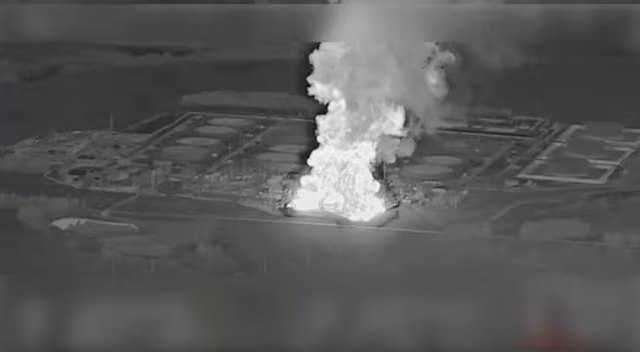
Ukraine has stepped up drone attacks on Russian oil refineries and exporting infrastructure, striking the most important sector of President Vladimir Putin’s economy to show it can fight back as the United States seeks to broker a peace deal.
The attacks disrupted Moscow’s oil processing and exports, created gasoline shortages in some parts of Russia and came in response to Moscow’s advances on the front lines and its pounding of Ukraine’s gas and power facilities.
Kyiv’s move is an attempt to raise the stakes in possible peace talks and challenge the idea that Ukraine has already lost the war after U.S. President Donald Trump and Putin met in Alaska this month, analysts have said.
Ukrainian attacks on 10 plants disrupted at least 17% of Russia’s refinery capacity, or 1.1 million barrels per day, according to Reuters calculations.
The drone war has pushed more crude towards exports from the world’s No.2 oil exporter at a time Washington is pressing China and India to reduce purchases of Russian oil.
The refinery hits come as Russia’s seasonal demand for gasoline from tourists and farmers peaks.
Russia had tightened its gasoline export ban in July to deal with a spike in domestic demand even before the attacks.
There were shortages of gasoline in some areas of Russian-controlled Ukraine, southern Russia and even the Far East, forcing motorists to switch to more expensive petrol due to shortages of the regular A-95 grade.
“We will endure, but this is a big hit to our family budget, a big hit. It’s really noticeable,” said Svetlana Bazhanova, a resident of Sevastopol, the largest city in Crimea which Russia annexed in 2014.
Russia’s far eastern port of Vladivostok saw long car queues at gasoline stations, according to a Reuters reporter.
The shortages are due to a seasonal influx of tourists, local authorities said.
The affected refineries have lost only part of their capacity but this could still create problems with domestic fuel supplies, said Sergei Vakulenko, a senior fellow at the Carnegie Russia Eurasia Center, who previously worked at Russian oil major Gazprom Neft.
Russia relies on oil and gas exports for a quarter of its budget revenues, which are funding a 25% rise in defence spending this year to the highest levels since the Cold War.
Western sanctions have forced Moscow to sell oil at discounts and stop gas sales in most of Europe. This has not deterred Moscow from producing record numbers of artillery and weapons, according to U.S. military generals.
The war in Ukraine has become a battle of attrition with both Russia and Ukraine using drones and missiles to strike far behind the front lines to damage each other’s economies.
Source: Reuters





 He emphasized AVRATE’s role in national energy projects, sustainable employment, and operational excellence.
In his keynote address, Eng. Henry Kojo Boateng, National President of the Institution of Engineering and Technology (IET), Ghana, called for robust protection of Ghana’s energy infrastructure.
He urged greater investment in renewable energy technologies such as solar and wind, as well as stronger collaboration between government, management, and engineering professionals to ensure long-term sustainability.
He emphasized AVRATE’s role in national energy projects, sustainable employment, and operational excellence.
In his keynote address, Eng. Henry Kojo Boateng, National President of the Institution of Engineering and Technology (IET), Ghana, called for robust protection of Ghana’s energy infrastructure.
He urged greater investment in renewable energy technologies such as solar and wind, as well as stronger collaboration between government, management, and engineering professionals to ensure long-term sustainability.
 Mr. Edward Ekow Obeng-Kenzo, Acting Chief Executive of VRA and Special Guest of Honour, applauded AVRATE’s significant contributions to VRA’s achievements, particularly highlighting the successful execution of the Anwomaso Thermal Plant project.
He described the congress theme as a reflection of unity, innovation, and a shared commitment to a sustainable energy future.
“With new capacity expansion projects ahead,” he stated, “AVRATE’s continued expertise, teamwork, and stakeholder engagement will be critical to our success.”
He also called for bold leadership to safeguard VRA’s legacy and ensure affordable, reliable energy for generations to come.
Other notable contributions came from senior VRA officials, including Mr. Samuel Fletcher, Deputy Chief Executive (Services); Ing. John Okine Yamoah, Acting Managing Director of NEDCo; and Mr. Dominic Ofosuhene, Director of Human Resources.
Solidarity messages were delivered by the Society of VRA Engineers (SOVRAE), the Senior Staff Association (SSA), and the Technician Engineers Association of GRIDCo (TEAG).
Mr. Edward Ekow Obeng-Kenzo, Acting Chief Executive of VRA and Special Guest of Honour, applauded AVRATE’s significant contributions to VRA’s achievements, particularly highlighting the successful execution of the Anwomaso Thermal Plant project.
He described the congress theme as a reflection of unity, innovation, and a shared commitment to a sustainable energy future.
“With new capacity expansion projects ahead,” he stated, “AVRATE’s continued expertise, teamwork, and stakeholder engagement will be critical to our success.”
He also called for bold leadership to safeguard VRA’s legacy and ensure affordable, reliable energy for generations to come.
Other notable contributions came from senior VRA officials, including Mr. Samuel Fletcher, Deputy Chief Executive (Services); Ing. John Okine Yamoah, Acting Managing Director of NEDCo; and Mr. Dominic Ofosuhene, Director of Human Resources.
Solidarity messages were delivered by the Society of VRA Engineers (SOVRAE), the Senior Staff Association (SSA), and the Technician Engineers Association of GRIDCo (TEAG).
 The second day of the congress focused on governance and capacity-building initiatives. Delegates adopted reports from the 2022 congress, reviewed the 2022–2025 financial statements, and engaged in open discussions on transparency and accountability.
The congress concluded with the dissolution of the outgoing National Executive Council, the election of new leaders, and their formal swearing-in—signifying a renewed phase in AVRATE’s leadership and direction.
The 2025 AVRATE National Delegates Congress reaffirmed the shared commitment of technical professionals and management to champion sustainable energy development, innovative partnerships, and a resilient future for Ghana’s power sector.
Source: https://energynewsafrica.com
The second day of the congress focused on governance and capacity-building initiatives. Delegates adopted reports from the 2022 congress, reviewed the 2022–2025 financial statements, and engaged in open discussions on transparency and accountability.
The congress concluded with the dissolution of the outgoing National Executive Council, the election of new leaders, and their formal swearing-in—signifying a renewed phase in AVRATE’s leadership and direction.
The 2025 AVRATE National Delegates Congress reaffirmed the shared commitment of technical professionals and management to champion sustainable energy development, innovative partnerships, and a resilient future for Ghana’s power sector.
Source: https://energynewsafrica.com