


ExxonMobil Accelerates African Energy Investments And Frontier Exploration

Leading oil-and-gas multinational ExxonMobil is progressing several energy initiatives on the African continent, consolidating its status as one of the drivers of the industry on the continent.
Recent developments herald further expansions of the robust ExxonMobil upstream pipeline to strengthen energy security through reliable, affordable energy supply while achieving industry-leading emissions intensity.
The latest expression of this saw ExxonMobil upstream President Liam Mallon meeting with Mozambican President Nyusi last month to confirm ExxonMobil’s commitment to the $24 billion Rovuma LNG project.
Mallon confirmed front-end engineering design (FEED) for the project and laid out a clear path to a final investment decision by 2026.
Also in the Southern Africa region, Exxon Mobil has emerged as an exploration leader in the Namibe basin, offshore Angola, where a wildcat well has been spud and results are keenly anticipated by the entire industry.
The basin extends from Angolan waters into northern Namibia, and favourable, commercially viable results could shape energy development in the region for decades to come.
In Nigeria, ExxonMobil is poised to shift focus to its deepwater investments, as the sale of its shallow-water JV asset reaches finality.
Nigeria’s rich reserves were recently estimated at 37.5 billion barrels by the Nigerian Upstream Petroleum Regulatory Commission (NUPRC). With offshore oil reserves currently responsible for 32% of Nigeria’s production, ExxonMobil – with its core deepwater engineering strengths – is perfectly positioned to drive the next development phase for Africa’s largest oil reserves.
ExxonMobil is looking to expand this broad engagement in the African upstream at the forthcoming AOW: Investing In African Energy event, where the company is a platinum sponsor.
“ExxonMobil is pleased to be a platinum sponsor for AOW as they commemorate 30 years of convening the energy industry for fruitful engagements and sharing of best practices,” said Richard Barke, ExxonMobil VP South Atlantic Exploration.”
The AOW partnership supports ExxonMobil’s role as one of the engines of the African upstream. AOW brings together governments, regulators, global operators, power producers, investors and service providers for engagements to develop policy, share discoveries, secure investment, and shape Africa’s energy future.
Through strategic partnerships such as these, as well as its deepwater expertise, and cutting-edge exploration in frontier regions, ExxonMobil has established itself as one of the most critically relevant energy businesses in the global sector.
As part of the AOW partnership, Richard Barke, ExxonMobil’s Vice President of Exploration for Africa, will deliver a keynote address at the event, outlining the company’s strategic vision for the region.
“Africa’s energy landscape presents a compelling blend of opportunity and potential,” said Barke. “We see significant alignment between the continent’s resources and the world’s evolving energy demands.
Nigeria: NNPC Hikes Petrol Price Across States

Nigeria’s National Oil Company (NNPC) Limited has adjusted the price of premium spirit (PMS), popularly known as petrol, upward after lifting the commodity at the price of N898 per litre from Dangote Refinery, Africa’s largest crude oil processing refinery in Lagos, Nigeria.
The NNPC said in a statement that a litre of PMS would be sold at N960.22 in Oyo State, N999.22 in Sokoto State, N999.22 in Kano State, N999.22 in Kaduna, N950.22, N980.22 in Rivers State, N992.22 in FCT and N1,019.22 in Bono State.
These increments incorporated the fee for NMDPRA (N8.99), inspection (N0.97), Distribution Cost (Lagos ) (N15) and Margin (N26.48).
The NNPC commenced lifting PMS from Dangote Refinery located in the Ibeju-Lekki area of Lagos State on Sunday.
Source: https://energynewsafrica.com
Venezuela Opposition Calls For U.S. Oil License Withdrawal
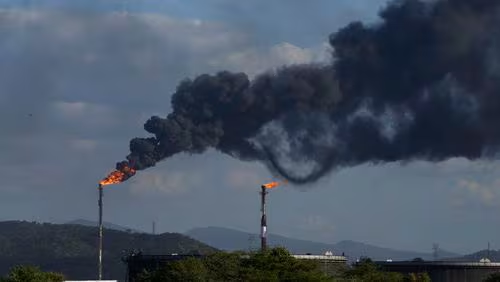
The Venezuelan opposition coalition called this week on the U.S. federal government to withdraw oil operation licenses issued to American companies for projects in Venezuela as a means of turning up the heat on the Maduro government further.
“We want them canceled … this is a lifeline to the regime,” Rafael de la Cruz, adviser to Edmundo Gonzalez Urrutia, the candidate who ran against Maduro in the July elections, said, as quoted by the AP. “We want all the oil companies to go to Venezuela. So, it’s not about the companies. It’s about the situation that is impoverishing the country so badly that practically the whole population wants this regime gone,” de la Cruz also said, speaking at an event organized by the Council of the Americas, a New York-based business entity, per the AP. U.S. sanctions against Venezuela’s oil industry effectively ban American companies from operating there without a special exemption license. The biggest energy major to get such a license was Chevron, back in 2022 when anti-Russian sanctions threatened global oil supply. Then, in October 2023, the U.S. introduced a temporary sanctions relief until April 2024 that allowed the production, lifting, sale, and exportation of oil or gas from Venezuela, and the provision of related goods and services, as well as payment of invoices for goods or services related to oil or gas sector operations in Venezuela. The period of the relief ended in mid-April and the sanctions snapped back in the absence of much progress in bilateral talks on fair elections. According to de la Cruz, the participation of American companies in the development of Venezuelan crude oil reserves under the Maduro government legitimizes said government. Their presence in the country, he argued, helped “normalize … de facto dictatorship that he is trying to set up in Venezuela.” Source: Oilprice.comKenya: Kenya To Assist Malawi In Setting Up Geothermal Projects

The Republic of Kenya is to use its geothermal energy expertise to assist its East African neighbour Malawi to develop geothermal energy projects.
Malawi is said to have 200MW potential in geothermal energy resources, because of its location within the East African Rift System, one of the hottest zones in the world.
The country, however, lacks capacity to exploit geothermal sources because it lacks technical know-how, personnel and resources.
Last year Kenya’s Geothermal Development Company and Malawi’s Electricity Generation Company (EGENCO) signed a Collaboration Framework Agreement (CFA) “on execution of geothermal projects in Malawi.”
“We have partnered with GDC to leverage their expertise, experience and equipment to develop geothermal energy in Malawi,” said Dr Maxon Chitawo, EGENCO Acting CEO.
He was speaking after visiting the Menengai geothermal plant in Kenya last week.
Chitawo said as Malawi also lies in the Rift Valley and has hot springs within its borders, it wants to use these natural attributes to produce electricity and diversify its energy mix.
Source: https://energynewsafrica.com
Ghana: The USD$250 Million For Ghana’s Energy Sector Recovery Program (ESRP) Is A Futile Strategy (Article).

By: Dr. Elikplim Kwabla Apetorgbor
The electricity sector is a vital pillar of Ghana’s economy, providing power to industries, businesses, and households that sustain economic growth.
In this context, the Electricity Company of Ghana (ECG), which manages the distribution of electricity, plays a crucial role in ensuring that the lights stay on across the southern zone of the country.
However, ECG has faced deep-seated challenges over the years, including operational inefficiencies, financial difficulties, and persistent losses, which have all led to an unstable and unreliable energy sector.
In an attempt to resolve these issues, the government secured parliamentary consent to inject USD$250 million facility from the World Bank into the Energy Sector Recovery Program (ESRP) aimed at revitalizing ECG and stabilizing the sector. However, this capital injection is akin to “fetching water in a basket.” It is a short-term, temporary measure that fails to address the fundamental challenges that continue to plague the energy sector.
Without a systematic overhaul of these structural problems, the expected outcomes of the recovery program will remain elusive.
Key issues such as political interference in ECG’s revenue administration, pressure to pay for the uncompetitively procured and excessively expensive liquid fuels, high and avoidable costs associated with distribution value addition services, rampant and high profile power theft, and the aggressive targeting of ECG’s most creditworthy customers by the Volta River Authority and other captive generators must be addressed before any substantial progress can be made.
Political Interference In ECG’s Revenue Administration Is One Perennial Obstacle
One of the most significant hurdles to ECG’s financial recovery is the persistent political interference in its revenue administration.
ECG is supposed to operate as a commercial entity with a mandate to generate revenue from electricity sales, recover costs, and reinvest in infrastructure and service delivery.
However, political interference has hampered its ability to function independently.
Political actors frequently influence tariff decisions, particularly during election period, with the aim of winning electoral support.
As a result, ECG is short-changed and unable to generate the required revenue that is critical to its financial sustainability.
For instance, electricity tariffs have been kept artificially low for certain politically connected and high energy consuming businesses, political pressure to pay for overpriced services to politically connected contractors, limiting ECG’s ability to recover its costs.
This erodes ECG’s revenue base and contributes to its financial losses.
Moreover, political interference often manifests in the form of leniency towards delinquent customers, especially those who are politically connected. ECG has struggled to enforce strict revenue collection policies, especially from public institutions and government agencies, which are some of its largest debtors.
The pressure to refrain from disconnecting these entities despite significant arrears further diminishes ECG’s ability to collect revenues and reinvest in its operations.
The injection of USD$250 million, while helpful in temporarily covering ECG’s financial shortfall, will not resolve the core issue of political interference.
Without granting ECG the autonomy to collect revenues, and enforce disconnections based on purely commercial considerations, the company will continue to suffer financial setbacks.
Until political influence is removed from ECG’s decision-making processes, the injected funds will be nothing more than a temporary bandage on a much larger wound.
Pressure On ECG To Finance Expensive Liquid Fuels For Generation
Another major issue undermining ECG’s financial health is the pressure to pay for expensive liquid fuel to generate electricity, even when more affordable natural gas option is available to pursue.
Over the years, Ghana has heavily relied on thermal plants that utilize liquid fuels like Heavy Fuel Oil (HFO), Light Crude Oil (LCO) and diesel to produce electricity.
These fuels are not only expensive but also subject to volatile global market prices, making them a risky and unsustainable energy source in the long run.
This reliance on costly liquid fuels has been exacerbated by politically entrenched business interests in the liquid fuel supply chain.
The procurement of liquid fuel has become a profitable business for certain politicians and entities that benefit from the high costs, and the political pressure on ECG to continue purchasing these fuels.
As a result, ECG finds itself burdened with high energy costs, which it struggles to pass on to consumers due to political interference in tariff setting.
What makes this situation even more troubling is that natural gas, a cheaper and more efficient alternative, is available within the country and our next door neighbour, which could significantly reduce the cost of electricity generation.
However, despite the availability of this more affordable option, ECG has been pressured to continue paying for liquid fuels, leading to higher operating costs.
If the same pressure and priority in payment for the liquid fuels can be directed towards the natural gas, supply will always be reliable to us.
The USD$250 million injection does little to address this issue. Unless ECG is allowed to prioritize cost-effective fuel sources such as natural gas, the company will continue to bear the burden of excessive generation costs.
Without tackling the entrenched interests that profit from liquid fuel procurement, the injection of funds into the sector is unlikely to yield sustainable improvements.
Exorbitant Operational Costs of Distribution Value-Addition Services:
Another factor contributing to ECG’s financial difficulties is the excessive operation cost of distribution value-addition services.
These include service expansion, network maintenance, and metering services, which are necessary for ECG to deliver electricity to consumers.
While such services are essential, ECG’s procurement processes for these services have been riddled with political influence, inefficiencies and, at times, corruption.
The costs of these services are often inflated due to the awarding of contracts based on political connections rather than merit or transaction cost-efficiency.
Service providers, knowing they can rely on political backing, inflate prices and deliver substandard work, further exacerbating ECG’s financial troubles.
The absence of a genuine competitive bidding processes and the lack of transparency in contract awards drive up costs, leading to ECG paying far more than necessary for basic operational services.
Even with the USD$250 million injection, ECG will remain financially unstable if the procurement processes that allow for inflated costs are not reformed.
It is essential that ECG streamlines its procurement processes, implements competitive bidding, and holds service providers accountable for delivering value for money.
Unless these changes are made, the company will continue to hemorrhage funds on overpriced services, rendering any capital injection ineffective in the long term.
Systemic Power Theft – A Hidden Drain on ECG’s Resources
One of the most pervasive and damaging problems facing ECG is systemic power theft.
Power theft through illegal connections, meter tampering, and under-billing significantly reduces ECG’s revenue, creating a wide gap between the electricity delivered and the electricity paid for by consumers.
It is estimated that non-technical losses, largely due to power theft, account for as much as 20-25% of ECG’s total electricity distribution.
The problem of power theft is further exacerbated by political and social factors. In certain regions and communities, power theft is tolerated due to the lack of enforcement and fear of political repercussions.
ECG’s attempts to crack down on illegal connections are often met with resistance from both local communities and political leaders who view such measures as politically damaging.
The USD$250 million injection does little to address the issue of power theft. Without a comprehensive strategy to tackle illegal connections and meter tampering, ECG will continue to lose a significant portion of its revenue.
The deployment of smart meters, stronger enforcement measures, and public education campaigns on the economic impact of power theft are critical to closing the revenue gap. Until such measures are implemented, the financial injection will merely serve as a stopgap solution, rather than a path to sustainable financial recovery.
The Rush For ECG’s Creditworthy Customers Is Another Key Threat To ECG’s Revenue Base
The liberalization and policy decision of Ghana’s power sector has led to increased competition from some power generators that now supply electricity to bulk customers.
While competition can be healthy for the market, there is a growing concern that some of these generators are aggressively targeting ECG’s most creditworthy customers, including large industrial and commercial clients.
These customers represent a significant portion of ECG’s revenue base, and their migration to private suppliers threatens to further weaken ECG’s financial position.
The current regulatory framework does little to protect ECG from losing its high-value customers, and without these customers, ECG will find it even more difficult to sustain its operations.
This situation creates a vicious cycle, where ECG’s financial instability pushes more customers to seek alternative suppliers, further eroding ECG’s revenue base.
The USD$250 million injection will not reverse this trend unless the regulatory environment is adjusted to empower and secure ECG’s businesses and also provide ECG with a more level playing field.
Additionally, ECG must improve its service delivery to retain its high-value customers and remain competitive in the face of growing competition.
Conclusion
The injection of USD$250 million into Ghana’s Energy Sector Recovery Program is, at best, a temporary measure that fails to address the underlying structural issues plaguing the Electricity Company of Ghana.
Without meaningful reforms to eliminate political interference in revenue administration, reduce reliance on expensive liquid fuels, overhaul procurement processes, combat power theft, and protect ECG’s creditworthy customers, the capital injection will not lead to sustainable improvements in ECG’s financial position or the broader energy sector.
The analogy of “fetching water in a basket” is apt in this context because the financial injection, while necessary for short-term liquidity, will quickly dissipate in the face of these unresolved challenges.
What is needed is a comprehensive restructuring of the sector, guided by transparency, accountability, and long-term sustainability.
Only by addressing the fundamental flaws in the system can Ghana hope to achieve a stable, reliable, and financially sound energy sector.
Source: Dr. Elikplim Kwabla Apetorgbor (Power Systems Economist)
Ghana: NDC, NPP Commit To Universal Access To Electricity By 2028

The two major political parties in the Republic of Ghana, the New Patriotic Party (NPP) and National Democratic Congress (NDC) have committed to lead the country to achieve universal access to electricity in their 2024 Manifestos by 2028.
The West African nation will be heading for the polls on December 7 this year, and the two main parties outdoored their manifestoes last month.
Ghana’s electricity access stands at 88.85 per cent as of December 2023.
When the current government took over power from the opposition National Democratic Congress (NDC), which ruled the nation for eight years from 2009 to 2016, it increased electricity access from 60.78 to 83.24 per cent.
Comparing the current figure of 88.85 per cent to the 2016 access rate of 83. 24, it shows that the opposition NDC increased the electricity access rate by 16.9 per cent while the current government has increased it by 5.6 per cent.
Speaking on Friday, during an Engagement with Energy Sector Players, Mr John Dramani Mahama said his government would aggressively pursue rural electrification programme aimed at achieving universal access to electricity by 2028.
Source: https://energynewsafrica.com
Ghana: Energy Awards Announces Shortlisted Nominees For The 8th Edition

The Ghana Energy Awards Secretariat has released the shortlisted nominees for the 8th Ghana Energy Awards.
This year’s competition has seen an impressive surge of interest with over 170 submissions received between the 27th of June and the 30th of August, 2024.
The nominations span across 25 competitive categories, showcasing the diverse contributions of individuals, companies, and institutions dedicated to advancing Ghana’s energy sector.
The process leading to the shortlisting has been rigorous, reflecting the high standards that the Ghana Energy Awards upholds.
The Awards Secretariat, together with the distinguished Awarding Panel, undertook significant measures to ensure transparency and accuracy.
These included courtesy calls to sector stakeholders to gather critical feedback, as well as site visitations to assess the numerous innovative projects nominated.
This hands-on approach highlights the thoroughness and dedication invested in recognising the exceptional achievements in Ghana’s energy development journey.
The theme for this year’s event, “The Role of Local Content in Building Ghana’s Energy Sector”, emphasises the critical role that local expertise, businesses, and investments play in the development of the energy landscape.
As Ghana strives to solidify its position as a regional energy hub, this theme draws attention to the importance of nurturing homegrown talent and resources to drive sustainable growth.
It is a call to action for stakeholders to champion local content policies that will not only enhance the sector, but also secure its future.
All roads now lead to the grand awards ceremony on Friday, 25th October 2024 at the Labadi Beach Hotel in Accra.
This landmark event promises to bring together industry leaders, policymakers, and key stakeholders in the energy sector, as they converge to celebrate excellence, innovation, and leadership within Ghana’s energy landscape.
The Ghana Energy Awards, organised by the Energy Media Group, seeks to recognise the contributions of industry players to Ghana’s energy development through healthy competition.
The Awards is fully endorsed by the Ministry of Energy and its allied agencies, and the World Energy Council Ghana, with validation from Forvis Mazars.
For sponsorship, tickets, or enquiries, please contact the Awards Secretariat on 030 3940 300 or [email protected].
Find the list of shortlisted nominees for the 8th Ghana Energy Awards below:
 Source: https://energynewsafrica.com
Source: https://energynewsafrica.com Namibia: Alpha Petroleum Wins Largest Diamond Mining Contract…Sets To Begin Operation In October

Nigerian-based Alpha Petroleum has secured the largest diamond mining contract in the Republic of Namibia and is set to commence operation on October 1, 2024.
The contract was awarded by NAMDEB, a joint venture between the Namibian government and De Beers Group.
This is the first time the company has won a major contract in the Central African nation.
The contract, valued at USD 200 million, would grant Alpha Petroleum rights to conduct mining operations within specified areas of NAMDEB’s sea mining licence on a contract basis.
Mining will take place offshore, targeting diamondiferous gravels identified through past prospecting and mining activities.
The company’s shallow water mining vessel, equipped with advanced technology, will extract, process and recover diamonds.
The diamonds will be delivered monthly to the Contractors Treatment Facility in Luderitz, Namibia.
Alpha Petroleum aims to deliver 30,000 to 60,000 carats per annum, solidifying Namibia’s position as a significant diamond-producing nation.
This project is expected to have a substantial economic impact on the region, particularly in the Halifax Island and Kerbehuk mining zones.
Commenting on the contract, Dr Babajide Agunbiade, Founder and CEO of Alpha Energy Resources, expressed pride and enthusiasm.
“We’re glad to have emerged winners of the rigorous bid. We’re now ready to commence operations, executing the largest diamond mining project in Namibia, with a significant impact on the African continent,” he said.
When asked how this is going to boost the company’s outlook, Dr Agunbiade stated that good publicity boosts any company’s outlook.
NAMDEB is a wholly-owned subsidiary of Namdeb Holdings (Proprietary) Limited, jointly owned by the Government of the Republic of Namibia and De Beers Group.
Alpha Energy Resources is a leading EPICC service provider in Africa’s mining and energy sector.
Alpha Energy Resources specialises in upstream and downstream services, with extensive experience in shallow to deep marine mining.
This landmark contract underscores Alpha Petroleum’s expertise and commitment to responsible mining practices, cementing Nigeria’s presence in the global mining industry.
Source: https://energynewsafrica.com
Ghana: GOIL Announces Significant Reduction In Petrol Price

Ghana’s leading Indigenous Oil Marketing Company, GOIL PLC, has announced a significant reduction in the prices of both Super XP (Ron 91) and Diesel XP for the second pricing window beginning September 16, 2024.
A litre of Super XP (Ron 91) has been reduced to Gh¢12.99 from Gh¢14.16 per litre, representing Gh¢1.17 (8.3%), while Diesel XP has been reduced to Gh¢14.49 from Gh¢14.70 per litre, representing 21 pesewas effective Monday, September 16, 2024.
Since the second pricing window in August, the cost of refined petroleum products has been declining, with petrol falling to US$696.38 per metric tonne while Diesel declined to about US$669.44 per metric tonne, according to estimates by the National Petroleum Authority.
Forex (exchange rate), which is also one key determinant of cost ex-pump price of fuel, has also seen some stabilisation, with a dollar being exchanged for Gh¢15.73
Crude oil prices on the international market have also been declining and hovering around US$70 per barrel.
As of Monday morning, September 16, 2024, the benchmark crude Brent is trading at US$71.87 per barrel, while West Texas Intermediate (WTI) is trading at US$69.03 per barrel.
Source: https://energynewsafrica.com
Ghana: Gas Act Needed To Develop Gas Industry—Dr Asante

The Chief Executive Officer of Ghana National Gas Company, Dr Benjamin K.D. Asante, has underscored the need for Ghana to pass and implement a ‘Gas Act’, noting that it is crucial for driving the sector forward.
The West African nation has developed a Gas Master Plan which outlines the country’s strategies for developing its natural gas resources.
Although there are other laws that regulate natural gas utilisation in the West African nation, the absence of a ‘Gas Act’ is somehow hindering the investment needed to develop the gas resources.
Speaking at the 2024 stakeholders’ roundtable conference under the theme: ‘Building an Effective Gas Sector Revenue Management System: The Role of Stakeholders’, Dr Asante emphasised the need for access to capital, particularly in Africa, where infrastructure development is capital-intensive.
“If you are going to be having a facility or infrastructure, you need access to capital, particularly in our part of the world, and then, develop the secondary market.
“So, currently, we use about 85–90 per cent of our gas for power generation, but we also need to accelerate the use of gas for non-power applications and, last but not least, the Gas Act.
“Now, when we start, we’re looking forward to accelerating the finalisation and implementation of this Gas Act because that’s the only way we can provide some impetus to all the things that we are talking about,” Dr Asante said.
He advocated for increased private sector participation, access to finance and local content provisions to build capacity and ensure sustainability.
“We also need access to finance and transactions. We have to encourage private sector participation in the industry. That is one of the ways we can actually sustain the industry. So, we need that as well and then, local content provision to build capacity or sustainability,” he added.
Source: https://energynewsafrica.com
The Gambia: Greater Banjul Area Hit With Load-Shedding

The Gambia’s National Water and Electricity Company Limited (NAWEC) has announced load-shedding in the Greater Banjul Area due to a shortfall in power supply.
The agency, in a statement, attributed the load-shedding to Karpower operating only one unit (engine) and a technical collapse at Senelec, the Senegalese power company where it imports power from.
The company apologised for the inconvenience caused by the situation and assured the public of their resolve to address the issues.
 Source: https://energynewsafrica.com
Source: https://energynewsafrica.com Nigerian Communities Seek $310 Million From Shell, Want Asset Sale Stopped

Nigerian communities are claiming 505 billion naira ($310 million) in damages from Shell, which they accuse of breaching an existing court order by striking a deal to sell its onshore assets in the Niger Delta, court papers showed on Friday.
Shell is set to exit Nigeria’s onshore oil and gas sector after agreeing in January to sell its business to a consortium of five mostly local companies for $2.4 billion.
But more than 1,200 representatives of Ilaje communities in the Niger Delta asked the Federal High Court in Abuja to stop the deal, arguing that Shell was violating a December 2023 ruling that suspended any assets sale until a compensation lawsuit was concluded.
The community has a pending lawsuit against Shell, which it accuses of causing an oil spill that damaged waterways and farms.
Shell has long maintained that such spills were mostly due to theft of oil and interference with pipelines.
In the court papers, the community said Shell should be penalised for going ahead with asset sale “when the plaintiffs and the host of their community members have remained in perpetual suffering over the failure of the defendants to obey the preservative orders of a competent court.”
Shell did not immediately comment.
It was not immediately clear when the court would hear the case.
The oil major has faced a string of lawsuits locally and abroad from communities demanding environmental restoration or compensation for land damaged by historical oil spills.
Source: Reuters
Ghana: GOIL PLC, SMB Of Cote d’ivoire Commission $40M Bitumen Plant In Tema

Ghana’s leading indigenous Oil Marketing Company, GOIL PLC, and its partner, Société Multinationale de Bitumes (SMB) of Côte d’lvoire, have commissioned a $40 million African Bitumen Terminal and production plant in the Tema industrial enclave.
The main operations of the 7,500MT facility include the transfer of bitumen from bitumen tanker vessels at the oil jetty to the terminal, the storage of bitumen AC 10 & AC 20 into dedicated tanks, production of Polymer Modified Bitumen (PMB), production of bitumen emulsions, laboratory testing for quality of products and distribution of products through bitumen bulk trucks, bitutainers and drums.
The terminal mainly consists of two bitumen storage tanks of capacity 1X4,000 MT (AC 20) & 1X2,000 MT (AC 10), one (1) Blend Stock tank of 450 MT capacity, 2X15 MT Mixing tanks (for PMB), and 3X133 MT Letdown tanks (for PMB), 2X133 MT emulsion storage tanks.
Products that will be available at the terminal are raw bitumen (AC 10 & AC 20), PMB and bitumen emulsions.
Commissioning the facility on Thursday, September 12, 2024, Ghana’s President Nana Akufo-Addo said “the US$40 million-dollar project stands as evidence of what can be achieved when we pool our resources, expertise and resolve as nations within the ECOWAS community.”
According to him, the establishment of the plant opens the door for Ghana and Cóte d’Ivoire to become exporters of bitumen to countries within the West African region and beyond.
“This facility has come at the right time. My government is undertaking the most expensive expansion of the road network ever seen in this country, with the construction of some 12,000 kilometres of road since 2017.
“I strongly believe that the contribution of the Goil, SMB Bitumen plant will complement fully government’s efforts in road construction.
“As we commission this plant today, it is crucial that we look to the future and consider its broader implications.
“This Bitumen plant will not only meet the needs of Ghana’s road construction sector, but it will also create significant opportunities for exports, particularly within the ECOWAS community,” President Akufo-Addo said.
“The economic and social benefits of this facility will ripple across our economy, contributing to foreign exchange earnings, job creation, and enhanced technological expertise. The importance of ensuring that this facility runs effectively and efficiently cannot be overemphasised.
“This plant must operate at the highest standards, ensuring that the Bitumenous product produced here is of the highest quality and meets international specifications,” he added.
H.E. Robert Beugré Mambé, Prime Minister of the Republic of Cóte d’Ivoire, who represented the Ivorian President, Alassane Ouattara, said the commissioning of the joint Bitumen Terminal marked a new elevated chapter in the diplomatic and bilateral relations between Ghana and Cóte d’Ivoire.
He indicated that the Ivorian President was delighted about the materialisation of the project as he looks forward to the success of the Bitumen production facility.
The Group Chief Executive Officer and Managing Director of Goil PLC, Mr. Kwame Osei-Prempeh, said with the commissioning of the project, Bitumen, which is a commodity that is much needed for road construction would be very much available directly in the country to support the massive road construction agenda of government.
He called on the government to ensure that the importation of Bitumen into the country through approved and unapproved routes and processes is stopped.
The Minister of State at the Energy Ministry, Mr. Herbert Krapa, noted that the Bitumen plant is not only an achievement for the road sector, but it is also going to have a positive impact on the entire Ghanaian economy.
He called on the managers of the facility to target zero carbon emission throughout its various operational levels.
“Today, being responsible in our carbon emmissions has now left the realm of being an option; we are seeing right before our own eyes all the signs of a fast-warming globe, and we know; we can’t wait any longer to take decisive action.
“This plant must be a zero-carbon emission model for others to follow. It must contribute directly to our efforts of reaching net-zero in the next few years, and it must ensure energy efficiency at all levels,” Herbert Krappa remarked.
“Explore renewable energy sources for the running of the plant; run your trucks on compressed natural gas, and develop carbon sinks for hard-to-abate areas,” he further remarked.


 Source: https://energynewsafrica.com
Source: https://energynewsafrica.com Zambia: ZESCO Implements Three-Hour Rotational Power Supply Due To Worsening Power Crisis
Zambia’s debilitating power situation has forced the power company, ZESCO Limited, to begin the implementation of three hours rotational power supply in groups.
“As of this morning, the three-hour supply of power is being implemented on a rotational basis in groups,” the company said in statement on Wednesday, September 11, 2024.
Factors Affecting Power Supply
According to ZESCO, it has experienced reduced inflow of scheduled power imports from Mozambique, due to annual maintenance works on generating units being undertaken by the country’s utility Electricidade de Moçambique (EDM).
As a result of this, the Corporation said it is receiving an average of 100MW out of the scheduled 140MW.
The Corporation also citied maintenance works of the 300MW thermal plant which has reduced generation by 150MW.
ZESCO has substantially reduced power generation at the Kariba Complex due to further reduced water levels.
As part of efforts to mitigate the impact of the power situation, the Corporation has 23 diesel generators in markets to support business continuity for traders during periods of power rationing.
The first four generators would be operational from Friday 13th September 2024.
“ZESCO will continue to prioritise provision of power supply to essential services such as hospitals, water supply stations, security and emergency services.
“ZESCO recognises the challenges faced by its customers and continues to pursue several other mitigating measures to cushion the impact of this drought induced power deficit which has reached a very challenging phase,’’ the Corporation said.
Source: https://energynewsafrica.com