



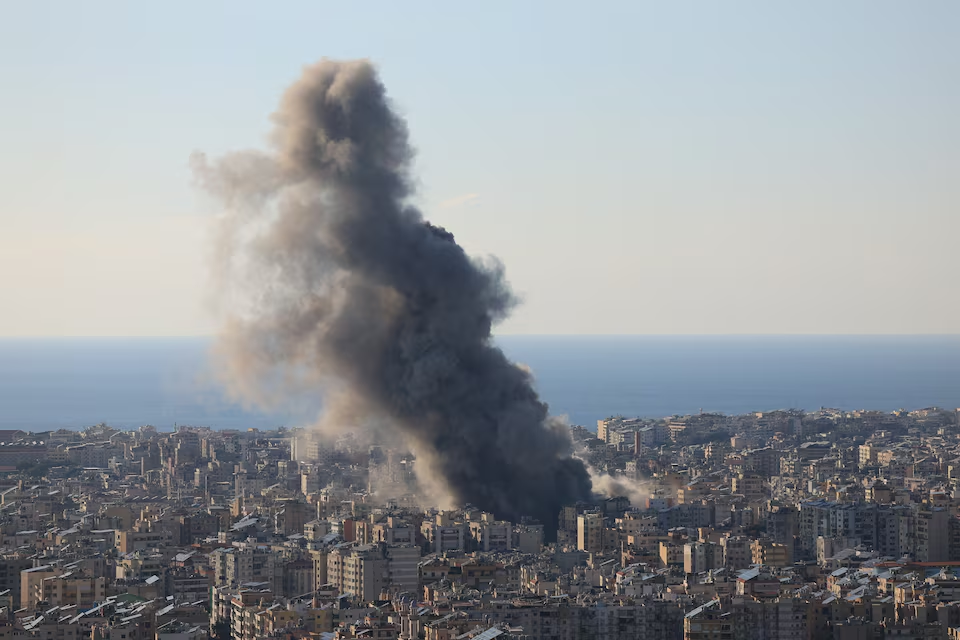
Qatar has halted its production of liquefied natural gas on Monday, as Iran continued to strike Gulf countries in retaliation for Israeli and U.S strikes against it, prompting precautionary shutdowns of oil and gas facilities across the Middle East.
Qatari LNG production is equivalent to about 20% of global supply and plays a major role in balancing both Asian and European markets’ demand for the fuel.
As a wave of attacks in the Middle East stretched into a third day, they also resulted in the suspension of operations at Saudi Arabia’s biggest domestic oil refinery after a drone strike, most oil production in Iraqi Kurdistan and several Israeli gas fields, throttling exports to Egypt.
State-owned QatarEnergy, 82% of whose clients are Asian, was set to declare force majeure on its LNG shipments after Iranian drone attacks on facilities in the sprawling Ras Laffan complex. The complex hosts Qatar’s gas trains — massive processing units that supercool natural gas into liquid form for export by ship.
Drones also hit the Mesaieed industrial zone in Qatar’s south that lies far from the gas fields but is home to petrochemical and manufacturing facilities.
Natural gas prices soared with the benchmark European price, the Dutch front-month contract at the TTF hub, up 46% as of 1426 GMT.
Oil prices jumped as much as 13% intraday to above $82 a barrel, the highest since January 2025, as the conflict ground shipping to a near halt in the Strait of Hormuz, through which a fifth of global oil supply flows.
State oil giant Saudi Aramco’s 550,000 barrels per day (bpd) Ras Tanura refinery, which was shut as a precautionary measure according to an industry source, is part of an energy complex on the kingdom’s Gulf coast which also serves as a critical export terminal for Saudi crude oil.
In Iraqi Kurdistan, which exported 200,000 barrels of oil per day (bpd) via pipeline to Turkey’s Ceyhan port in February, companies including DNO, Gulf Keystone Petroleum, Dana Gas, and HKN Energy have stopped output at their fields as a precaution, with no damage reported.
Offshore Israel, the Israeli government instructed Chevron to temporarily shut down the giant Leviathan gas field where it is in the process of expanding capacity to around 21 billion cubic metres a year as part of a $35 billion export deal to Egypt. A spokesperson for Chevron, which also operates the Tamar gas field offshore Israel, said its facilities were safe.
Energean shut down its production vessel serving smaller Israeli gas fields.
In Iran, explosions were heard on Saturday in Kharg Island, which processes 90% of Iran’s crude exports. It was unclear how the facilities were impacted.
Iran, the third largest producer in the Organization of the Petroleum Exporting Countries, pumps about 4.5% of global oil supplies. Iran’s output is about 3.3 million barrels per day of crude, plus 1.3 million bpd of condensate and other liquids.
Discover more from Energy News Africa
Subscribe to get the latest posts sent to your email.