


Nigeria: Oando Completes Acquisition Of Eni’s Subsidiary

Italian oil and gas giant, Eni, has announced the closing of the sale of its wholly-owned subsidiary, Nigerian Agip Oil Company Ltd (NAOC), to Oando PLC (Oando), Nigeria’s leading indigenous energy solutions provider.
Oando is listed on both the Nigerian Exchange Limited and Johannesburg Stock Exchange.
NAOC engages in onshore oil & gas exploration and production in Nigeria, as well as power generation,
The transaction, which received the approval of all relevant authorities, is in line with Eni’s strategy focused on the rationalisation of the upstream activities by rebalancing its portfolio and divesting non-strategic assets.
The five per cent participating interest in SPDC (Shell Production Development Company Joint Venture) is not included in the transaction, as it will be retained in Eni’s portfolio.
Eni will continue to be present in the Country through investment in deepwater projects and Nigeria LNG, while also exploring new opportunities related to the agri-feedstock sector.
The $783-million transaction sees Oando’s participating interests in Oil Mining Licenses (OML) 60, 61, 62 and 63 increase from 20% to 40% and its total reserves grow by almost 100% to one billion barrels of oil equivalent.
Oando’s ownership stake will also increase in NAOC’s joint venture assets, which include 40 discovered oil and gas fields – of which 24 are currently producing – 40 identified prospects and leads, 12 production stations, 1,490 km of pipelines, three gas processing plants, the Brass River Oil Terminal, the Kwale-Okpai Phase 1 & 2 power plants and associated infrastructure.
With a diverse portfolio of on- and offshore assets in Nigeria’s oil and gas sector, Oando represents one of the leading indigenous explorers on the continent.
Currently, its producing assets include Qua Iboe (OML 13) and the Ebendo Field (OML 56), in addition to the four OMLs acquired from NAOC.
The company’s promising development pipeline includes OML 90 and OML 122, which hold tremendous potential for boosting Oando’s operational capacity, while its exploration prospects center around interests in several strategic assets, including OMLs 321 and 323, as well as Blocks 5 and 12, OML 131 and OML 145.
“This announcement is the culmination of ten years of toil, resilience and an unwavering belief in the realization of our ambition since the 2014 entry into the Joint Venture via the acquisition of Conoco-Philips Nigerian Portfolio.
It is a win for Oando, and every indigenous energy player, as we take our destiny in our hands, and play a pivotal role in this next phase of the nation’s upstream evolution,” said Wale Tinubu CON, Group Chief Executive, Oando PLC.
Affirming its commitment to Africa’s energy sector growth, the company will discuss its latest acquisition and investment strategy, with a focus on integrating just transition principles and technologies and ensuring local value creation.
Boasting a number of strategic partnerships and with a focus on sustainable growth, Oando PLC is well-positioned to harness the full potential of Africa’s energy resources and create long-term value for the company’s stakeholders.
With a diverse and robust array of assets, Oando PLC has established a firm foundation for its business operations, ensuring a strong and sustainable presence in the dynamic and ever-evolving oil and gas sector.
Commenting on the deal Executive Chairman of African Energy Chamber NJ Ayuk said: “Oando is delivering on its pledge to expand upstream investments and its position in Nigeria’s oil and gas sector.
The AEC congratulates and supports Oando on the successful completion of this milestone transaction, as it affirms the influence of local exploration and production companies and their unwavering belief in harnessing the full scope of Africa’s energy resources.
“We look forward to unpacking this deal and its many implications for the sector at this year’s AEW,” he said.
Source: https://energynewsafrica.com
Colombia Reports Five Attacks On Oil Pipelines

Colombia’s state-owned oil company Ecopetrol has reported five attacks on two pipelines, adding that exports of the commodity have not been affected.
The Cano Limon-Covenas pipeline was attacked three times, Ecopetrol’s subsidiary Cenit reported, as quoted by Reuters, and the Bicentenario pipeline suffered two attacks.
It added that the Colombian army had been deployed to the area of the attacks on the Cano Limon-Covenas pipeline to protect staff who were repairing the infrastructure.
Colombia’s oil pipelines are a frequent target for guerilla groups active in the country. They are also targeted by crime groups stealing crude and using it in drug production, Reuters said in its report.
Colombia currently produces close to 800,000 barrels of oil daily but wants to increase this to over 1 million bpd.
For 2024, the target is to reach 800,000 bpd, the head of the country’s energy regulator said earlier in the year.
At the same time, the current government has ambitious plans for wind and solar growth as it seeks to reduce Colombia’s dependence on oil, gas, and coal revenues. Hydrocarbons, however, remain a major contributor to budget revenues.
Even so, the Petro government has not held any new oil and gas exploration tenders since coming into office.
 State oil company Ecopetrol is contributing to the output increase through enhanced oil recovery techniques, improving extraction volumes from reservoirs.
Colombia’s current oil recovery rate averages 27 percent, energy minister Andres Camacho said in May this year.
The government is also reviewing contracts for oil exploration due to speculation, with some companies signing contracts just to resell them at higher prices without conducting any actual exploration—a practice that could stifle future oil production.
“We’re going contract by contract to see where there really are good reasons to suspend these activities and where there aren’t, to declare possible non-compliance due to negligence,” Orlando Velandia, head of the energy regulator ANH said earlier this year.
Source: Oilprice.com
State oil company Ecopetrol is contributing to the output increase through enhanced oil recovery techniques, improving extraction volumes from reservoirs.
Colombia’s current oil recovery rate averages 27 percent, energy minister Andres Camacho said in May this year.
The government is also reviewing contracts for oil exploration due to speculation, with some companies signing contracts just to resell them at higher prices without conducting any actual exploration—a practice that could stifle future oil production.
“We’re going contract by contract to see where there really are good reasons to suspend these activities and where there aren’t, to declare possible non-compliance due to negligence,” Orlando Velandia, head of the energy regulator ANH said earlier this year.
Source: Oilprice.com
State oil company Ecopetrol is contributing to the output increase through enhanced oil recovery techniques, improving extraction volumes from reservoirs.
Colombia’s current oil recovery rate averages 27 percent, energy minister Andres Camacho said in May this year.
The government is also reviewing contracts for oil exploration due to speculation, with some companies signing contracts just to resell them at higher prices without conducting any actual exploration—a practice that could stifle future oil production.
“We’re going contract by contract to see where there really are good reasons to suspend these activities and where there aren’t, to declare possible non-compliance due to negligence,” Orlando Velandia, head of the energy regulator ANH said earlier this year.
Source: Oilprice.com Russia Launches 200 Missiles At Ukrainian Energy Installations

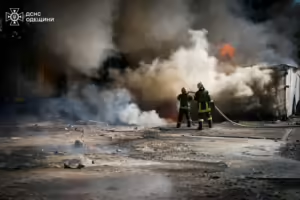
Russia on Monday launched some 200 missiles at Ukraine, targeting energy installations, while Polish media report that Warsaw has deployed aircraft to defend Polish airspace against the onslaught, and a U.S. airbase in Germany remains on full alert in a state of preparedness.
Parts of Kyiv have been rendered without power and water, according to Reuters.
“The desire to destroy our energy sector will cost the Russians dearly for their infrastructure,” the Kyiv Post quoted Andriy Yermak, head of the Office of the President of Ukraine, as saying
According to the Kyiv Post, at least four people have been killed and authorities across the country have been forced to introduce emergency blackouts, with 15 regions targeted in one of the biggest assaults Moscow has launched in weeks in retaliation for Ukraine’s brazen ground offensive on the Russian region of Kursk.
Ukraine’s Kursk offensive has carried on now for nearly three weeks, with military authorities claiming that the advance continues.
Russian forces are now attempting to advance in Ukraine’s east, hoping to take the transport hub of Pokrovsk, according to the Kyiv Post.
Also on Monday, Ukrainian forces reportedly targeted Russia’s Engels airfield, home to military aircraft, in the Saratov region, though it remains unclear what the extent of the damage from that attack was.
The Russian Defense Ministry reported on its Telegram channel on Monday that it shot down Ukrainian UAVs over Saratov overnight, the BBC reported.
 According to Ukraine’s UA wire, citing German intelligence sources, Germany has thwarted an alleged Russian plan to target a NATO air base in Geilenkirchen last week.
The base was rendered combat ready following U.S. Secret Service warnings of a potential attack last week, and then the level of preparedness was reduced after it was determined that Moscow had withdrawn its plans.
Source: Oilprice.com
According to Ukraine’s UA wire, citing German intelligence sources, Germany has thwarted an alleged Russian plan to target a NATO air base in Geilenkirchen last week.
The base was rendered combat ready following U.S. Secret Service warnings of a potential attack last week, and then the level of preparedness was reduced after it was determined that Moscow had withdrawn its plans.
Source: Oilprice.com
According to Ukraine’s UA wire, citing German intelligence sources, Germany has thwarted an alleged Russian plan to target a NATO air base in Geilenkirchen last week.
The base was rendered combat ready following U.S. Secret Service warnings of a potential attack last week, and then the level of preparedness was reduced after it was determined that Moscow had withdrawn its plans.
Source: Oilprice.com Nigeria To Sign Off On $1.3 Billion ExxonMobil Oil And Gas Asset Sale To Seplat Energy

Nigerian regulators said they expect to formally consent to ExxonMobil’s sale of its oil and gas assets to Seplat Energy Plc within four months, ending a hiatus that has stalled the conclusion of a transaction that was first announced in February 2022.
The approval process should be completed within the 120-day legal timeframe, the Upstream Petroleum Regulatory Commission said in a statement on Monday.
Nigeria’s state oil and gas company in May said it reached an agreement that would allow ExxonMobil to proceed with the asset disposal.
Seplat, a local energy supplier, agreed to acquire them for $1.3 billion, a deal that could almost quadruple its oil output to more than 130,000 bpd.
Former President Muhammadu Buhari backed the transaction, but approval was later reversed amid objections from the regulator.
Source: Worldoil.com
Ghana: Opposition NDC To Review LPG Cylinder Recirculation Model Programme

The opposition National Democratic Congress (NDC) in the Republic of Ghana has given a hint about its plans to review the implementation of a cylinder recirculation model (CRM) programme initiated by the current administration spearheaded by the country’s downstream petroleum regulator – National Petroleum Authority (NPA).
The CRM was introduced by the current government after an atomic gas explosion in 2017 that claimed seven lives, including a journalist.
The programme has led to the establishment of LPG bottling plants where cylinders are filled and transported to exchange points.
Consumers would go to these exchange points with their empty cylinders and exchange them for already filled cylinders.
The policy is aimed at increasing access to LPG usage, creating jobs and reducing the risk of fire explosion at LPG refilling stations.
Although the CRM programme is currently underway, one of the stakeholders – LPG Marketing Companies Association – has raised concerns about the involvement of Sage Petroleum (Quantum Terminals) and Blue Ocean in the programme.
Two weeks ago the LPG marketing companies cut ties with Sage Petroleum and Blue Ocean. In other words, they have ceased doing business with them.
The action of LPG marketing companies triggered a response from the Chamber of Bulk Oil Distributors, which is the umbrella body of all bulk oil importers.
On page 64 of the NDC 2024 Manifesto for the December 7 general election, the party has announced some interventions to promote LPG penetration.
Among the interventions are a review of the CRM programme, relaunch of the rural LPG promotion programme and reduction of taxes on LPG.
Source: https://energynewsafrica.com
Angola: How Government Enables Energy Success (Article)

A productive, mutually beneficial partnership with regional governments can be the cornerstone of successful energy development, says Ane Aubert, managing director of Equinor Angola.
The key to the successful, long-term development of a country’s natural energy resources can be a government that is willing to partner with energy companies to share risks as well as benefits, and to devise compliance approaches for effective social and environmental transformation.
So says Equinor Angola managing director Ane Aubert, of the company’s decades-long investment in Angola.
Government effort
Equinor is an international energy company headquartered in Norway, but over the years since the company entered the Angolan market in 1991, Angola has become one of the largest contributors to Equinor’s energy production outside Norway.
“The Angolan energy sector has made significant progress over the years” says Aubert. “We recognize the government´s effort to improve the business environment and remain attractive for investors.”
Among these efforts, Aubert notes the recent Presidential decree on incremental production. “It’s a great development,” says Aubert. “It introduces better terms for all oil and gas licenses, including incentives for mature fields and cost recovery for dry exploration wells.”
The Angolan government has also taken steps to enhance transparency and governance in the sector, by joining the Extractive Industries Transparency Initiative (EITI).
“Equinor has been a longstanding supporter of the EITI, and this was a significant move towards greater accountability and public awareness about Angola’s natural resources,” she says.
CO2 Reduction
Aubert says the Angolan government’s commitment to enabling sustainable development is expected to stimulate more activity and investment.
“A key element of maintaining and enhancing Angola’s competitiveness is the continuous focus on CO2 reduction measures,” she says. “This is essential, not only for the environment but also for attracting investment in a global market increasingly focused on low-carbon initiatives.”
For its part, Equinor is poised to continue its investment. It is set to drill two promising exploration opportunities in its blocks 1/14, and 47 offshore assets, and has plans for new infill and near-field exploration (ILX) wells in its legacy assets over the next five years.
The company made its first Angolan discovery in 1995. Its portfolio today is partner operated and delivers around 110 000 barrels of oil per day – around 10% of Angola’s total oil production.
Significant Player
Despite the recent emergence of new frontier discoveries, Aubert is confident that Angola will remain a significant energy player on the continent long into the future.
“While Namibia is gaining attention as a potential new world-class exploration frontier, Angola continues to hold a strong position in Africa thanks to its established infrastructure, skilled workforce, and still substantial reserves potential,” says Aubert. “This combination, together with the government’s proactive approach, and increased focus on compliance, provides a stable and attractive environment for investors“.
Aubert says unlocking that attractive investment potential must go hand-in-hand with real ESG commitments. Equinor is itself part of several initiatives to boost efficiency and sustainability.
Through CO2 reduction roadmaps with partners and operators, process optimization, energy efficiency, and technology upgrades, the company reduced its CO2 emissions in Angola by 40% from 2018 to 2023.
It has also committed, alongside Sonangol and its operators, to the Oil and Gas Decarbonization Charter to end routine flaring by 2030 and achieve net-zero targets by 2050. It is also part of the Satellite Monitoring Campaign to detect methane leaks across assets.
“We believe it’s possible to lead in the energy transition while continuing our oil and gas activities, by optimizing our operations and focusing on efficient hydrocarbon development,” says Aubert.
Community Projects
The company also has numerous community projects aimed at achieving social as well as economic progress.
A project in the southern Huila province aims to support 5 000 people in 10 rural communities affected by droughts and climate change through access to water and clean energy, as well as sustainable agricultural practices.
A biodiversity project supports a national inventory of mangrove ecosystems, which could hopefully lead to the recognition of Angolan mangroves as wetlands of international importance under the Ramsar Convention.
“Energy development in Africa must mean investing in the local workforce, promoting human rights, and being a constructive, proactive partner with authorities,” concludes Aubert. “Continued commitment, innovation, and collaboration across the Angolan industry is crucial to further reducing carbon emissions and achieving a sustainable energy future for all Angolans.”
Ane Aubert will be a featured speaker at AOW: Investing in African Energy, to be held in Cape Town at the CTICC2 from October 7 – 10.
AOW is the meeting place for the global community of African energy stakeholders committed to enabling a prosperous energy outlook for Africa.
Ghana: Respect Sanctity Of Power Purchase Agreements-Dr Apetorgbor Tells Gov’t

The Chief Executive Officer of the Independent Power Generators, Ghana Dr Elikplim Kwabla Apetorgbor, has advised the Government of Ghana to respect the sanctity of power contract to avoid unnecessary judgment debts.
According to him, Power Purchase Agreements are not mere formalities but essential components that drive investment, ensure energy security and support economic stability.
He argued that not only does failure to honour these agreements lead to financial liabilities but also damages Ghana’s reputation as a reliable partner in the global market.
Dr Apetorgbor’s advice follows the government of Ghana’s failure to fully pay the US$134 million judgment debt awarded to Ghana Power Generation Company (GPGC) owned by Commodity Trader Trafigura, which compelled the company to seize Regina House, Ghana’s commercial property, in the UK.
In an opinion piece, Dr Apetorgbor also advised Ghana to consider setting up a contingency fund specifically for managing judgment debt.
Below is Dr Elikplim Kwabla Apetorgbor’s write up
The Judgment Debt Against Ghana is avoidable
Ghana is now faced with a significant financial burden, following the award of a USD $134 million judgment debt in favor of Trafigura’s Power Generation Company.
This debt stems from the early termination of a Power Purchase Agreement (PPA) between Trafigura and the Government of Ghana, a decision that now has far-reaching consequences.
The situation serves as a stark reminder of the importance of respecting the sanctity of multinational and international agreements, especially within the project finance realm of the power sector.
The recent judgment debt highlights the critical need for Ghana to adhere to its contractual obligations.
International agreements, such as Power Purchase Agreements, are not mere formalities but essential components that drive investment, ensure energy security, and support economic stability.
Failure to honor these agreements not only leads to financial liabilities but also damages Ghana’s reputation as a reliable partner in the global market.
In 2018, the government’s decision to unilaterally convert all ‘take or pay’ PPAs to ‘take and pay’ agreements was widely criticized as a rash move that could have led to similar or even worse consequences.
Such actions undermine investor confidence and can lead to costly legal disputes, as evidenced by the current situation with Trafigura.
These are not mere administrative decisions; they carry the weight of legal obligations that, if ignored, result in significant financial and reputational damage.
The immediate financial impact of the judgment debt is severe, particularly as it comes at a time when the government is already grappling with overdue arrears to independent power generators (IPGs).
The requirement to pay USD $134 million to Trafigura strains the government’s resources and may further delay payments to IPGs, which are vital for maintaining the stability of Ghana’s power supply.
This delay not only risks power shortages but could also result in additional financial penalties, compounding the economic challenges facing the country.
The sustainability of Ghana’s power sector hinges on the timely and consistent payment to IPGs, which cannot be compromised if the country aims to maintain a reliable and efficient power supply.
To prevent such scenarios in the future, Ghana must adopt a more strategic and disciplined approach to its contractual engagements.
This includes a thorough legal review of all existing IPGs, ensuring that any amendments or terminations are handled with the utmost caution and respect for the agreements in place.
The inclusion of dispute resolution mechanisms, such as arbitration clauses, in future contracts can also provide a more structured and less adversarial means of addressing disagreements.
Furthermore, Ghana should consider setting up a contingency fund specifically for managing judgment debts and other unexpected liabilities.
This fund would provide a buffer, allowing the government to meet its financial obligations without jeopardizing payments to critical sectors such as energy.
Source: https://energynewsafrica.com
Ghana: My Gov’t Will Probe Gold-For-Oil Programme If Elected- Mr Mahama
Ghana’s former president John Dramani Mahama and the flag-bearer of the opposition National Democratic Congress for the December 7 General Election has declared his intention to investigate the God-For-Oil (G4O) programme introduced by the current government of Nana Akufo-Addo.
He argued that the G4O programme introduced in 2021 by the current the government to address the cedi depreciation and the hike in fuel prices lacks transparency and warrants thorough investigations.
Speaking at the 3rd Annual Transformational Dialogue on Small-scale Mining at the University of Energy and Natural Resources (UENR) in Sunyani, Mr Mahama said the deal would be looked at again should he form the next government.
“We will investigate the opaque gold for oil programme and expose the actors benefiting from this so-called barter agreement.
“Reports reaching me suggest that a new debt burden is being created because Ghana has not been able to keep up with its delivery of gold under the programme.”
Under the ‘G4O’ programme, Ghana aims to secure competitively priced oil by selling gold to ease pressure on the Cedi (its local currency), reverse rocketing fuel prices and fix the balance of payment problems.
By March 2023, more than 60,000 ounces of gold valued at over US$97 million had been purchased from local mines, but the PMMC is targeting at least 160,000 ounces of gold valued at about US$300 million per month, which could help purchase about 50 per cent of the country’s monthly oil demand.
Source: https://energynewsafrica.com
Namibia Plans To Become The Fifth Largest Oil Producer In Africa

Namibia has ambitions to become one of the largest oil producers in Africa by 2035, with an average output of half a million barrels daily, displacing Egypt in the top five list, a government official has said.
“With four floating production storage and offloading units deployed by 2035, we could be producing more than half a million barrels per day of oil equivalent,” Ebson Uanguta, interim managing director of the National Petroleum Corporation of Namibia, said at an industry event, as quoted by China’s Xinhua.
Several significant oil and gas discoveries were made recently in Namibian waters, with supermajors tapping an estimated 11 billion barrels of oil in offshore resources, with first production expected in 2030.
Shell and TotalEnergies are the leading investors in Namibia’s oil future, along with Qatar Energy and a UK-listed Australian driller by the name of Global Petroleum.
Chevron, Portugal’s Galp, and Rhino Resources are also exploring for oil in the country’s Orange Basin.
Earlier reports pegged the country’s oil and gas production capacity at 700,000 bpd as of 2030—the year that commercial production should begin.
Two discoveries in particular could transform the country into not only a new oil producer but a major one, as they are estimated to contain billions of barrels in oil and gas.
One of these is Shell’s Graff discovery, which could hold as much as 1.7 billion barrels of oil and gas across three wells, according to Barclays estimates.
The other major discovery is TotalEnergies’ Venus, which is even bigger than Graff, with reserves seen at up to 3 billion barrels of oil equivalent.
Portugal’s Galp, meanwhile, earlier this year struck hydrocarbons at the Mopane discovery, which the company said could contain 10 billion barrels of oil equivalent or more.
This would essentially dwarf the Shell and TotalEnergies discoveries, if proven, and make Namibia an even more attractive oil development destination.
Source: Oilprice.com
Ghana: CBOD Defends Sage Petroleum, Blue Ocean…Urges LPG Marketers To Collaborate With NPA

The Chamber of Bulk Oil Distributors (CBOD) in the Republic of Ghana has thrown its weight behind Sage Petroleum (Quantum Terminals) and Blue Ocean for their investments in LPG distribution system under the Cylinder Recirculation Model programme to boost LPG access.
According to the chamber, the two entities are Ghanaian companies that have been legally registered under the laws of Ghana and complied with the National Petroleum Authority (NPA) Act 691, Act 2005.
The two entities together have made an investment of US$30 million in LPG bottling plants, storage facilities, and cylinders, as well as a US$70 million investment within the next 18 months.
The chamber’s defence follows a statement issued last week by the LPG Marketing Companies which announced their decision to cease business with Sage Petroleum and Blue Ocean’s depots in the Tema enclave.
The action by the LPG Marketing Companies was in protest by Sage Petroleum and Blue Ocean’s decision to register new businesses and participating in CRM programme.
The LPG Marketing Companies deemed the action by the two entities as an unhealthy competition because the LPG they sell in their retail outlets are purchased from the same companies that want to take over their market.
However, reacting to the issue, CBOD, in a statement, mentioned that GOIL had acquired a licence and had constructed and commissioned two bottling plants in Tema and Kumasi, adding that Ghana Gas had also acquired a licence and it intended to establish its own bottling plant.
The chamber questioned whether it is illegal for both institutions to participate in the LPG market.
The chamber described the LPG Marketing Companies’ decision to cut ties with Sage Petroleum and Blue Ocean as counterproductive to the LPG promotion efforts by the government, NPA and all stakeholders.
While urging all stakeholders to engage in constructive dialogue to resolve the current issue and foster collaboration within the industry, it encouraged the LPG Marketing Companies to collaborate with the regulator and all relevant stakeholders, stressing that working together is the key to ensuring nationwide access to safe LPG by 2030.
Source: https://energynewsafrica.com
Russia To Open New Laboratory To Study Technologies For Hydrogen Production

Russia’s St. Petersburg Polytechnic University is in the process of creating a laboratory to carry out research on the use of hydrogen energy as a sustainable source in the near future.
The topic is actively developing all over the world and may give a fresh insight on energy to Africa.
Peter the Great St. Petersburg Polytechnic University (SPbPU, belongs to Consortium of Rosatom’s Flagship Universities) together with Rosatom’s Mechanical Engineering Division CDBMB JSC has set about creating a laboratory to study chemical technologies using digital solutions for hydrogen energy projects.
The laboratory will be equipped with the latest equipment so master’s students could carry out chemical technologies research, develop kinetic models of catalytic processes, including the production of hydrogen and its derivatives (ammonia, methanol, synthetic fuels, etc.), and collect data to create and verify digital twins.
Up to 15 people will be able to work in the laboratory at the same time.
The laboratory is scheduled to open in autumn 2024.
“Today, hydrogen technologies play a key role in the development of the chemical industry and energy sector. Modern energy sector needs an efficient and ecofriendly fuel, and hydrogen will become such an energy source in the near future.
The knowledge-intensive projects of Advanced Engineering School in the interests of CDBMB JSC provide the foundation for new Gen equipment that will allow the industrial partner to become a technology licensor and take a leading position in the new industry,” concluded Yuri Aristovich, Head of the “Digital Engineering of the Main Equipment of Chemical-Engineering Systems” scientific and educational centre.
SPbPU Advanced Engineering School with the support of CDBMB JSC have organised “Digital Engineering of the Main Technological Equipment of Hydrogen Technologies and New Generation Energy Systems” new master’s programme for 2024-2025 academic year.
The programme starts on September 1, 2024.
“The importance of scientific research in master’s training cannot be understated. In the new laboratory, students will not only master the methodology of scientific research and gain research experience, but will also be able to conduct important studies within the framework of the promising hydrogen energy projects of CDBMB JSC,” noted Alexey Mikhailov, Director of Business Development at CDBMB JSC.
The laboratory may also be useful for training African students and exchanging research experience.
Developing renewable hydrogen production in Africa would allow African nations to meet domestic electricity needs while becoming a major exporter to supply growing global demand.
The use of hydrogen as a fuel is not a new concept. It is currently widely used in different applications such as fuel for cars, refining petroleum, treating metals, producing fertilizer, and processing foods.
Hydrogen releases a significant amount of energy when used as fuel, almost three times what can be obtained from diesel or gasoline.
Source: https://energynewsafrica.com
Ghana: Petrol, And Diesel Prices Reduced At The Pumps

Oil Marketing Companies in the Republic of Ghana have reduced the pump prices of both petrol and diesel for the second pricing window of August, which runs from the 16th to the 30th of August.
A litre of petrol is now sold between Gh¢14.65 and Gh¢13.65 while diesel is sold between Gh¢14.80 and Gh¢14.60 per litre.
Unlike other parts of Africa where fuel prices are reviewed every month, in Ghana, fuel prices are reviewed every two weeks.
The reduction in fuel prices is a result of a reduction in refined petroleum products on the international market.
During the first pricing window which ended on August 15th, a US dollar was exchanged for between Gh¢15.55 and Gh¢15.80.
Data from the National Petroleum Authority, the petroleum downstream regulator, showed that the price of refined petroleum products -petrol and diesel went down.
Petrol price decreased to US$794.58 from US$817.75 per metric tonne while diesel price decreased to Gh¢720.20 from US$755.93 per metric tonne for the second pricing window of August.
Crude oil prices also witnessed some decreases during the first pricing window of August, with Brent falling from $80 to $74 per barrel and WTI falling from $84 to $77 per barrel.
Currently, GOIL is selling petrol (Ron 91) at Gh¢14.22 per litre while petrol (Ron 95) is sold at Gh¢15.62, with diesel being sold at Gh¢14.90 per litre.
Shell is selling petrol at Gh¢14.69 per litre while diesel is sold at Gh¢14.90 per litre.
TotalEnergies is selling petrol at Gh¢14.69 while diesel is sold at Gh¢14.85 per litre.
Star Oil is selling petrol at Gh¢13.65 per litre while diesel is sold at Gh¢14.02 per litre.
Petrosol is selling petrol at Gh¢13.99 while diesel is sold at Gh¢14.65 per litre.
Cash Oil is selling petrol at Gh¢13.65 while diesel is sold at Gh¢14.02 per litre.
Lucky is selling petrol at Gh¢13.49 while diesel is sold at Gh¢13.65 per litre.
Zen Petroleum is selling petrol at Gh¢13.65 per litre while diesel is sold at Gh¢14.02 per litre.
Allied is selling petrol at Gh¢13.93 while diesel is sold at Gh¢14.48 per litre.
Pacific is selling petrol at Gh¢13.27 per litre while diesel is sold at Gh¢13.49 per litre.
Engen Ghana is selling petrol at Gh¢14.60 while diesel is sold at Gh¢14.80 per litre.
Benab is selling petrol at Gh¢13.65 while diesel is sold at Gh¢14.02 per litre.
Source: https://energynewsafrica.com
Nigeria: IBEDC Engages Customers In Ibadan, Ogun States

The Ibadan Electricity Distribution Company (IBEDC) has conducted visits and engagements with some of its Maximum Demand (MD) customers in Ibadan and Ogun States.
This initiative is part of the company’s ongoing commitment to fostering strong relationships and gathering valuable feedback from its esteemed customers.
During the visits, Engr Agoha, who led the IBEDC team, emphasised the importance of customer satisfaction and outlined several key measures that IBEDC is undertaking to ensure an improved customer experience.
He highlighted the company’s determination to explore bilateral partnerships and other options.
Engr Agoha also mandated the IBEDC team to ensure a quicker turnaround time for fault resolutions, emphasising that prompt response and resolution of issues within IBEDC’s control are critical to maintaining customer trust and satisfaction.
Furthermore, he assured the customers that IBEDC is committed to strengthening its working relationships with other stakeholders in the power sector to enhance overall service delivery.
“Our engagement with customers is crucial to understanding their needs and ensuring we meet their expectations.
“Their feedback is invaluable to us, and we are committed to addressing their concerns and improving our services to meet their expectations.
“Our goal is to build a power distribution network that is efficient, reliable, and customer-centric.”
The customers expressed their appreciation for the visit and the proactive steps being taken by IBEDC.
They conveyed their hopes for a smoother and more productive working relationship.
IBEDC said it remains dedicated to providing excellent electricity distribution services and ensuring customer satisfaction across its coverage areas.
The company promised to continue to seek innovative solutions and foster partnerships that would benefit its customers and the larger community.
Source: https://energynewsafrica.com
Mozambique: Coral Sul FLNG Achieves 5 Million Tons Of LNG Production

Italian oil and gas giant Eni, which is the Delegated Operator of Area 4, on behalf of its partners namely ExxonMobil, CNPC, GALP, KOGAS and ENH, have celebrated the achievement of 5 million tons of LNG produced from the Coral Sul FLNG, located in the ultra-deep waters of the Rovuma Basin, offshore Mozambique.
This is a significant milestone for the project, and it represents not only a major technical and operational accomplishment, but also stands as a testament to the dedication, commitment, and collaboration of all the team and stakeholders.
The Coral Sul FLNG started production in October 2022 and has exported so far 70 cargos of LNG and 10 of Condensate, contributing significantly to the country´s economic growth.
Coral South is a landmark project for the industry, and it placed Mozambique among the global LNG producing countries, laying the foundation to a transformational change of Mozambique through development of gas resources, while also supporting a just and sustainable energy transition.
Marica Calabrese, Eni Rovuma Basin Managing Director, made the following remarks “We are truly proud to announce this very important milestone today.
“This accomplishment reinforces our commitment to delivering outstanding value to the country of Mozambique.
“We will continue to work with our partners and the Government of Mozambique to ensure a timely valorization of Mozambique’s vast gas resources with additional developments of gas projects.
“As we celebrate, we recognize the importance of remaining focused on safety, environment, and operational excellence.”
Source: https://energynewsafrica.com