


Ghana Elected To IAEA Board Of Governors

The Republic of Ghana and ten other countries including Morocco and Egypt, have been elected to serve on the 35-member International Atomic Energy Agency (IAEA) Board of Governors for the 2024–2025 period.
The election happened on Thursday, 19th September, at the plenary session of the 68th IAEA General Conference in Vienna, Austria.
The newly-elected Board members are Argentina, Colombia, Egypt, Italy, Luxembourg, Georgia, Ghana, Morocco, Pakistan, Thailand and the Bolivarian Republic of Venezuela.
For the 2024-2025 period, the new composition of the 35-member IAEA Board will be Algeria, Argentina, Armenia, Australia, Bangladesh, Belgium, Brazil, Burkina Faso, Canada, China, Colombia, Ecuador, Egypt, France, Georgia, Germany, Ghana, India, Indonesia, Italy, Japan, the Republic of Korea, Luxembourg, Morocco, the Kingdom of the Netherlands, Pakistan, Paraguay, the Russian Federation, South Africa, Spain, Thailand, Ukraine, the United Kingdom of Great Britain and Northern Ireland, the United States of America and the Bolivarian Republic of Venezuela.
The Board of Governors is one of the two policy-making bodies of the IAEA, along with the annual General Conference of IAEA Member States.
The Board will meet on Monday, 23 September, to elect its officers.
Source: https://energynewsafrica.com
Morocco Elected To IAEA Board Of Governors

Morocco has been elected to the Board of Governors of the International Atomic Energy Agency (IAEA) for the 2024-2026 term, during the 68th regular session of the IAEA General Conference in Vienna.
The Kingdom’s election by acclamation to the IAEA’s key decision-making body, representing Africa, reflects the international community’s trust in Morocco as a nation committed to peace, dialogue, and consensus in multilateral for a, under the leadership of HM King Mohammed VI.
Morocco’s Permanent Representative to the International Organizations in Vienna, Ambassador Azzeddine Farhane, highlighted Morocco’s dedication to South-South cooperation, which is central to its foreign policy, particularly in supporting African nations.
Morocco, which chaired the IAEA General Conference in 2020, will focus on promoting dialogue and consensus-building to strengthen multilateralism and advance nuclear disarmament and non-proliferation during its tenure.
The Kingdom also aims to enhance the IAEA’s technical cooperation, especially in helping African nations use nuclear technology for peaceful purposes in areas like water, agriculture, health, and the environment.
The 35-member Board of Governors is one of the two executive bodies of the IAEA, alongside the General Conference, tasked with overseeing the agency’s operations and policy decisions.
Source: https://energynewsafrica.com
Nigeria: TCN Unveils $56Million SCADA System

The Transmission Company of Nigeria (TCN) has taken a significant step towards automating the national grid’s management and control with the successful demonstration of its new Supervisory Control and Data Acquisition (SCADA) system.
This historic demo was held on Wednesday September 18th, 2024 at the soon-to-be completed National Control Centre, Gwagwalada, Abuja.
Speaking at the event, the Honourable Minister of Power, Chief Adebayo Adelabu, who was represented by the Acting Permanent Secretary of the Ministry, Engr. Dr. Emmanuel Nosike said that the SCADA system will enable real-time monitoring and control, crucial for effective national grid management.
Adelabu urged all stakeholders in the Nigerian Electricity Supply Industry (NESI) to embrace the opportunities the SCADA system offers to improve their operational capabilities and service delivery to Nigerians.
On his part, the MD/CEO of TCN, Engr. Sule Ahmed Abdulaziz, expressed excitement that the project is finally becoming a reality after several failed attempts. He revealed that the project, currently 69% complete, will be fully implemented by mid-next year.
He emphasized that, the SCADA system, designed to enhance grid stability, reduce power outages, and improve energy efficiency, is a technology that will allow TCN to monitor the entire electricity network from a central location, ensuring prompt responses to outages and efficient load management.
The $56m World Bank funded project is part of TCN’s broader digital transformation strategy, which includes upgrading existing systems and leveraging new technologies to improve efficiency and effectiveness.


 Source: https://energynewsafrica.com
Source: https://energynewsafrica.com Egypt, UK To Expand Collaboration In Renewable Energy Sector

Globeleq, a UK-based energy projects developer is set to collaborate with the Egyptian government to establish a substantial project for green hydrogen production, aiming to diversify its investments within Egypt’s renewable energy sector.
This initiative was unveiled in a statement released by the Ministry of Investments and Foreign Trade.
During a meeting in London with the Minister of Investment and Foreign Trade, Hassan El-Khatib and representatives from British renewable energy firms, Globeleq expressed its intentions to broaden investments in wind energy generation and the development of water desalination plants powered by renewable sources.
The discussions delved into projects geared towards diminishing reliance on imported liquefied gas to curtail the import expenditure.
Additionally, Globeleq articulated its interest in proposing ventures for sustainable transportation utilizing clean energy solutions in Egypt.
Moreover, Minister El-Khatib engaged with Oge Diala, the Founder of the British company PASH Global, renowned for its endeavors in renewable energy.
Their dialogue revolved around PASH Global’s ambition to establish solar panel manufacturing facilities in Egypt, with the overarching goal of positioning Egypt as a pivotal hub for solar energy on regional and international fronts.
Noteworthy is PASH Global’s prior memorandum of understanding with the General Authority for the Suez Canal Economic Zone, amounting to £2 billion, underscoring their commitment to advancing Egypt’s renewable energy landscape.
Source: https://energynewsafrica.com
Zambia: Security Agencies Stop Smuggling Of More Than 33,000 Litres Of Gasoline To Zambia

Angola’s Criminal Investigation Service (SIC), in cooperation with the other bodies of the Interior Ministry, thwarted the smuggling of 33,750 liters of gasoline from Cuando Cubango province to the Republic of Zambia.
Addressing a press conference on Monday, Chief Superintendent Novais Eduardo Chissesso, Deputy Director of the SIC in Cuando Cubango, said that the operation took place in the last 48 hours, explaining that the product was transported in 135 containers, with 250 liters each, coming from the municipality of Menongue, the capital of the province.
He stated that the criminals, in addition to presenting dubious documents, the quantity of the product transported constituted the crime of smuggling under the terms of Law 5/24 of 23 August, Law to combat the smuggling of petroleum products.
While detailing the criminals’ plan, the official explained that being in the municipality of Rivungo, the product would be placed in smaller containers, such as 1/20 and 1/25 liter containers, in order to facilitate accommodation in small shipments and cross the Cuando River from the port river in the municipality.
Once this procedure, the product would be in Zambia’s territorial space within an estimated time of fifteen minutes with the use of high-displacement trucks which facilitate movement and take unconventional routes.
This is the second case of seizure of petroleum products in large quantities this year in the Cuando Cubango province.
The first case involved 15,250 liters seized in March in the same region.
The operation culminated in the arrest of six national citizens.
ANGOP found that five liters of gasoline can be sold at the price of 500 Kwatchas, Zambian currency, equivalent to 20,000 kwanzas, if converted into the Angolan currency.
After all the calculations, the illicit fuel business in that country would have a revenue of 675 million kwanzas.
Source: https://energynewsafrica.com
Ghana: Sack ECG’s Top Management As Soon As Possible—ACEP Demands

The African Centre for Energy Policy (ACEP), a civil society group in the Republic of Ghana, is demanding an immediate dismissal of the top management of the power distribution firm, Electricity Company of Ghana (ECG), over alleged mismanagement which, the group says is crippling the entire power sector.
Addressing a press conference a while ago on Thursday, Kotso Yaotse, Policy Lead Petroleum and Conventional Energy at ACEP, accused the ECG management of signing a dubious contract with Hubtel, a digital services provider for their revenue collection.
The ECG management members are Samuel Dubik Mansubir Mahama,(the Managing Director), David Boadi Asamoah, Samuel Tagoe, Eric Ansah Antwi, Yaw Frimpong, Ing. Jackline A. Ofori -Atta, Cynthia Amartey, Ing. George Hommey and Leonard N.L Lamptey Esq.
“The current management of ECG should be relieved of the jobs and immediately be replaced with effective and transparent management that would salvage the company and its attendant fiscal burden on the state,” he demanded.
According to him, the ECG is supposed to be collecting over Gh¢2 billion in revenues, however, it is collecting over Gh¢800 million.
He said despite this abysmal revenue performance, the power distribution company has been failing to properly account for the limited revenue it collects.
Kodzo Yaotse noted that after the ECG refused to comply with a directive by the PURC and President Akufo-Addo to create a single account for the collection of its revenue, it then outsourced the development and maintenance of its payment system to Hubtel.
According to him, the contract the ECG had with Hubtel lacks transparency.
“According to a contract received from the ECG, the total cost for the design and development of the platform is about GH¢171.8 million.
Between November 2022 and December 2023, the cumulative service charge was over GH¢100 million.
In addition, Hubtel will be paid 0.95% of all revenues collected as service charges. At the time of contract execution, GH¢75 million had been paid to Hubtel on the framework cost.
This information in the contract contradicts information Hubtel has communicated on its proceeds from the agreement. On March 28, 2024, eight days after the contract was executed, Hubtel published the cost of developing the payment system at US$25 million (GH¢315 million), of which US$12 million (GH¢151 million) had been paid.
“The contract gives Hubtel control over all revenues collected until such a time it is disbursed to the ECG. The contract also creates a fund designed to receive an undetermined portion of revenues collected before the balance is disbursed to the ECG.
This retention of unspecified amounts from all revenues collected undermines the requirements of the cash waterfall mechanism and efforts under the IMF programme to bring visibility to the ECG’s total revenues,” he said.
Kodzo Yaotse also noted that in many instances, the exchange rate reported by the ECG to the cash waterfall committee was significantly higher than the interbank exchange rate.
“This exchange rate manipulation created a net exchange loss of about GH¢6.5 billion in 2022 (from GH¢609 million in 2021) and about GH¢7 billion in 2023. ACEP, through the RTI process, requested historical exchange rates used by ECG for its transactions. The company has since May 2024 not been able to supply our request.”
He warned that the growing fiscal burden imposed on the economy by the ECG’s poor performance has become a ticking time bomb that can undermine the progress made after the domestic and international debt restructuring to keep Ghana solvent.
“With the level of debt accumulation and the intervention required of the state, it is just a matter of time before Ghana is plunged into another debt crisis,” he noted.
He urged the PURC to assume its regulatory functions over the ECG
Source: https://energynewsafrica.com
Ghana: Ghanaian OMCs Pay Better Salaries Than Foreign-owned Companies–CEMSE Report Reveals

The Center for Environmental Management and Sustainable Energy (CEMSE), an advocacy group in the Republic of Ghana, has revealed that Oil Marketing Companies (OMCs) with dealer-owned, mostly foreign filling stations, poorly pay their fuel attendants with salaries ranging from GH₵600 to GH₵1,200 per month.
However, locally-owned OMCs have salaries ranging from GH₵1,250 to GH₵2,000 per month.
OMCs like Star Oil, Zen Petroleum and Dessert Oil were found to pay their workers better compared to the others.
The study also showed that some OMCs do not pay Social Security and National Insurance Trust (SSNIT) contributions for their staff.
Contrary to expectations, the surge in sales volumes of the industry was anticipated to improve the welfare of the employees within the end of the value chain of petroleum distribution and marketing but the result is the opposite.
The International Labour Organisation defines decent work as employment that offers equitable income, job security, social protection, bargaining power, workplace equality among employees and better prospects for personal development and integration.
According to the CEMSE, most OMCs in Ghana do not provide decent work for their fuel attendants.
The Executive Director for CEMSE, Benjamin Nsiah, observed the situation is unfair and must be corrected.
“Looking at the hazardous environment within which these employees operate, if they are paid between GH₵600 and GH₵1,200 with no medical allowances and insurance policies to cover them and their family in times of need, then it is grossly unfair.”
The study further showed that most of the employees of OMCs work between eight to sixteen hours daily, implying that some fuel attendants work over sixty hours a week, which is against the ILO’s standardised working hours of 48 hours per week.
“Employees who work overtime are expected to get some overtime bonuses but most OMCs do not pay overtime bonuses to these workers. It must be noted that some few OMCs that fully own and operate their filling stations pay between GH₵1,500 and GH₵2,000 per month with bonuses of GH₵200 per month,” the study uncovered.
The study also found that the low salary received by fuel attendants ultimately affects their work performance and output.
The CEMSE’s review of the OMCs’ performance report in the last three years has observed that OMCs that pay their employees well, between GH₵1,500 and GH₵2,000 per month are contracting the market shares of OMCs that do not pay their employees well.
“The latter’s market performance is observed to be dwindling because some of their employees engage in unfriendly market practices that drive away consumers, and this is so because of lower salaries received monthly to survive in a highly cost-inflated Accra,” the study revealed.
Another reason for the poor performance of low-wage paying OMCs is because of lack of attraction of experienced and honest fuel attendants.
“This disparity highlights that dealer-operated OMCs tend to offer lower wages compared to those without dealers, a situation that needs addressing within the industry,” the study concluded.
Source: https://energynewsafrica.com
Italy Shuts The Door On New Oil Exploration

Italy will no longer grant concessions for oil and condensate exploration and production, a draft of a new government decree shows.
The decree, seen by Reuters, specifies that the oil exploration and production ban will only apply to new concessions—not existing ones that have already secured government approval.
The ban is part of Italy’s green ambitions, which include abandoning coal-fired electricity by the end of 2025 in favor of gas-fired power plants.
To that end, Italy approved four new gas-fired power plants in the past few years, capable of producing 3,400 MW of power, with upgrades to existing power plants expected to add another 700 MW by 2026 as the country attempts to move entirely away from Russian-supplied natural gas.
Oil exploration and production in Italy is regulated primarily through state legislation, with operators holding no title to exploration and production areas.
The Italian government is due a 10% royalty for onshore oil production and 7% for offshore.
While taking a step back from oil and gas exploration and production, Italy’s Central Bank, is pushing for developed economies with higher per-capital emissions to help developing economies transition away from fossil fuels in hopes of accelerating the clean energy rollout.
The call to assist, made by bank governor Fabio Panetta at the G7 – IEA Ensuring an Orderly Energy Transition conference in Rome, would help to reduce the overall cost of the energy transition globally, Panetta said.
But last week, Italy’s power utility Enel scrapped its plans to participate in the energy transition of Vietnam, deciding to exit the country’s wind and solar markets, which have been categorized by a rather complicated grid connection mechanism that has prompted even a transition-eager Italy is unwilling to tackle.
Source: Oilprice.com
Ghana Nominates Wisdom Ahiataku -Togobo To Compete For International Solar Alliance Director- General Post

The Republic of Ghana has nominated Mr Wisdom Ahiataku-Togobo, a former Director for Renewable Energy at the Ministry of Energy and Bui Power Authority (BPA), to compete for the position of Director-General of the International Solar Alliance (ISA) headquartered in Delhi, India.
The nomination followed a request by the President of International Solar Alliance, asking Ghana to nominate someone for the position of Director-General of the Alliance.
The request was passed through Ghana’s Ministry of Foriegn Affairs and Regional Integration.
The Republic of Ghana, upon careful thought based on his experience in the renewable energy industry, nominated Mr Wisdom Ahiataku-Togobo to represent Ghana and compete for the position.
Wizzie, as he is affectionately called has over 30 years in the renewable energy sector.
He pioneered most of the renewable energy deployment in Ghana including the largest floating solar facility in Africa.
He was very instrumental in the development of renewable energy policies, plans and regulations in Ghana.
He delivered speeches on Renewable Energy at international events.
In a related development, Mr Wisdom Ahiataku -Togobo has also been nominated for two awards at the upcoming Ghana Energy Awards scheduled for October 2024.
The International Solar Alliance (ISA) aims to promote solar energy globally, especially in sunny countries.
Founded in 2015 by India and France, ISA: enhances international cooperation to promote solar energy, supports countries in developing solar infrastructure, facilitates technology transfer and knowledge sharing, mobilises funding for solar projects and promotes sustainable development and climate change mitigation.
ISA’s objectives align with the United Nations’ Sustainable Development Goals (SDGs) and the Paris Agreement.
Source: https://energynewsafrica.com
Nigeria: TCN To Shut Down Effurun And Delta Transmission Substations For Maintenance

The Transmission Company of Nigeria (TCN) has announced that it will shut down its 132/33kV transmission substations in Effurun and Delta, Delta State, on September 19, 2024, for maintenance.
A statement issued by Ndidi Mbah, General Manager Public Affairs at TCN, said the scheduled preventive maintenance at the 132/33kV 60MVA transformer at the Effurun Substation would take place from 9 a.m. to 3 p.m.
Consequently, there will be power interruption affecting Benin DisCo customers in ENERHEN, SAPELE, EFFURUN, PTI, and ENVIRONS.
Similarly, the maintenance work on the Delta Substation will commence from 10 a.m. to 2 p.m., allowing TCN’s linesmen to treat a hotspot on the blue phase down dropper to the Delta/Effurun 132kV Line isolator.
“This will result in a four-hour power interruption for Benin DisCo customers in REFINERY 1, REFINERY 2, EFFURUN, WARRI, ENERHEN, PTI, SAPELE, and ENVIRONS,” the statement said.
According to the statement, the power interruption is necessary to create a safe working environment for the maintenance crew.
“Power supply will be restored immediately after the maintenance crew completes the work,” the statement concluded.
Source: https://energynewsafrica.com
Ghana: BEST, GNPC, VRA Named Among 10 Best Performing SOEs In 2023

Three state-owned entities in the power and petroleum sectors of Ghana made it to the top 10 best performing Public Enterprises League Table (PELT) in 2023.
The Volta River Authority (VRA) scored 4.098 points to place fifth position; Ghana National Petroleum Corporation (GNPC) scored 4.080 to place 6th position, while Bulk Energy Storage and Transportation Company (BEST), formerly BOST, scored 4.067 to place 7th position.
The PELT Awards, held at Rock City Hotel at Kwahu in the Eastern Region, saw the Food and Drugs Authority (FDA) scoring 4.335 to emerge as the overall Best Performing State-Owned Entity in 2023, followed by the Ghana Civil Aviation Authority (GCAA) which scored 4.247 to place second.
The PELT Awards, an innovation of the Minister of Public Enterprises, Hon. Joseph Cudjoe, seeks to introduce a carrot and stick approach in the management of Specified Entities, where outstanding entities are rewarded, while their underperforming contemporaries are rightfully sanctioned.
It was instituted in 2022 with the aim of fostering competition among public enterprises to enhance performance.
Source: https://energynewsafrica.com
ExxonMobil Accelerates African Energy Investments And Frontier Exploration

Leading oil-and-gas multinational ExxonMobil is progressing several energy initiatives on the African continent, consolidating its status as one of the drivers of the industry on the continent.
Recent developments herald further expansions of the robust ExxonMobil upstream pipeline to strengthen energy security through reliable, affordable energy supply while achieving industry-leading emissions intensity.
The latest expression of this saw ExxonMobil upstream President Liam Mallon meeting with Mozambican President Nyusi last month to confirm ExxonMobil’s commitment to the $24 billion Rovuma LNG project.
Mallon confirmed front-end engineering design (FEED) for the project and laid out a clear path to a final investment decision by 2026.
Also in the Southern Africa region, Exxon Mobil has emerged as an exploration leader in the Namibe basin, offshore Angola, where a wildcat well has been spud and results are keenly anticipated by the entire industry.
The basin extends from Angolan waters into northern Namibia, and favourable, commercially viable results could shape energy development in the region for decades to come.
In Nigeria, ExxonMobil is poised to shift focus to its deepwater investments, as the sale of its shallow-water JV asset reaches finality.
Nigeria’s rich reserves were recently estimated at 37.5 billion barrels by the Nigerian Upstream Petroleum Regulatory Commission (NUPRC). With offshore oil reserves currently responsible for 32% of Nigeria’s production, ExxonMobil – with its core deepwater engineering strengths – is perfectly positioned to drive the next development phase for Africa’s largest oil reserves.
ExxonMobil is looking to expand this broad engagement in the African upstream at the forthcoming AOW: Investing In African Energy event, where the company is a platinum sponsor.
“ExxonMobil is pleased to be a platinum sponsor for AOW as they commemorate 30 years of convening the energy industry for fruitful engagements and sharing of best practices,” said Richard Barke, ExxonMobil VP South Atlantic Exploration.”
The AOW partnership supports ExxonMobil’s role as one of the engines of the African upstream. AOW brings together governments, regulators, global operators, power producers, investors and service providers for engagements to develop policy, share discoveries, secure investment, and shape Africa’s energy future.
Through strategic partnerships such as these, as well as its deepwater expertise, and cutting-edge exploration in frontier regions, ExxonMobil has established itself as one of the most critically relevant energy businesses in the global sector.
As part of the AOW partnership, Richard Barke, ExxonMobil’s Vice President of Exploration for Africa, will deliver a keynote address at the event, outlining the company’s strategic vision for the region.
“Africa’s energy landscape presents a compelling blend of opportunity and potential,” said Barke. “We see significant alignment between the continent’s resources and the world’s evolving energy demands.
Nigeria: NNPC Hikes Petrol Price Across States

Nigeria’s National Oil Company (NNPC) Limited has adjusted the price of premium spirit (PMS), popularly known as petrol, upward after lifting the commodity at the price of N898 per litre from Dangote Refinery, Africa’s largest crude oil processing refinery in Lagos, Nigeria.
The NNPC said in a statement that a litre of PMS would be sold at N960.22 in Oyo State, N999.22 in Sokoto State, N999.22 in Kano State, N999.22 in Kaduna, N950.22, N980.22 in Rivers State, N992.22 in FCT and N1,019.22 in Bono State.
These increments incorporated the fee for NMDPRA (N8.99), inspection (N0.97), Distribution Cost (Lagos ) (N15) and Margin (N26.48).
The NNPC commenced lifting PMS from Dangote Refinery located in the Ibeju-Lekki area of Lagos State on Sunday.
Source: https://energynewsafrica.com
Venezuela Opposition Calls For U.S. Oil License Withdrawal
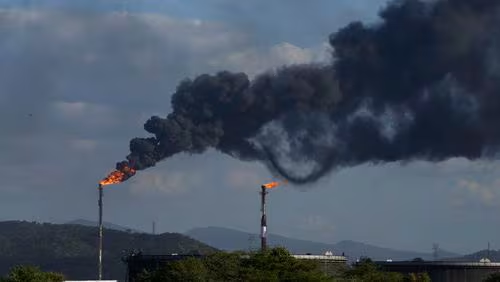
The Venezuelan opposition coalition called this week on the U.S. federal government to withdraw oil operation licenses issued to American companies for projects in Venezuela as a means of turning up the heat on the Maduro government further.
“We want them canceled … this is a lifeline to the regime,” Rafael de la Cruz, adviser to Edmundo Gonzalez Urrutia, the candidate who ran against Maduro in the July elections, said, as quoted by the AP. “We want all the oil companies to go to Venezuela. So, it’s not about the companies. It’s about the situation that is impoverishing the country so badly that practically the whole population wants this regime gone,” de la Cruz also said, speaking at an event organized by the Council of the Americas, a New York-based business entity, per the AP. U.S. sanctions against Venezuela’s oil industry effectively ban American companies from operating there without a special exemption license. The biggest energy major to get such a license was Chevron, back in 2022 when anti-Russian sanctions threatened global oil supply. Then, in October 2023, the U.S. introduced a temporary sanctions relief until April 2024 that allowed the production, lifting, sale, and exportation of oil or gas from Venezuela, and the provision of related goods and services, as well as payment of invoices for goods or services related to oil or gas sector operations in Venezuela. The period of the relief ended in mid-April and the sanctions snapped back in the absence of much progress in bilateral talks on fair elections. According to de la Cruz, the participation of American companies in the development of Venezuelan crude oil reserves under the Maduro government legitimizes said government. Their presence in the country, he argued, helped “normalize … de facto dictatorship that he is trying to set up in Venezuela.” Source: Oilprice.com