


Ghana: Zambian Energy Board Understudies NPA’s Operations

A seven-member delegation from the Energy Regulatory Board of Zambia has paid a three-day working visit to Ghana’s downstream petroleum regulator, National Petroleum Authority (NPA) to understudy the Authority’s operations in the regulation of the petroleum downstream industry.
The team came to have a better insight into the Unified Price Petroleum Fund (UPPF), fuel marking, and electronic cargo tracking, amongst others, from 18th to 20th September 2024.
In her remarks at a meeting with the Zambian team, a Deputy Chief Executive of NPA, Mrs Linda Boamah Asante, who stood in the stead of the Chief Executive, Dr Mustapha Abdul-Hamid, expressed profound appreciation to the Zambian Energy Board for their continuous engagement with the NPA.
She called for more such learning collaborations and stressed that the doors of the NPA are always open and ready to assist its neighbours in such corporate learning.
For her part, the Director of Corporate Affairs, Mrs Maria Edith Oquaye, welcomed the delegation and assured the members of NPA’s readiness to share experiences with member countries for the good of the continent.
She said the collaboration between countries was critical now, especially for the NPA as a regulator of the energy industry, and indicated that Ghana now exports petroleum products to neighbouring countries like Mali, Niger, Burkina Faso, Cote d’ Ivoire and Togo all within the sub-region.
She assured the delegation of NPA’s readiness to take them through its operations, including visits to system areas in Accra and Tema “to gain insight into what we do.”
The seven-member delegation was taken through a detailed presentation on the UPPF.
The Coordinator of the UPPF, Mr Jacob Amuah, underscored the important role the UPPF plays in the petroleum downstream industry in Ghana.
He said fuel prices directly affect nearly every sector of the economy from food prices to transportation and manufacturing.
Mr Amuah said fluctuations in fuel costs could cause widespread economic disruptions. “By maintaining uniform prices across the country, the UPPF has curtailed regional disparities, stabilised inflation and encouraged economic growth,”
He said the UPPF is a crucial mechanism in the petroleum industry of many nations, aimed at stabilising fuel prices across different regions.
Mr Amuah stressed that the UPPF is essentially a fund set up by the government or a regulatory body to ensure uniformity in fuel prices across various parts of the country.
Given that the cost of transporting petroleum products to different regions in Ghana can vary significantly due to factors like distance and infrastructure, the UPPF acts as a balancing tool.
It helps to ensure that consumers in remote or underdeveloped areas do not pay significantly more for fuel than those in urban centres.
Citing the northern part of Ghana as an example, Mr Amuah noted that for the implementation of the UPPF, consumers in the north would have paid more for the petroleum products than those in the south due to longer distances from the refinery.
However, he said the fund compensates the difference, allowing the price at the pump to remain the same as in more accessible areas.
The team, as part of their learning, was taken to the Bulk Oil Storage and Transportation (BOST) Tema depot, an oil marketing company, and a fully automated retail outlet to have hands-on experience in their operations.
The leader of the delegation of the delegation, Mr Ezra Siamasumo, thanked the NPA for accepting the request to understudy Ghana’s downstream industry and their readiness to replicate the UPPF in Zambia.
He affirmed the commitment of Zambia’s Energy Board to continue its collaboration in the petroleum sector with Ghana.
Source: https://energynewsafrica.com
Ghana: Trafigura Threatens To Seize Ghana’s Assets In South Africa

Singapore-based commodity trading company, Trafigura, has threatened to seize Ghana’s assets in the Republic of South Africa if the West African nation continues to delay in paying a US$134 million judgment awarded against Ghana for terminating a power purchase agreement with the company about four years ago.
As a result, the company has taken control over one of Ghana’s key commercial properties, Regina House, in London.
In a letter addressed to Ghana’s Finance Minister Dr Mohammed Amin dated September 23, 2024, which was leaked on social media, Trafigura expressed frustration over the government’s failure to settle the debt.
“Further to our letter on September 20, 2024, to which we have not yet received a response, we can confirm that we have today filled the relevant papers to commence the enforcement of the arbitral award in South Africa.
“In addition to the 16 banks based in United States that GPGC has subpoenad (as evidence in the attached at Annex 2), we plan to issue further subpoenas to US corporations with ties to the Government of Ghana, this week with further action to follow.
“We would nevertheless like to reiterate the message of our previous correspondence, that we would prefer not to take any further enforcement action and instead to resolve the matter amicably by fully executing the settlement agreement, as soon as possible, ideally within this week, and receiving payment in accordance with the agreed schedule,” Patrick Burke, Managing Director of GPGC wrote to Dr. Mohammed Amin, Ghana’s Finance Minister.
However, this letter has not enthused the Government of Ghana, with the Finance Ministry expressing surprise at the release of the letter on social media.
In a release issued on Tuesday, the Finance Ministry wrote: “It has come to our attention that a letter received today, 24th September 2024, about our engagement with Trafigura is circulating in the media, creating the impression of the government’s inaction on a yet-to-be executed Settlement Agreement.
As it may have been noticed, the said letter references ongoing engagement on pathways towards settling the claims.”
“We have made the necessary arrangements to pay off the outstanding claims agreed with Trafigura after several rounds of negotiations. We are, therefore, surprised at the circulation of this letter on social media.
“The Government of Ghana remains committed to honouring its obligation under the Settlement Agreement with Trafigura with a view to bringing this matter to closure,” the Ministry of Finance said.
Background
The debt dates back to January 26, 2021, when a UK tribunal ruled that Ghana breached its contractual obligations by terminating a power purchase agreement with GPGC, a subsidiary of Trafigura in 2018.
The tribunal awarded GPGC $134 million in damages, including interest and reimbursement of arbitration fees.
In January 2024, GPGC filed a case in the U.S. District Court, seeking to recover the remaining debt under the New York Convention.
Ghana was served with the petition but failed to respond by the deadline.
The court, citing Ghana’s waiver of sovereign immunity and commitment to international arbitration, ruled in favour of GPGC.
The court decision added post-judgment interest to the financial burden on Ghana, further complicating the country’s efforts to resolve the debt.
Source: https://energynewsafrica.com
Trafigura Names Richard Holtum As New CEO
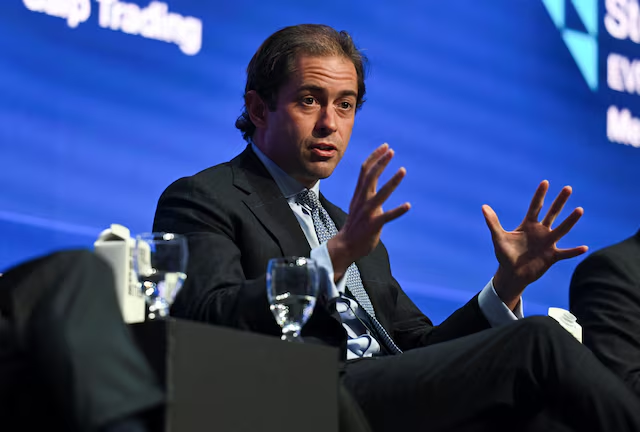
Richard Holtum will take over as chief executive of global trading house Trafigura from Jan. 1 next year, the company said on Tuesday.
Holtum will take over the helm at a time when trading firms are set to see reduced profits following windfall years after the COVID-19 pandemic, while sharp equity growth in recent years will also mean hefty expenses in paying out departing shareholders.
Holtum becomes the group’s third ever CEO after around 10 years at the company. He joined Trafigura in 2014 on the firm’s Liquefied Natural Gas (LNG) team, rising to global head of gas and power in 2022 and adding renewables to his portfolio in 2023.
His rise at the company coincides with a booming gas market, with prices spiking on the back of Russia’s invasion of Ukraine, which helped to generate billions of dollars worth of profit for trading houses and helped gas and LNG desk profit rise to unprecedented levels.
Prior to joining Trafigura, Holtum worked on rival trader Glencore’s crude oil desk. He began his career in the British army.
Outgoing CEO Jeremy Weir, who held the position for over 10 years, will take up the role of group chairman on Jan 1.
Reuters exclusively reported in April that Weir had begun priming Holtum to take the helm.
“The Board of Directors unanimously selected Richard Holtum to lead the Trafigura Group,” independent non-executive director Sipko Schat said.
The announcement is the second organisational reshuffle in Trafigura in quick succession. A little over a week ago the firm said it would create a fourth pillar for its business, operational assets, to be headed by Jiri Zrust.
Holtum’s former role as global head of gas, power and renewables will pass to current head of power trading, Igor Marin.
PROFIT IN FOCUS
Holtum will take over Trafigura at a time profits for trading houses are set to weaken following two years of jumbo earnings due to energy prices spikes and volatility following Russia’s invasion of Ukraine.
Trafigura’s net profit for the first half of its financial year fell by more than 74% this year, the lowest since 2020 for the same period, after posting record or near-record results every year over 2020-2023.
The drop in profit in the first half of this year came despite a 15% rise in traded oil volumes compared with the same period of 2023.
Record profit in recent years allowed Trafigura to grow equity almost 2.5 times to $16.5 billion in the last 4 years.
The company will therefore have to spend billions on buying out departing shareholders in the next few years.
Former CFO Christophe Salmon, executive director Jose Maria Larocca, and COO Mike Wainwright announced their intention to retire this year.
Source: Reuters.com
IEA Says Massive Investments Are Needed To Hit Global Renewable Energy Target

The global goal to triple renewable energy capacity by the end of the decade is still within reach, but massive investments in power grids and energy storage will be needed, the International Energy Agency (IEA) said in a new report on Tuesday.
At the COP28 climate summit in Dubai at the end of 2023, nearly 200 countries made a collective pledge to triple global renewable capacity by 2030, aiming to keep within reach the Paris Agreement target of limiting global warming to 1.5 degrees Celsius. They also committed to doubling the rate of energy efficiency improvement by 2030.
However, in order to reach these goals, all countries need to accelerate the work and deployment of renewables and energy efficiency policies.
“The goal of doubling the rate of energy efficiency improvements globally could provide larger emissions reductions by 2030 than anything else, but it looks far out of reach under today’s policy settings,” the IEA noted in the report.
The tripling of renewables capacity will need faster expansion because with today’s policy settings and technology trends, the world is on track to achieve more than three-quarters of the growth needed for the goal, says the agency advocating for a rapid energy transition.
Moreover, countries would need to make huge investments in expanding and strengthening the grids and building energy storage to accommodate the surge in renewables.
“Without grids and storage, the tripling of renewables will not succeed,” said the agency, adding that more than 25 million kilometers of electricity grids will need to be built or upgraded by 2030, and global energy storage capacity needs to grow to 1,500 GW by 2030. Of this, 1,200 GW needs to be battery storage – a nearly 15-fold increase compared to current levels.
Even if the goals are reached, “greater capacity does not automatically mean that more renewable electricity will clean up the world’s power systems, lower costs for consumers and slash fossil fuel use,” the IEA said.
Progress in renewable energy uptake in the largest energy-consuming sectors slowed globally in 2023, amid high interest rates, supply-chain issues, and regulatory and policy uncertainties in the wake of the energy crisis, renewable energy think tank REN21 said in a report in May.
Source: Oilprice.com
TotalEnergies Eyes Potential Petrobras Partnership Opportunities In Namibia, Suriname, Angola

TotalEnergies is interested in partnering with Petrobras on projects outside of Brazil as the French supermajor expands in Latin America’s most populous nation, Chief Executive Officer Patrick Pouyanne said Monday.
Namibia, Suriname and Angola were among the areas Pouyanne mentioned as potential cooperation zones. In Brazil, the offshore Mero project in the so-called pre-salt region, where Total has a partnership with Petrobras, is growing fast, he said.
Total executives used a $50-to-$60-a-barrel benchmark to test the viability of oil projects when presenting them for board approval, and is “very close” to approving a 220,000 bpd project in Suriname, he said at a conference in Rio de Janeiro.
Total’s interest in partnering with Petrobras abroad highlights a rebound in interest in high-risk, offshore exploration at a time when the energy transition appears to be taking longer than what was expected a few years ago.
“Petrobras is ready to explore abroad and in the Atlantic basin, so I keep that in mind,” Pouyanne said. “And if we have opportunities, as we’re exploring in different countries, we could offer to Petrobras to participate.”
Aside from offshore oil, Total also has large investments in wind energy in Brazil and sees more potential in onshore wind than offshore, which Pouyanne said could wait a few years.
Source: World Oil
Nigeria: NNPC Ltd Moves To Revive Brass, OK LNG Projects

Nigeria’s national oil company, NNPC Ltd, has begun discussions with investors towards bringing back two Liquefied Natural Gas (LNG) projects, Brass and Olokola LNG projects.
NNPC Ltd’s Chief Financial Officer (CFO), Mr. Umar Ajiya disclosed this on the sidelines of the ongoing 2024 Gas Technology Conference and Exhibition (Gastech), in Houston, United States, last Thursday.
Brass LNG and OK LNG are two LNG projects with the potential of manifold economic benefits for the country which include job creation, power generation, revenue generation and economic diversification.
The multi-billion dollar projects were however stalled due to unfavourable market dynamics and slow decision-making by the political class in the past.
“In the past, gas prices went down, the economics of the projects meant a high Capital Expenditure (CAPEX) and this was a dis-incentive for investors and partners. Also, there was slow decision-making by the political class,”’ the CFO added.
While describing NNPC Ltd as a commercially driven Company which recognises timely project development and execution, the CFO said there are abundant gas resources in many parts of the world and therefore, the earlier Nigeria makes smart decisions to bring partners to the table, the better.
Ajiya commended President Bola Ahmed Tinubu for his support in driving new projects in the Industry through the Presidential Executive Orders on Oil & Gas Reforms.
“We are also happy to have the Petroleum Industry Act (PIA) has provided fiscal incentives for investors and is creating the enabling environment that has rekindled hope in the energy sector.”
Ajiya described Gastech as an avenue for NNPC Ltd to learn new technologies which will help the Company decarbonise its operations and promote its abundant LNG resources to the global market.
Gastech is the world’s leading forum dedicated to delivering a more sustainable energy future by bringing together experts who brainstorm to create pathways towards global energy security for lasting climate impact.
Source: https://energynewsafrica.com
Nigeria: NNPC Made Big Mistake By Lowering Its Stake To 7.2% – Dangote

The Chairman of the Dangote Group, Aliko Dangote, has revealed that the Nigerian National Petroleum Corporation Limited made a significant mistake by reducing its stake in the Dangote Refinery.
In a recent interview with Bloomberg, Dangote revealed that the NNPC was originally meant to take a 20% stake in the refinery, but that has now been reduced to 7.2%, a report by Punch said.
According to Dangote, the NNPC had originally agreed to a deal worth $2.79 billion, which included an upfront payment of $1 billion.
However, after renegotiating the terms, the corporation decided to reduce its equity share.
“They’ve made a big mistake, but that’s where we are now,” Dangote remarked, emphasising that the agreement is now finalised, with Dangote Group holding the majority of the refinery’s shares.
He said, “We agreed with them and we gave them a good deal. Well, we structured an agreement. The first agreement was that they would pay us $1 billion as part of a deal worth about $2.79 billion.
They paid that $1 billion roughly a year and a half ago. The balance of the payment was to be split into two portions:
“The first portion is every time they supplied us with crude (around 300,000 barrels), we would deduct $2 from the balance until the debt was paid off.
“The other portion would come out of their profits.
“However, the NNPC opted out of this structure. They got confused, or maybe there was some misunderstanding. They no longer wanted the crude deduction arrangement and preferred to pay the remaining balance in cash.”
Dangote further explained that the company later signed a new agreement to replace the previous one.
He added, “In this new agreement, they agreed to pay us the balance of $1.8 billion, but with no interest, and after one year.
“The due date was in June, but in June, they came back to us and said they had changed their minds. They wanted to stick to their 7.2% stake instead of the original 20%. We accepted that and now we own the rest of the shares. They have 7.2%, and we own the remaining balance.
“I think they made a big mistake, but that’s how things are now. There’s no further negotiation—the agreement is done, and finalised. NNPC holds 7.2%, and that’s where we stand.”
Source: https://energynewsafrica.com
IAEA Board Of Governors Elects New Chairperson For 2024-2025

The International Atomic Energy Agency (IAEA) has elected Ambassador Philbert Abaka Johnson as the Chairperson of the IAEA’s Board of Governors for 2024–2025.
His one-year term commences today. He succeeds Ambassador Holger Federico Martinsen of Argentina.
Ambassador Johnson is the Permanent Representative of Ghana to the Agency, the United Nations Offices and other International Organizations in Vienna.
Since his appointment in 2020, he has chaired the 54th Session of the United Nations Commission on International Trade Law (UNCITRAL), Subsidiary Body III of the Tenth Review Conference of the Treaty on the Non-Proliferation of Nuclear Weapons (NPT), the standing open-ended intergovernmental working group on improving the governance and financial situation of the United Nations Office on Drugs and Crime (FINGOV), the Commission on Narcotic Drugs, and the Vienna-based African Group.
He is currently serving as Co-Chair for the preparations of the Ministrial Conference on Nuclear Science, Technology and Application and the Technical Cooperation programme in 2024.
A career diplomat with close to 30 years of experience, Ambassador Johnson’s first diplomatic assignment was in Liberia in 1995.
He has since served in multiple Ghana Missions in Switzerland, the Russian Federation, Belgium, Canada and New York and has held numerous positions in the Ministry of Foreign Affairs and Regional Integration, including as the first Director of the Diaspora Affairs Bureau in 2014.
Before his appointment in Vienna, he was the Director of Africa and Regional Integration Bureau and Head of the Economic Community of West African States (ECOWAS) National Office from 2019 to 2020 and contributed towards Ghana’s bid to host the African Continental Free Trade Area (AfCFTA) Secretariat and the establishment of the ECOWAS Early Warning Centre in Accra.
Ambassador Johnson holds a Bachelor of Arts degree in History and a Diploma in Education from the University of Cape Coast, as well as two master’s degrees: a Master’s of International Affairs from the Legon Centre for International Affairs & Diplomacy in Ghana, and a Master’s of International Law and Economics from the World Trade Institute in Switzerland.
He has participated in various courses on leadership and diplomacy and was the recipient of the Best Ghana Diplomatic Mission Award for 2024.
Source: https://energynewsafrica.com
South Korea: TotalEnergies Will Supply 200,000 Tons Per Year Of LNG To HD Hyundai Chemical Until 2033

TotalEnergies has announced the signing of a Heads of Agreement (HoA) with HD Hyundai Chemical for the delivery of 200,000 tons of LNG per year for 7 years starting from 2027.
“We are pleased with this agreement with HD Hyundai Chemical, which will supply natural gas to one of their industrial sites.
“This agreement allows us to continue securing long-term sales in Asia and reduce our exposure to spot market gas prices,” said Gregory Joffroy, Senior Vice President, LNG at TotalEnergies.
Source: https://energynewsafrica.com
Ghana: Seven Lives Lost As Fuel Tanker Crashes With Bus Near Suhum

Seven people died on the spot on Saturday morning following a collision between a VIP Yutong bus with registration number GR 7632-24 and a fuel tanker with registration number UE 9644-22 near Suhum on the Accra-Kumasi highway.
The accident occurred around 4:30 a.m. after the fuel tanker had a burst tyre and reportedly veered into the lane of the VIP bus.
According to a report by the Eastern Regional branch of the Ghana National Fire Service (GNFS), a 31-year-old Emmanuel Assibey was in charge of a Daf Tanker vehicle loaded with diesel from Accra and heading towards the Kumasi direction of the road.
On reaching a section of the road between Obretema and Omenako, near Suhum on the Accra-Kumasi highway, the tanker veered off from its lane, crossed the median of the road and crashed into the driver side of a Yutong bus with registration number GR 7632-24 with 32 passengers on board from Tamale to Accra.
“The passengers on board both vehicles were trapped,” a report from the GNFS said.
The GNFS at Suhum assisted in removing the victims, who sustained various degrees of injury. They were then rushed to the Suhum Government Hospital for treatment.
According to the GNFS, the tanker driver, his mate, the Yutong driver, two females and two male passengers on board the bus were pronounced dead on arrival.
 The Regional Police Commander led a team of officers to the Suhum Government Hospital and the doctor on duty confirmed that 27 passengers are currently on admission at the hospital receiving treatment whilst two of the victims whose conditions were critical were being prepared to be referred to the regional hospital in Koforidua for further treatment.
The bodies of the seven deceased persons have been deposited at the Suhum hospital mortuary for preservation, identification and autopsy.
Source: https://energynewsafrica.com
The Regional Police Commander led a team of officers to the Suhum Government Hospital and the doctor on duty confirmed that 27 passengers are currently on admission at the hospital receiving treatment whilst two of the victims whose conditions were critical were being prepared to be referred to the regional hospital in Koforidua for further treatment.
The bodies of the seven deceased persons have been deposited at the Suhum hospital mortuary for preservation, identification and autopsy.
Source: https://energynewsafrica.com
The Regional Police Commander led a team of officers to the Suhum Government Hospital and the doctor on duty confirmed that 27 passengers are currently on admission at the hospital receiving treatment whilst two of the victims whose conditions were critical were being prepared to be referred to the regional hospital in Koforidua for further treatment.
The bodies of the seven deceased persons have been deposited at the Suhum hospital mortuary for preservation, identification and autopsy.
Source: https://energynewsafrica.com Nigeria: Maiduguri Flood Victims Receive ₦100M Support From Mainstream Energy Solutions Limited

Mainstream Energy Solutions Limited, the operator of the Kainji, Jebba and Zungeru hydropower plants in the Federal Republic of Nigeria, has donated the sum of ₦100 million to support the victims of the recent flood disaster in Maiduguri, Borno State.
Leading the delegation to the government house in Maiduguri, the Managing Director of Mainstream Energy Services Limited, Engr. Lamu Audu, and the Executive Director for Corporate Services, Usman Muhammad Umar, presented the cheque to the Executive Governor of Borno State, Professor Babagana Zulum, in the presence of other executives of the Company.
Engr. Lamu expressed the deepest sympathies of the Chairman and Board of Mainstream on the tragic loss of lives, property and the displacement of people.
He stated: “We are acutely aware of the magnitude of this disaster and share in the grief of the people of Maiduguri. We stand with them during this challenging time”.
Engr. Lamu further stated, “This heartbreaking event has caused immense pain and hardship, and we are acutely aware of the destruction this deluge has caused. Please accept our heartfelt sympathies and the token of 100 million naira only. Our prayers are with the people of Maiduguri at this time and we are all in it together”.
On his part, the Governor expressed his sincere appreciation for the sympathies shown to his people and bemoaned the devastating impact of the flood and how it has disrupted the socio-economic activities of the state.
He stated that the donated amount will go a long way in complementing the relief efforts of the state government and assured that every single amount will be spent on the affected people.
As the operator of Kainji, Jebba, and Zungeru Hydropower Plants, Mainstream Energy Solutions Limited has consistently demonstrated its commitment to supporting Nigerian communities especially those around the River Niger. This donation is a testament to the corporate social responsibility of the company and its willingness to partner with the government in this time of need.
Source: https://energynewsafrica.com
Rosatom Speaks On Safety Of Nuclear Plants And Breakthroughs In Austria

The Director General of Russia’s state atomic corporation (Rosatom), Mr Alexey Likhachev, has held a meeting with the Director-General of the International Atomic Energy Agency (IAEA), Mr. Rafael Grossi, on the sidelines of the 68th Regular Session of the IAEA General Conference in Vienna, Austria.
During the meeting, Alexey Likhachev and Rafael Grossi briefly reviewed the main issues of current and prospective co-operation between Russia and the IAEA, as well as industry-specific international events for the coming months.
In particular, events related to the topics of closing nuclear fuel cycle and small modular reactors, which the Rosatom Director General highlighted in detail in his speech at the General Conference, were touched on.
Speaking during a press conference, Alexey Likhachev highlighted the importance of creating the next fourth generation of nuclear power.
“We understand this as a comprehensive solution, including, of course, fast neutron reactors, appropriate fuel refabrication facilities that allow to recycle spent nuclear fuel between reactors of different types multiple times. This is, of course, work with spent nuclear fuel.
“All this allows us to talk about a completely new quality of nuclear power of the next generation.
“The Proryv (‘Breakthrough’) project that we are implementing in the Tomsk region in the city of Seversk is a real confirmation of how it is possible to return to the natural original principles of safety of nuclear facilities, make them very attractive from the point of view of ecology and economy, and actually expand the resource base of already explored fields to infinity and repeatedly use fuel that has already been extracted and undergone initial processing,” Alexey Likhachev noted.
The main focus, as in all recent negotiations, was on ensuring safety of nuclear facilities. Both sides consider this task as an absolute priority.
Alexey Likhachev and Rafael Grossi synchronised watches on the situation around the Zaporozhskaya NPP and the Kursk NPP.
It was confirmed that, despite the known accents in the positions of the parties, Russia and the IAEA Secretariat work on these issues in parallel modes.
Joint work in the context of maintaining the IAEA permanent presence at the ZNPP site will be continued.
Source: https://energynewsafrica.com
South Africa: Former Eskom Contractor Extradited From UK To South Africa On fraud Charges

A British businessman, who was a former contractor for South Africa’s ailing power utility Eskom, has been extradited from the UK to face charges of corruption and fraud.
Michael Lomas is accused of taking kickbacks on contracts between his firm, Tubular Construction, and Eskom for work at the Kusile power station, which were worth in excess of 1.5bn rand ($85m: £64m).
“He allegedly manipulated contracts. He was previously arrested, got bail and fled the country to the UK,” national police spokesperson Brigadier Athlenda Mathe told AFP.
He has not yet commented on the allegations against him.
Eskom has been beset with corruption allegations and is struggling to recover from years of mismanagement that has led to prolonged blackouts in the country.
Mr Lomas landed at OR Tambo Airport in Johannesburg early on Friday morning. He was in a wheelchair and under heavy police escort.
Ms Mathe told local news website News24 that one of the conditions of the extradition was to have a medical doctor on the plane because of Mr Lomas’s poor health.
He is set to be formally charged at Kempton Park Magistrate’s Court later on Friday.
The National Prosecuting Authority (NPA) requested Mr Lomas’s extradition in 2022, but it was delayed while he lodged an appeal, which was ultimately rejected.
He was accused alongside four other alleged co-conspirators – two senior executives at Eskom and two other businessmen. They were arrested in 2019.
The other four men have been charged with fraud, money laundering and corruption for allegedly taking kickbacks and inflating the cost of the work carried out at Kusile power station.
This was meant to help alleviate South Africa’s crippling electricity shortages but the project has been beset by delays and faults, according to AFP.
Mr Mathe said Mr Lomas was a “wanted fugitive” who would be handed over to the Hawks, the police unit that investigates economic crime, corruption and organised crime.
Hawks has been working on this case since 2017, when an employee placed a complaint about one of the tenders.
Source: BBC
Egypt: Govt Announces End To Year-Long Load Shedding Programme
Egypt has ended a year-long load shedding programme which started way back in July 2023, this portal can confirm.
The one-year load shedding affected businesses and households, with some finding alternative means to keep their businesses running.
Electricity consumption in Egypt saw an unprecedented rise due to the consequent heatwaves across the country.
In July, this year, daily consumption rate exceeded 37.5 gigawatts, up by more than 12 per cent compared to the previous year.
However, addressing a press conference on Thursday, Egyptian Prime Minister Mostafa Madbouly told the nation that power outages would not reoccur as the necessary shipments had been secured to ensure uninterrupted supply.
Madbouly said government had allocated LE 7 billion to the Ministry of Electricity to ensure the implementation of energy projects.
He mentioned the prosecution of around 513,771 electricity theft cases, saying: “If half of these thefts did not exist, there would be no [electricity supply] problems again.”
Madbouly said Egypt would be able to restore normal gas production rate from the Zohr field as before the global economic crisis before the end of June.
Source: https://energynewsafrica.com