


South Africa: Eskom Outlines Measures For Reliable Power Supply During Winter

Eskom board chairperson, Mthethwa Nyathi, says they have put in place measures to ensure reliable power supply during winter.
“The good thing is that there is nothing really special that we needed to do more than what we have been doing which is to implement the planned maintenance that we have been implementing. If you look at it, now that we are entering winter, we will be reducing the planned maintenance, giving us additional capacity to be able to take care of the additional demand that we will be experiencing during winter.”
Meanwhile, the Minister of Electricity, Dr kgosientsho Ramokgopa expressed confidence that his ministry will no longer be needed by the end of the year.
Speaking at the NinetyOne Annual Infrastructure Forum last month, Ramokgopa said “For as long as I exist, you know that the problem exists. So I’m a personification of the problem if you know what I am saying. We are doing everything possible to address it.”
“I am more than confident that there will not be a need for this ministry by the end of this year.”
During a media briefing earlier this week on an update of the country’s Energy Action Plan, Ramokgopa attributed the current reduced levels of blackouts to Eskom’s increased planned maintenance and good management.
Ramokgopa added that electricity supply is currently higher than demand, saying that planned maintenance allows for the accelerated sourcing of spares.
Source: Sabcnews
ADNOC Considered Buying Oil Giant BP

Abu Dhabi National Oil Company (ADNOC) has recently weighed buying BP, but talks didn’t go far and ultimately the state firm of the United Arab Emirates decided not to pursue a takeover of the UK supermajor, sources with knowledge of the discussions have told Reuters.
ADNOC has recently held preliminary talks with BP and has contacted investment banks for advice on a potential takeover, according to two of Reuters’ sources.
The reported approach by ADNOC comes as the U.S. oil and gas industry is undergoing a major consolidation, with many multi-billion deals announced in America in recent months.
The mergers and acquisitions (M&A) wave hasn’t reached Europe yet, although analysts have said that BP could be a target of a potential takeover by a rival.
BP’s stock suffered early this decade when the company announced its net-zero strategy. In early 2023, investors cheered BP’s reversal of some goals and its commitment to invest more in resilient oil and gas projects than previously planned and pump more hydrocarbons for longer to meet the world’s needs.
BP said in February 2023 it would be producing more oil and gas for longer and increase investment into oil and gas projects by an average of up to $1 billion a year until 2030.
For the European majors, the focus “is to narrow and even close the structural valuation gap to their premium-rated US peers,” Wood Mackenzie’s analysts said in the wake of the Exxon and Chevron announcements of mega all-stock mergers.
In ADNOC’s pursuit of a takeover target, BP was one of the companies the UAE firm has looked at, one of Reuters’ sources said.
There were some direct talks between ADNOC and BP but “It didn’t go far,” the source told Reuters.
BP and ADNOC have been partnering on projects for more than five decades. The most recent collaboration was the creation of a natural gas joint venture in Egypt.
Source: Oilprice.com
Secret Meeting Between Venezuela And The U.S. As Oil Sanctions Loom

U.S. and Venezuelan government officials met secretly this week ahead of the expiry of oil sanction relief next week.
The meeting, in Mexico City, discussed the possibility of reforms in Venezuela, Bloomberg reported citing unnamed sources, with a focus on elections.
The United States granted a six-month oil sanction waiver to Caracas last year after the two sides discussed election reforms that would have given Venezuela’s opposition a chance in the upcoming vote in July.
However, just months later, the Maduro government effectively banned the opposition’s leader, Maria Corina Machado, from running for office, prompting threats from Washington that the sanctions would snap back.
Following the sanction waiver last October, Venezuela had planned to expand its oil production from below 800,000 bpd to over 1 million bpd. The prospects of that happening have dimmed since then as the threat of the return of sanctions hung over PDVSA’s head. Analysts have also forecast a higher risk of domestic fuel shortages if the sanctions snap back on April 18.
The easing of the sanctions helped Venezuela boost its oil export revenues, with expectations for this year at $20 billion, according to Reuters estimates from January, versus a total of $12 billion in oil revenues for last year. If the sanctions are reimposed, however, the outlook will change drastically.
Bloomberg cited one Venezuela-based analyst as estimating the potential losses at $2 billion for this year alone. Another said that the lifting of the sanctions for six months has boosted the country’s oil revenues by an additional $740 million.
The return of sanctions will also affect the U.S. as it would put an end to heavy crude imports from Venezuela. These started flowing to Gulf Coast refineries once again after the sanction suspension entered into effect in October. The suspension expires on April 18.
Source: Oilprice.com
Nigeria: FG To Move All Electricity Consumers To Band ‘A’ In 3 Years — Minister Adelabu

The Minister of Power, Adebayo Adelabu, has disclosed the Federal Government’s plan to convert the entire power sector into a single band from the current six, in the next three years.
Speaking during a weekly briefing organised by the Ministry of Information in Abuja, the minister said the recent electricity tariff hike was the first step in government’s plan to completely remove subsidy payment.
According to Mr Adelabu, the federal government has spent about N2.9 trillion on electricity subsidy, adding that the government was still subsidising 85 per cent of electricity supply in the country despite increase in tariff for Band A customers.
He said the government was not ready to aggravate the sufferings by refusing to adopt 100 per cent withdrawal of subsidy on electricity.
“This tariff review is in conformity with our policy thrust of maintaining a subsidised pricing regime in the short-run or the short-term with a transition plan to achieve a full cost reflective tariff for over a period of, let us say three years.
“It is because of government sensitivity to the pains of our people that will not make us migrate fully into a cost-reflective tariff or to remove subsidy 100 per cent in the power sector like it was done in oil and gas sector.
“We are not ready to aggravate the sufferings any longer which is why we said it must be a journey rather than a destination and the journey starts from now on, that we should do a gradual migration from the subsidy regime to a full cost-reflective regime and we must start with some customers.
“This is more like a pilot (scheme) for us at the Ministry of Power and our agencies. It is like a proof of concept that those that have the infrastructure sufficient enough to deliver stable power, those enjoying 20 hours of light should be the ones to get tariff added,” he pointed out.
Mr Adelabu argued that anybody that goes into any business intends to first recover cost, then if possible, make some profit, explaining that the moment a business cannot cover costs, the sustainability of such business is doubtful and will be run aground.
He observed that if the federal government was to pay the about N3 trillion subsidy for this year, it would be more than 10 per cent of the national budget for 2024.
“The power sector is just a single sector out of so many sectors that government has to attend to. We have works, we have housing, we have education, we have health, we have defence and so on that are all competing for this meagre revenue from the government.
“So it will be very insensitive on our part to force or compel government to continue to subsidise at that rate of almost N3 trillion for the power sector alone.
“We just have to be realistic and considerate. We also must ensure that the regulators are independent and there is consequence management,” he stressed.
With a little above 12 million registered electricity customers nationwide, Mr Adelabu said the recent increase would only affect about 1.5 million customers.
The remaining 10.5 million customers, he said, would continue to enjoy government subsidy at about almost 70 per cent, until it is gradually phased out.
He emphasised that if the DisCos are able to comply with the service level agreement, which is 20 hours for Band ‘A’ at the minimum, it is still far cheaper than the alternative source of diesel and petrol generators.
“You will agree with me that the average cost of generating a kilowatt hour of power today, using diesel and petrol generator is not less than N450 to N500 because of the capital investment of purchasing the generator, the daily operational fuelling of the generator and the intermittent servicing of these generators.
“The cost is not less than N500. So, if we are putting the tariff at N225, I believe it is more than 50 per cent cheaper than running alternative power sources,” Mr Adelabu said.
Source: https://energynewsafrica.com
Kenya Power Electricity Losses Rise Above Allowed Limit

Kenya Power continues to make electricity losses above the limit set by the Energy and Petroleum Regulatory Authority (EPRA).
The increasing system losses arising from illegal connections and inefficient transmission systems are expected to eat into the utility’s revenues.
Kenya Power made system losses of 25% in December last year; in the last 6 months of 2023, these losses averaged at 23.2%, despite the company’s goal to cut the losses to at least 20.93%.
EPRA allows Kenya Power to pass on to consumers 18.5% of these losses; this translates to billions of shillings every year.
“‘In terms of what is specific to transmission, the losses are somewhere between 4.5 to 5%. Then now the balance is distribution and commercial,” said Kenya Power CEO Dr. Eng. Joseph Siror.
System losses emanate from technical and commercial losses. Technical losses are those occasioned by an inefficient or dilapidated distribution infrastructure.
Commercial losses arise from power theft. Kenya Power says it is taking steps to reduce the losses.
“Efficiency of the system is one of the key areas that has been quite a challenge for the business. We’ve actually studied this and seen that quite a bit of this is actually due to the technical dynamics of the system,” said Stephen Vikiru, General Manger of Finance, Kenya Power,
“But we are working to see how we can specifically isolate areas that are high loss generating, and see the interventions that can be put into that to reduce the system losses.”
These losses are occurring at a time when EPRA has increased retail tariffs by about 20% to bolster Kenya Power’s revenue, to facilitate the overhaul of its aging infrastructure.
Source: Citizen
U.S. Power Plant Proposals Surge By 90% As Electricity Demand Rises
Proposals for new power generation capacity in the United States have increased by an impressive 90% over the last three years, as reported, in anticipation of a surge in demand for electricity.
Notably, some 80% of the proposed capacity is solar plus batteries, with only 3% of proposed power plants running on natural gas or coal. The total proposed capacity stands at close to 2,600 GW, according to the data, which comes from the Lawrence Berkeley National Laboratory.
This does not mean, of course, that all of this proposed capacity will end up getting built. In fact, historical data suggests that only a fifth of all proposed projects do get completed. At the same time, demand for electricity in the country is set for a significant increase, driven by data center proliferation and the incorporation of artificial intelligence and more and more software applications.
Reuters reported earlier this week that U.S. power utilities were revising their demand estimates radically from only a few months ago. The report said that nine out of the top power suppliers in the country had raised their capital expenditure plans and demand projections.
“The truth of the matter is these things (data centers) are pigs when it comes to energy use, and now they’re the size of an elephant,” Eric Woodell, founder of software service provider Amerruss, told Reuters.
Woodell then said in a LinkedIn post on the Reuters report that “The gap between power production and demand will continue to grow, leading to shortages (brownouts or blackouts) happening more frequently. These events will test your data center infrastructure, whether you like it or not, whether you own or lease.”
The planned electrification of the transport sector will also help—if it materializes, that is. The EV push has slowed down recently and whether it would pick up again or not is an open question for the time being. Yet the surge in electricity demand from the IT sector may well be enough to prompt more capacity additions than normal.
Source: Oilprice.com
Ghana: Koforidua Court Sentences Electrician For Stealing ECG Cables

A circuit court in Koforidua in the Eastern Region of Ghana has sentenced a 27-year-old electrician, Masaudu Fuseini, to one month in prison for stealing cables belonging to the Electricity Company of Ghana (ECG).
Fuseini, who was arrested on 25th March 2024, was put before court and remanded in prison custody to reappear in court for judgment next Monday, after pleading guilty to the charges.
The court, presided over by Miss Asare Anima, found the suspect guilty and sentenced him accordingly.
The court also convicted him to a fine of 1,000 penalty units amounting to GH¢12,000 or in default serve two (2) years in prison.
Besides, he was ordered by the court to replace the cables which were valued by the police at a cost of GH¢9,000.
The court was informed by the ECG representative that the convict had replaced the cables.
The Prosecutor, Inspector Elorm Arku Klaye, told the court that Fuseini was arrested at Klo-Agogo, a community in the Asesewa District of the Eastern Region, an operational area of ECG, on Monday, 25th March 2024.
Fuseini, a resident of Nkurakan in the Asesewa District, was seen cutting some cables belonging to the ECG in some parts of the town. In the process, he was nabbed by members of a watchdog committee set up by the assembly member for the area.
They informed the police about his activity and while carrying out a second operation, he was arrested.
He led the police to where he kept the stolen cables he cut from the poles and, after investigations, he was sent to court.
Source: https://energynewsafrica.com
Venezuela Arrests Ex-Oil Minister For Corruption
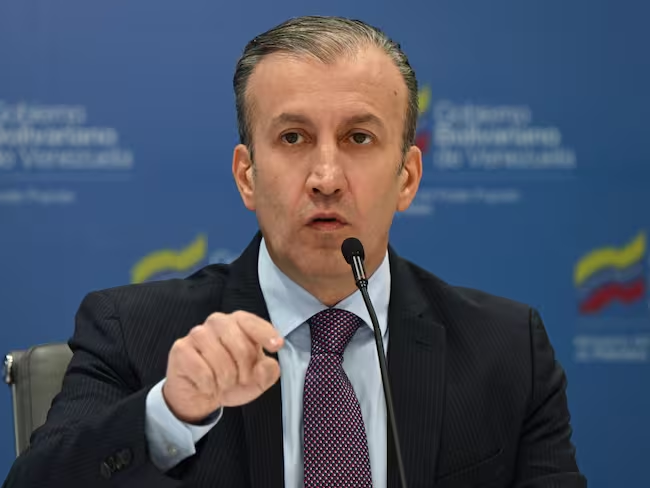
Venezuelan authorities have arrested the country’s former oil minister, Tareck El Aissami on allegations of corruption.
According to information released by the Venezuelan government and cited by the AP, El Aissami was arrested for a scheme that siphoned hundreds of millions of dollars in oil revenue from the state.
The charges brought against the former official include money laundering, treason, and criminal association.
El Aissami was oil minister until March last year when he announced his resignation amid a corruption scandal at state energy company PDVSA.
The scandal concerned the apparent disappearance of as much as $3 billion from oil sales.
It is as a result of the investigation following that scandal that El Aissami was arrested.
The AP cited Venezuela’s Attorney General Tarek William Saab as saying the arrest took a while because of “the various steps” of the investigation that uncovered a mechanism for selling oil through the country’s cryptocurrency control agency in addition to the official channel of PDVSA.
Right now, Venezuela’s government and the state oil company should be bracing up for the return of U.S. sanctions. These could snap back as soon as April 18, when the six-month sanction suspension expires.
The easing of sanctions authorized the production, lifting, sale, and exportation of oil or gas from Venezuela, and the provision of related goods and services, as well as payment of invoices for goods or services related to oil or gas sector operations in Venezuela.
That suspension was based on the commitment of the Venezuelan government to hold fair and free elections but Maduro blocked opposition candidate Maria Corina Machado from running in the elections, which Washington signaled was not what the two sides had agreed.
The suspension of sanctions allowed Chevron to return to Venezuela and helped the country boost its oil production.
A new market was also on the horizon as Europe sought to diversify its oil supplier base.
All this could end before it really began if sanctions return on April 18.
Source: Oilprice.com
South Africa: New Load Shedding Guidelines Do Not Signal Blackout Risk: NERSA

National Energy Regulator of South Africa (Nersa) says approving new guidelines for implementing load shedding did not mean the country was close to a blackout.
This comes after Nersa approved guidelines for implementing rolling blackouts up to stage 16.
The newly released guidelines will allow Eskom to implement drastic rolling blackouts beyond stage 8 or up to 20 hours of power cuts.
Earlier, Eskom said drastic rolling blackouts are not on the cards because the grid is gradually improving.
Vally Padayachee, one of the Nersa members says, “Load shedding is one of the most effective and efficient management tools globally to prevent us from going into a total blackout and a collapse of the grid, that’s in essence the intent of the new edition three. We don’t want to get into a blackout and South Africa has been fortunate to have never had a blackout for the last 100 years of the existence of Eskom. The second point is that when we get to higher stages of load shedding it does not mean that we are closer to a blackout.”
Meanwhile, Eskom says drastic rolling blackouts are not on the cards because the grid is gradually improving. It has sought to allay consumers’ fears that the country is slipping into stage 16 rolling blackouts.
Eskom spokesperson says, “We are now on Day 12 without any load shedding we’ve seen in December. We actually spent 19 days without load shedding. We’ve seen from January up until April that we had fewer stages of load shedding, if you may, and this shows you that our plan which is the generation recovery or operational recovery plan is indeed yielding the desired results. It is just to make sure that in case we have to move to a higher stage, our system operator is basically prepared for.”
Source: Sabcnews
Mexico Set To Slash Oil Exports By Over 300,000 Bpd In May

Mexico is planning to cut the amount of crude oil it exports by 330,000 barrels daily next month as it redirects supply to local refineries.
The volume to be cut represents a third of the total that Mexico sells abroad, Reuters noted in a report, which also said 330,000 bpd is the minimum that will get redirected from overseas market to local refineries.
This month, Pemex slashed oil exports by 436,000 barrels daily as Mexican refineries ramp up, including the new Dos Bocas facility, which will take in some 179,000 bpd this year.
The refinery’s nameplate capacity is 340,000 barrels daily.
The reduction in exports was necessary because Pemex’s output has been on a steady decline due to natural depletion and not enough new discoveries.
In February, the daily average fell to the lowest in 45 years, Reuters said in its report.
Currently, Pemex processes half of its daily crude oil output, which stands at an average of 1.8 million barrels, according to a recent update by Mexico’s President, Andres Manuel Lopez Obrador.
This means the export shrinkage could deepen further. Last year, Pemex exported an average daily of 1.03 million barrels, according to Reuters. This year, the average for the first two months of the year fell to 945,000 barrels daily.
The Mexican energy ministry expects oil processing rates to rise to 1.04 million barrels daily this year, which, based on 2023 export figures suggests Mexico might well have to stop exporting crude as a whole. But this depends on the Dos Bocas refinery ramping up in accordance with government plans, which is not guaranteed.
Right now, the Mexican state firm is also facing a sharp drop in production following a fire on an offshore platform that forced the shutdown of several wells. The amount lost is yet to be determined.
Source: Oilprice.com
Ghana: Ameri Power Plant To Be Back On Grid Next Week To Generate Power After Two Years Of Sitting Idle

Ghana’s power supply which, in recent times, has been erratic and sparked public criticisms of the government, is likely to improve in the coming days as the Volta River Authority (VRA) has finally completed the installation of the Ameri Power Plant at Anwomaso near Kumasi in the Ashanti Region.
The Plant is due for inauguration by President Akufo-Addo on Wednesday, 17th April 2024.
According to sources within the Volta River Authority (VRA), six units which are about 150MW out of the total capacity of 250MW have been installed and technically tested for inauguration by President Akufo-Addo.
The reconnection of the Ameri Power Plant to the national grid is to improve power supply and boost economic activities, especially in the Ashanti Region.
The Ameri Plant was previously located at Aboadze in the Western Region and utilising natural gas produced from Ghana’s Jubilee and Sankofa fields.
However, few years later, the Ministry of Energy, upon the advice of Ghana Grid Company decided to relocate the plant to Anwomaso to stabilise the grid since all the power plants were located in the southern part of Ghana.
The relocation of the Ameri Power Plant to the Ashanti Region is aimed to ensure stability to the national grid and ensure power reliability in the Ashanti Region.
Ameri Power Plant which is on a wheel was procured from the UAE-based Africa & Middle East Resources Investment Group in 2015 by the erstwhile government, when the West African nation was experiencing an erratic power supply due to a shortfall in electricity generation.
The plant cost US$510 million and it was to be managed by its owners for five years and later transferred to the Government of Ghana under the Build Own Operate and Transfer (BOOT) agreement.
The Ameri deal was one of the numbers of power deals which generated public anger, with the then opposition, the New Patriotic Party, now in government, accusing the then administration of ripping the nation.
After negotiations between the current government and the Ameri Group, the latter waived over US$2 million of the cost of the plant.
In 2022, the plant was handed over to Ghana and VRA was assigned to manage the plant.
Source: https://energynewsafrica.com
Shell Considers Leaving London Stock Exchange

Shell’s chief executive has floated the possibility of the petrogiant abandoning its “undervalued” London listing.
Wael Sawan, who runs the largest company on the FTSE 100, said the embattled London exchange was an “undervalued location” as he joined a raft of global CEOs in complaining about the capital’s equity markets.
Shell, he said, was a “fantastic” investment opportunity due to its undervaluation in the interview with Bloomberg.
“I will keep buying back those shares, and buying back those shares at a discount,” he added.
Sawan is set to embark on a so-called ‘sprint’ to improve the firm’s competitiveness and profit-making.
The firm is undervalued compared to peers listed on Wall Street.
“If we work through the sprint, and we are doing what we are doing, and we still don’t see that the gap is closing, we have to look at all options.”
An exit by Shell would be a bruising and almost terminal blow for the London Stock Exchange after a torrid year in which new IPOs have dried up and a string of firms have scrapped their listings for New York.
Just 23 companies listed in London last year, raising around £1bn, the lowest level since just after the financial crisis, according to data from EY.
The move by the British chipmaker Arm to float in New York despite a major charm offensive by ministers and regulators was also seen as a major snub for the City.
The Treasury and regulators have been on the offensive to try and boost the appeal of the London Stock Exchange by overhauling listing rules and directing more capital into the market from retail investors and pension fund.
Source: CityAM
Ghana: GRIDCo Laments Over How ECG’s Non-Compliance To Load Management Instruction Threatened Grid….But ECG Denies Claim

Ghana’s power transmission company and system operator, Ghana Grid Company Limited (GRIDCo), has detailed how the power distribution company responsible for power supply in the southern Ghana, ECG, disregarded its instruction which posed significant risk to the power stability across the country.
According to GRIDCo, the non-compliance to its instruction by ECG compelled it to take feeders out of service to prevent system collapse.
In a letter to Dr Matthew Opoku Prempeh, Energy Minister of the Republic of Ghana, and signed by the CEO of GRIDCo, Ing Ebenezer Kofi Essienyi cited instances where ECG engineers refused to comply with GRIDCo’s load management instructions.
The letter stated that on March 20, 2024, Peak Hours the National System Control Center (SCC) had to take Tafo Feeders out of service due to ECG’s failure to properly implement load management instructions.
GRIDCo said this resulted in a system frequency drop to a critical level of 49.47Hz.
GRIDCo said similar thing happened on March 21, 2024, during Peak Hours when ECG refused to comply with its instructions. This forced the National System Control Centre (SCC) to disconnect feeders in Tema, Winneba, Kasoa and Kumasi.
“This action was taken to prevent system collapse after the frequency dropped to a concerning 49.29Hz,” GRIDCo said..
“When these emergency disconnections occur, ECG publishes customer notices attributing the loss of power supply to GRIDCo, which is not an accurate description of the current situation. Furthermore, ECG’s disregard for load management instructions is a clear violation of the regulations.”
As a result, GRIDCo urged the Minister to intervene to ensure ECG complied with the issuance of a load-shedding timetable.
“We, therefore, bring this to your kind attention, Honourable Minister, and seek your urgent intervention to ensure cooperation from ECG with respect to load management operations,” GRIDCo said.
However, ECG has responded to GRIDCo’s concerns and expressed shock that GRIDCo portrayed it as uncooperative.
ECG in a letter signed by its Managing Director Samuel Dubik Mansubir Mahama and forwarded to the Energy Minister sighted by Myjoyonline, ECG provided detailed statistics on load management requests received from GRIDCo between January and March 2024, demonstrating instances where requests were received shortly before peak or off-peak periods, limiting ECG’s ability to plan and inform customers adequately.
“It is a fact that GRIDCO routinely directs ECG’s System Operators to drop load at some of our Bulk Supply Points (BSPs), but the issue has been the inadequacy between the time these requests are received and the time these requests must be effected to sustain the integrity of the power system and also for ECG to inform its customers.
“It worthy to note that, between January and March 2024, sixty-four (64No.) requests were received from GRIDCo for load management. Out of this, forty (40No.) were for peak periods (18:00 – 24:00 hrs) and twenty-four (24No.) for off-peak (06:00 – 18:00 hrs) load management.
“Out of the forty (40no.) peak load requests, thirty-five (35No.) (88%) of them were received within an hour to the peak period. There were only five (5No) (12%) instances where ECG received the request within 2-3 hours of the peak period.
“Out of the Twenty-Four (24No.) off-peak load requests, three (3No) (13%) of them were received within 30 minutes to the off-peak period while the remaining Twenty-One (21 No.) (87%) instances were received far into the off-peak period,” portion of the letter reads.
Source: https://energynewsafrica.com
Zambia: Zesco Continues Staggered Load-shedding In Parts Of Lusaka

Zambia’s power utility company, Zesco Limited, has entered week two of the staggered eight-hour daily load-shedding for some residential areas in Lusaka, the capital of Zambia.
The company began the staggered load shedding exercise in Lusaka effective April 1.
According to the power distribution company, the affected residential areas will experience two power outages of four hours each, spread throughout the day.
In a statement issued by Matongo Maumbi, spokesperson for Zesco Limited on Monday, April 8, it said the rest of the country, including industrial, commercial and farming areas, remain on the 8-hour straight load shedding since 11 March 2024.
The aim of the load-shedding is to minimise disruption and ensure grid stability due to low generation capacity.
The Southern African nation has an installed generation capacity of 3356.6MW.
This capacity comprises of 83 percent of hydro, nine percent of coal, five percent of heavy fuel oil and three percent solar PV.
The mining sector remains the largest consumer of power at 51 per cent of total generated electricity, followed by the domestic sector at 33 per cent.
Source: https://energynewsafrica.com