


Iran Says U.S. Can No Longer Obstruct Its Oil Production And Exports

Any future U.S. administration cannot prevent Iran from boosting its oil production and exports, Iranian Petroleum Minister Jawad Owji said on Wednesday.
“With the measures that have been taken in President Raisi’s government in the field of the oil industry, I should announce that any government that comes to power in the US cannot prevent the export and production of Iranian oil,” Iranian media quoted Owji as telling Parliament today.
Over the past three years, Iran has increased its crude oil production by 1.4 million barrels per day (bpd), the petroleum minister said.
During this period, Iran launched 150 oil industry projects, worth a total of $34 billion, according to the minister’s remarks from a few days ago carried by the news service Shana.
The oil industry grew by 20% last year, the highest growth rate of any Iranian sector of the economy, Owji was quoted as saying.
Last month, the minister said that Iran would soon launch 32 oil industry projects worth a total investment of $ 4.6 billion.
Iran plans to increase its crude oil output to 4 million bpd, the country’s Tasnim news agency reported at the end of May, as cited by Reuters.
No specific sources for the plan were provided but the original report in Tasnim said that “An economic council headed by Iran’s interim president Mohammad Mokhber has approved a plan to raise the country’s oil output from 3.6 million barrels per day to 4 million barrels per day.”
Iran has been eager to increase its oil production despite U.S. sanctions that have significantly reduced the market for Iranian oil.
Even so, Iran reported an increase in exports of crude recently, with the average daily for the first quarter hitting the highest in six years at 1.56 million bpd according to Vortexa data. Last year, the country exported 1.29 million bpd on average, which was 50% more than a year earlier.
Source: Oilprice.com
Tanzania: UK Development Arm Funds Its First Tanzania Green Energy Project

British International Investment Plc, the UK government’s development-finance arm, is providing its first support for renewable energy in Tanzania.
The firm has agreed to lend an initial $15 million to Meridiam SAS’s Rift Valley Energy to develop 7.6 megawatts of wind and small-scale hydro projects, said Nick O’Donohoe, BII’s chief executive officer.
That amount may rise to $25 million.
“The new installations will provide power to 170,000 consumers, with many of them not having been connected to the grid before,” O’Donohoe said in a report by Energy Connects.
BII’s investment plans come as a host of finance institutions jostle to provide the finance needed to boost access to electricity in Africa, meet climate change challenges and develop infrastructure.
The African Development Bank, the continent’s leading multilateral lender, estimates that the region needs between $130 billion and $170 billion for infrastructure development annually.
Just 37% of Tanzania’s 66 million people have access to electricity, according to BII.
Rift Valley already operates some small hydro power projects and Tanzania’s sole wind farm, Mwenga.
Meridiam acquired the company, which is developing projects that may generate 30 megawatts of power, last year and separately has invested in 100 megawatts of assets in neighboring Kenya.
Source: https://energynewsafrica.com
Rwanda: Gov’t Will Require $1.5bn To Achieve Universal Energy Access By 2029

Rwanda will require about $1.5bn investment in the power sector to achieve universal energy access by 2029 after missing the 2024 target, Rwanda Energy Group (REG) has said.
Access to electricity currently stands at 77.7 per cent, up from 34.4 per cent in 2017 under the National Strategy for Transformation (NST1) which ran from July 1, 2017, to June 30, 2024.
Twenty-five districts out of 30 have an access rate exceeding 70 per cent while the remaining five districts have access rates ranging from 61 to 69 per cent.
The East –Central African nation had targeted to increase energy generation capacity from 208 MW in 2017 to 556 MW by 2024, by developing a mix of hydropower, thermal methane, solar, and other renewable energy projects.
The strategic objective of the project was to build a balanced and cost-optimised generation mix sufficient to meet growing demand.
According to Armand Zingiro, CEO of Rwanda Energy Group (REG), the key factors that contribute to the expansion of electrification are numerous, one of which is developing internal capacity to address gaps, particularly when contractors fail to meet expectations.
“On our journey to universal access, one of the approaches/strategies we took with the support of the government is that we started by extending the national grid in all the provinces, then we went in all districts, and after that, all sectors got electricity, now we are at the village level,” Zingiro explained in a report filed by Newtimes.co.rw.
According to Zingiro, the failure to achieve the universal energy access goal was impeded by funding shortages, procurement challenges, Covid-19-related material supply chain disruptions, as well as other political crises.
Moreover, households residing in dispersed communities and lacking the capacity to maintain off-grid solutions were identified as contributing factors.
Zingiro said there are projects in the pipeline to connect 1.3 million households between 2024 and 2029.
The projects to expand the energy mix through increased use of renewable sources involve the Nyabarongo II Hydropower Project, aiming to produce 43.5 MW of power.
Located at the Nyabarongo River, the Nyabarongo II Multipurpose Dam is currently being built on the Northern and Southern provinces’ border, between Kamonyi and Gakenke Districts.
The dam will measure 59 metres high and 363 metres long, creating a reservoir with a storage capacity of 803,000,000 cubic metres.
Source: https://energynewsafrica.com
Ivory Coast: Gov’t Expects Threefold Oil Output Increase By 2027

The Republic of Ivory Coast is expecting more than threefold increase to its oil output by 2027, boosted by recent oil and gas discoveries at the West African nation’s Baleine and Calao offshore fields, President Alassane Ouattara said on Tuesday.
The world’s top cocoa-producing nation is hoping to become a major regional oil and gas producer and regional energy hub.
Ouattara told a joint session of parliament that more than $15 billion is expected to be invested in the country’s oil sector, adding that output would grow to about 200,000 barrels per day (bpd) from 60,000 bpd by 2027.
“It will be a spectacular leap,” Ouattara said in a report by Marinelink.com.
Italy’s Eni has said it would invest $10 billion in developing the Baleine field, which will take place in three phases from 2023 to 2027.
Certified reserves of the Baleine field, discovered by the Italian energy group in 2021, are estimated at 2.5 billion barrels of oil and 3.3 trillion cubic feet of natural gas.
The group announced its Calao discovery in March, with preliminary assessments indicating potential resources ranging between 1 billion and 1.5 billion barrels of oil.
Ivory Coast’s economic growth is forecast around 7% between 2024 and 2027, President Alassane Ouattara also said, adding that the country is expected to remain the economic powerhouse of the French-speaking West Africa region.
Source: https://energynewsafrica.com
Fire Continues To Burn After Drone Attack On Russian Oil Depot
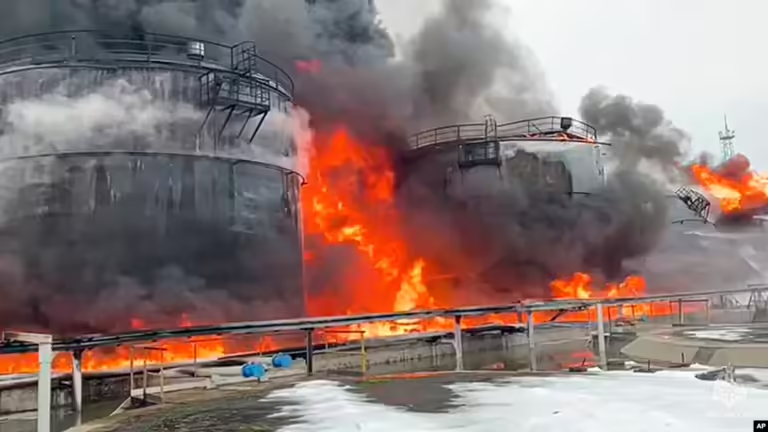
A fire ignited by a drone attack on an oil depot in the southern Russian region of Rostov has gone into its second day with local emergency services still trying to put it out.
According to a Reuters report, the drone attack had been carried out by the Security Service of Ukraine.
Ukrainian attacks on Russian refineries and other energy infrastructure have become a fixture this year, with drones the weapon of choice for conducting the strikes.
The series of strikes has affected Russia’s refining capacity and earlier this year led the U.S. to call on the Ukrainians to stop targeting refineries in order to avoid a fuel price spike ahead of the November elections.
This week’s attack on the oil depot is the second since the start of the month in the region of Rostov. In early June, Ukrainian forces struck an oil refinery in Novosakhatinsk, causing another fire and prompting the suspension of work at the facility.
They also attacked an oil depot in the Belgorod region on the border with Ukraine.
“The Ukrainian Armed Forces, using a kamikaze drone, attacked an oil depot on the territory of the Stary Oskol urban district. As a result of the explosion, one of the tanks caught fire. Four fire crews quickly extinguished the fire.
“The blast wave blew out the windows in the security building. There were no casualties,” the governor of Belgorod said at the time.
The amount of refining capacity affected by Ukrainian drone attacks since the start of the year was estimated at around 600,000 barrels daily in April by Gunvor, the commodity trading major. According to JP Morgan, the amount was much higher, at 900,000 barrels daily.
Repairs are ongoing at many sites but it seems the Ukrainians are not heeding the Biden administration’s advice to stop targeting oil infrastructure.
Source: Oilprice.com
Ghana: Consortium Signs $12 Billion Deal To Develop Petroleum Hub In Western Region

The Petroleum Hub Development Corporation, the agency spearheading the establishment of petroleum hub in the western part of Ghana, has signed a $12 billion agreement with a consortium comprising Touchstone Capital Group Holdings Ltd., UIC Energy Ghana Ltd., China Wuhan Engineering Co. Ltd., and China Construction Third Engineering Bureau Co. Ltd for the development of the first phase of the project.
This project aims at positioning Ghana as the destination for energy trading in the West Africa sub-region.
This agreement is a critical step towards President Akufo-Addo’s vision of Ghana becoming a regional hub for petroleum refining, storage and distribution.
The Petroleum Hub project is expected to accelerate the growth of Ghana’s petroleum downstream sub-sector and make it a major player in the economy, creating jobs, attracting foreign direct investment, and enhancing energy security.
The hub, which is a private sector led, will have three (3) refineries, five (5) petrochemical plants, 10 million cubic metre storage facilities, and two (2) jetties with multiple berths.
The ancillary infrastructure and services include a power plant, rail and road network, Liquefied Natural Gas (LNG) terminals, pipelines, water treatment facilities, repairs & maintenance services, nautical services, waste treatment facilities, logistics, security & emergency response centre, residential & commercial facilities, light to medium industrial area and recreational centres.
Other services and infrastructure, such as a state-of-the-art laboratory for petroleum products, fabrication workshop, metering and calibration services, equipment supplies, logistics services, remote monitoring & diagnostics, lubricant storage & supply, and inspection & certification services, will also be available.
The project is estimated to cost about US$60 billion.
The development of the Petroleum Hub project will be executed in three phases, between 2024 and 2036, with the first phase focusing on developing a 300,000 barrel per day (bpd) refinery, 90,000 bpd petrochemical plant, 3 million m3 storage facility, jetty and port infrastructure.
The project is expected to transform Ghana’s economy and create over 780,000 direct and indirect jobs by 2036.
The signing of the agreement was witnessed by Ghana’s Minister for Energy Dr Matthew Opoku Prempeh and some Members of Parliament in the Western Region.
Commenting, Dr Prempeh emphasised the relevance of the hub to develop Ghana’s potential and revenue drive.
“This hub has been long time coming, and I am excited that today, we can do the signing for work to begin in earnest.
“We are hopeful that all the hard work we put in will yield the results that we desire. We are determined to achieve this goal, and we will continue working to see this materialise,” he said.
He also gave an assurance about adding value to Ghana’s natural resources for the benefit of all.
The Paramount Chief of Western Nzema Traditional Council, Awulea Annor Adjaye III, who doubles as Chair of the Petroleum Hub Development Corporation, charged the corporation to ensure wealth creation for the people of Jomoro and Ghana at large.
“We as leaders hold in trust these natural resources for our people, so every time we have to use them, we must ensure our people are the main beneficiaries of them,” he stressed.
Source: https://energynewsafrica.com
Ghana: Vivo Energy Ghana Launches Safety Day And Pledges Goal Zero

Vivo Energy Ghana, the Shell Licensee, has launched 2024 Safety Day at its head office in Cantonment, Accra, capital of Ghana.
The Safety Day, a cherished tradition of the business, underscores the company’s commitment to Health, Safety, Security, Environment and Quality (HSSEQ) practices while celebrating its safety achievements and milestones.
With a vision of becoming the leading and most respected energy business in Africa, we remain committed to ensuring the safety and security of our employees, partners, customers and communities.
The focus for this year’s Safety Day is on our HSSEQ Management System (MS), an integral part of our commitment to achieving Goal Zero- no harm to people and minimising our impact on the environment.
Speaking at the launch, the Managing Director of Vivo Energy Ghana, Kader Maiga, emphasised the company’s collaboration with regulatory bodies like the National Petroleum Authority (NPA), Ghana Standard Authority (GSA), Environmental Protection Agency (EPA), and the Association of Oil Marketing Companies (AOMC) to ensure compliance with procedures, standards, environmental sustainability, and industry best practices.
“I wish to throw more light on our Goal Zero Days (4,900 days/over 13 years) – the number of days without a recordable incident in our operations as a company. We could only achieve this with the help of our employees, third party contractors, site attendants, customers and regulatory bodies by complying with our safety procedures, standards, and regulations”, he said.
The Special Guest, CEO/Industry coordinator of the Association of Oil Marketing Companies (AOMC), Dr. Riverson Oppong, commended Vivo Energy Ghana for its proactive approach to safety, noting, “It is heartening to see a company that prioritises the well-being of its employees and partners. AOMC is immensely proud to partner with Vivo Energy Ghana and all its members in the relentless pursuit of Goal Zero through collaborative efforts to achieve a future where safety and sustainability are the cornerstones of every operation within the downstream petroleum industry.”
Representing Vivo Energy Ghana Transporters, the CEO of S. O. Frimpong Transport Limited, Randy Frimpong, in his goodwill message applauded the leadership and management of Vivo Energy Ghana for their dedication to a proper way of doing business which is a safer alternative. “We are happy to say that all transporters of Vivo Energy Ghana, through the adaptation of its HSSEQ Management System (MS), are now professional companies and we are also able to share knowledge and best practices to others in the industry,” he said.
Vivo Energy Ghana pledges to integrate safety into every aspect of its operations and commits to staying informed and adhering to safety protocols to safeguard its colleagues, families and communities. Together we will achieve Goal-Zero and set a benchmark for others to follow.
Kenya: Gov’t Proposes Excise Tax On E-Bikes

Kenya has proposed to introduce excise duty on all imported electric motorbikes other than motorcycle ambulances.
This move by William Samoei Ruto’s administration has been viewed as contradictory to the government’s earlier policy on promoting e-mobility.
The proposal is contained in the Finance Bill 2024 which is aimed to amend Part 1 of the first schedule to the Excise Duty Act to remove excise duty on petrol engine motorcycles, according to a report by Kenya Star.
Nine months ago, President William Ruto launched electric bikes in Mombasa in a bid to accelerate e-mobility adoption.
In Kenya, electric motorcycles valued at KSh150,000 are currently not subject to excise duty.
This was one of the incentives put in place by the state to empower the youth by lowering the operational costs in the ‘boda boda’ industry.
The Deloitte 2024 Budget Analysis report deemed the decision by the government counter-effective as this would lower the demand for electric bikes.
“The proposal to remove excise duty on petrol-powered motorcycles may increase the demand for petrol motorcycles and derail the Government’s policy on electric motorcycles,” said the report.
The latest data from the Clean Air Fund report on Nairobi and air pollution shows transport caters for 40 per cent of pollution followed by biomass fuels at 25 per cent.
This further shows the need to find solutions to curb air pollution by automobiles in large cities, especially Nairobi whose population is 4.3 million according to the 2019 census.
Source: https://energynewsafrica.com
Ghana: World Bank Approves $260m Grant For Ghana’s Energy Sector Recovery Programme

The World Bank has approved a $250 million credit from the International Development Association (IDA) and a $10 million grant from the Energy Sector Management Assistance Program for a 4-year Ghana Energy Sector Recovery Program for Results (PforR).
The PforR will support Ghana’s Energy Sector Recovery Programme (ESRP) to improve the financial viability of electricity distribution and increase access to clean cooking solutions.
Electricity distribution losses are high in Ghana due to a low collection rate and below-cost recovery tariffs, undermining the operational and financial performance of energy utilities in the country.
The Government of Ghana transfers about 2 percent of GDP annually to cover the energy sector’s financial shortfall.
“Through this important results-based financing, the World Bank is committed to supporting the recovery of Ghana’s energy sector and its financial sustainability.
“The operation aims to strengthen revenue collection and improve the quality of energy supply, including through investments in prepaid metering and in the commercial and meter management systems of distribution utilities,” said Robert Taliercio, World Bank Country Director for Ghana, Liberia, and Sierra Leone.
“The PforR aims to reduce the cost of electricity service provision by improving the economic dispatch of generation and by strengthening the commercial and operational performance of distribution utilities,” said Dhruva Sahai, Program Leader for Infrastructure.
The Clean Cooking Component of the Program will increase the access of Ghanaian households, schools, and businesses to Liquified Petroleum Gas for domestic and commercial use.
The PforR will provide direct incentives to subsidize the cost of stoves and accessories – excluding cylinders – for first-time domestic users, commercial caterers, and second-cycle schools.
Through these efforts, the Program aims to increase women’s access to clean cooking solutions, reduce time poverty, reduce health risks from smoke exposure from charcoal stoves, and improve women’s income generating opportunities and employability.
Minister for Finance, Dr Mohammed Amin Adam also said, “the Government of Ghana is grateful to the World Bank for their support in the attainment of the Sustainable Development Goals (SDGs), particularly Goal 7 (Affordable and Clean Energy).
“Our quest to achieve financial viability in electricity distribution and increasing access to clean cooking solutions is essential for building sustainable energy systems that support economic development, improve public health, and protect the environment while promoting energy access and equity for all”.
He added “our access to sustainable energy is not just about powering homes and businesses, it’s about empowering communities, protecting the environment, and fostering inclusive and sustainable development”.
Source: https://energynewsafrica.com
Guinea Signs MoU With Russia To Deliver Floating Nuclear Power Plant

The Republic of Guinea has signed a Memorandum of Understanding (MoU) with Russia to cooperate on the development of floating nuclear power to deal with Guinea’s electricity supply challenges.
The MoU was signed on June 7, 2024, during the St. Petersburg International Economic Forum between the Mechanical Engineering Division of Rosatom, the state atomic corporation of Russia, and the Government of Guinea.
The signing was witnessed by Andrey Nikipelov, Deputy Director General for Mechanical Engineering and Industrial Solutions of ROSATOM, and Igor Kotov, Head of Rosatom’s Mechanical Engineering Division.
Under the reached agreements, the parties will explore the implementation of floating power units in the Republic of Guinea and work on the project’s terms and conditions.
The signed memorandum supplements the roadmap of Rosatom’s Mechanical Engineering Division for the production of advanced equipment for the new generation of the nuclear industry and demonstrates the high global interest in our technology.
Commenting, Vladimir Aptekarev, Deputy Head of ROSATOM’s Mechanical Engineering Division, said: “The cooperation involves joint work on developing a power supply solution both to industrial and domestic consumers in the Republic of Guinea, by deploying floating nuclear power units with RITM-200 reactors, which have already proven efficient.
As you know, the power supply issue in the African region is urgent, and our main task is to provide a fast, reliable, and environmentally friendly solution for our partners.”
Source: https://energynewsafrica.com
UK Oil Industry Needs Investment And Political Support To Halt Output Decline

The UK could be producing 30% more oil from the North Sea in 2030 than previously expected if investments worth some $25 billion (20 billion pounds) are deployed for that purpose.
This is according to Offshore Energies UK, formerly Oil and Gas UK, the industry group that earlier today published its Economy and People Report 2024.
In the report, the authority also said that with the right political support investment in what it calls offshore energy could rise to over $25 billion from $16.5 billion in 2023.
The offshore energy that OEUK talked about included oil and gas, hydrogen, carbon capture, and offshore wind power.
“With supportive policy, the industry can deliver enduring economic value, scale up our supply chain capacity, sustain skilled jobs, deliver energy security, all while delivering on our climate goals,” Offshore Energies UK said.
The UK is currently producing some 1.2 million barrels of oil equivalent but this will fall steeply to just 700,000 barrels daily by 2030, according to forecasts by the North Sea Transition Authority—the industry regulator, as cited by Bloomberg.
According to Offshore Energies UK, the decline could be softened to 900,000 bpd if investments keep flowing into the industry, a 30% increase on current estimates.
Yet for that to happen, oil and gas operators in the North Sea need a hand from the government.
They are, however, unlikely to get that hand if the next government is Labour, which appears to be the case per recent polls that predicted “political extinction” for the Conservatives.
There has been little difference on energy transition matters between Labour and Conservatives but the latter have signaled some support for continued oil and gas production, and even new exploration licenses.
Labour, on the other hand, plans to hike taxes for the industry even higher if it wins the vote, and it also promised its voters to cancel new exploration licenses.
In a further blow to the industry, a Labour government would scrap a tac inventive dubbed investment allowance that exempts profits from taxes as long as they are reinvested in production.
Source:Oilprice.com
Zambia: Zesco Restores Electricity Supply To Areas That Suffered Power Cut

Zambia’s power utility company, Zesco Limited, has restored power supply to parts of the country that experienced supply interruptions caused by the South African Power Pool (SAPP) interconnected network
Parts of Zambia experienced a power cut at about 17:05 hours on Monday.
The corporation, in a statement, assured its customers that it was doing its best to rectify the problem and restore power supply to all affected areas.
In the latest update on the situation, the power utility notified Zambians that power supply had been restored to Northern, Muchinga, Luapula, Eastern and Central provinces at 19:17 hours.
“ZESCO expressed regret about the inconvenience caused by the unplanned power supply interruption,” the statement ended.
Source: https://energynewsafrica.com
Nigeria: NNPC Limited Pushes For Specialised Court To Stem Crude Oil Theft, Pipeline Vandalism

Nigeria’s national oil company, NNPC Limited, is pushing for the establishment of a specialised court to deal with persons who would be caught involved in crude oil theft and vandalism of crude oil pipelines.
The company’s Group Chief Executive Officer, Mr Mele Kyari, believes that it is about time the country’s judiciary
supported in tackling the twin challenges of crude oil theft and pipeline vandalism.
Kyari made the call in a speech read for him at the National Judges’ Capacity Building Workshop on the Petroleum Industry Act (PIA) 2021, in Abuja, last week, stating that the gains of the PIA have been severely undermined by crude oil theft and pipeline vandalism.
In light of this, he urged the judiciary to consider the creation of a special court to try offences related to crude oil theft and pipeline vandalism or granting accelerated hearings to such cases.
According to him, the role of the judiciary was critical to the success of the efforts of the various security arrangements put in place by the NNPC, law enforcement agencies and other stakeholders in the industry.
“In particular, is the recommendation that a special court be created to try those offences as they hinge on our survival as a country and/or for such trials to be conducted under an accelerated hearing process by the issuance of Practice Directions to that effect, with concomitant sanctions to deter would-be offenders,” Kyari stated.
The GCEO also called on the judiciary to accelerate hearings on criminal cases in their courts, through timely determination of the criminal charges and imposing adequate punishments and sanctions on culprits to serve as deterrence to others.
He said that NNPC remains committed to collaborating with all relevant stakeholders to ensure the successful implementation of the PIA, adding that “together, we can ensure that the benefits of our natural resources are maximised for the economic and social development of our country.”
Kyari also commended the Chief Justice of the Federation, Olukayode Ariwoola, and the organisers of the workshop for extending the invitation to him and the opportunity to deliver a goodwill message at the workshop.
Source:https://energynewsafrica.com
Ghana: Tamale Court Jails Man Six Months For Power Theft

A Tamale District Court has sentenced a man to a six-month jail term for illegally connecting power and consuming it freely from the Northern Electricity Distribution Company (NEDCo).
The convict, Wahab Shiraz, will also pay a fine of 500 penalty units, equivalent to GH¢6,000 to the state.
The convict who is a resident of Bulpella, a suburb of Tamale, is also expected to pay GH¢10,096.55 to the Northern Electricity Distribution Company (NEDCo), an estimated value of the electricity he had stolen.
The court presided over by Justice Derrick Annan, stated that should Shiraz fail to pay the amount owed to the state, he would face an additional seven months in prison.
Wahab Shiraz pleaded guilty to the charge of interference with the “electricity distribution system” under Rule 41 (2A) and 1 (6) of the Electricity Supply and Distribution Rules 2005 (L.I.1816).
His illegal activities were uncovered during NEDCo’s Mass Revenue Mobilisation Exercise in December 2023.
After receiving an illegal connection notice and failing to report for investigation, Shiraz’s case was referred to the Tamale police, leading to his prosecution and conviction.
Following the sentencing, NEDCo’s legal representative, Ms Esther Yirbom, urged the public to avoid illegal power connections and instead, take advantage of NEDCo’s resolution options.
She highlighted that suspects who cooperate by paying for stolen power and signing a bond of good behaviour might face reduced penalties if their cases go to court.
Ms Yirbom emphasised that while these measures do not absolve the offence, they could mitigate the severity of punishment.
Source: https://energynewsafrica.com