


Ghana: GOIL Maintains Dividends To Shareholders Despite Challenging Year

GOIL PLC, a leading indigenous oil company in the Republic of Ghana has maintained its dividend to shareholders despite a challenging year.
This was announced at the company’s 55th Annual General Meeting of shareholders held in Accra.
The meeting which was also attended by other stakeholders declared a dividend of GH¢0.056 per share, amounting to GH¢21,944,335.00 for the year ending 31st December.
The Board Chairman of the company, Mr Reginald Daniel Laryea, told shareholders that despite a tough operating environment, GOIL PLC achieved a modest profit of GH¢54.7 million profit.
He explained that the adoption of sound financial, operating and marketing strategies enabled the company to achieve modest consolidated profit in the face of difficulties it faced in 2023.
This includes high operational costs, elevated inflationary pressures and higher utility costs.
This was in addition to industry-wide product quality issues which have been successfully resolved.
GOIL, he said, would continue to showcase its resilience in its ability to generate returns for shareholders as a demonstration of keeping faith with them even in times of difficulties.
He expressed appreciation for the steadfast support and confidence shareholders of GOIL have in the company, saying, “Your shareholding is highly valued and cherished, thus, the decision to maintain the dividend payment. This reflects our commitment to shareholder value and our optimism for the future of your company.”
On assets, Mr Laryea noted that even though the consolidated total assets decreased from GH¢4.6 billion in 2022 to GH¢4.0 billion in 2023, the consolidated non-current assets including property, plant and equipment grew from GH¢1.4 billion in 2022 to GH¢1.6 billion in 2023, representing a 14.58 per cent increase. This highlights the company’s continued investment in key assets to support future growth and sustainability, he asserted.
GOIL, he noted, has also identified a strategic partner with whom it has signed a Farmout Agreement after conducting mutual due diligence.
The signing of a new farm-out agreement followed the pull-out and exit of ExxonMobil from the Deepwater Cape Three Points (DWCTP) block Petroleum Agreement (PA).
On the future outlook for the business, the Group CEO/MD of GOIL Plc, Hon. Kwame Osei Prempeh, announced that the GOIL Bitumen plant is now fully operational and would officially be inaugurated soon.
Additionally, the two LPG Cylinder Recirculation Plants in Tema and Kumasi are expected to be completed in the first quarter of 2025.
These and other prudent administrative decisions by the Board and Management of the business, make the prospects of the company very bright, hoping to give shareholders good dividends.
Present at the 55th GOIL AGM were board members, management of business, shareholders, representatives from the oil marketing industry, the Board Chairman of GoEnergy and former MD of GOIL, Mr Patrick Akorli, Brand Ambassador for GOIL, Prof Azumah Nelson, and other stakeholders.
Source: https://energynewsafrica.com
Ghana: Vivo Energy Ghana Set To Promote Green Energy Through The Green4Clean Project

Vivo Energy Ghana, the Shell Licensee, in partnership with the United Way Ghana and the Academic City University College, have launched an innovative sustainable development initiative dubbed Green4Clean Schools Renewable Energy Project for schools in its communities.
The launch also included the donation of solar lamps to all final year students of La Enobal Basic School and La Presby Primary School A&B to ensure they have a reliable source of light as they prepare towards their Basic Education Certificate Examination (BECE) in July.
Under the theme, ‘Building a sustainable future’ the Green4Clean Schools Renewable Energy project seeks to empower and provide students of beneficiary schools with an in-depth understanding of various renewable energy sources, including solar energy.
With the introduction of innovative educational programmes and practical demonstrations, the project aims to inspire the next generation to embrace sustainable energy solutions and raise awareness about environmental challenges and the importance of adopting sustainable energy practices within the school and the broader community.
In her keynote speech, Shirley Tony Kum, Corporate Communications Manager at Vivo Energy Ghana, who spoke on behalf of the Managing Director, reiterated the company’s dedication to nurturing a generation of eco-conscious leaders who will shape a more sustainable future.
“Vivo Energy Ghana believes in the power of education as a catalyst for change. Each solar lamp donated, each panel installed, each lesson taught, and each mind inspired may seem like a small step, but collectively, have the power to transform our world,” she said.
The President of the Governing Council of United Way Ghana, Mr Worlanyo Ocloo commended Vivo Energy Ghana for their commitment and generous funding of the project: “Your dedication to supporting underserved communities and infectious excitement for green energy are truly inspiring.” he said.
Mr Ocloo emphasised the importance of the project in helping to address current climate issues, stating that the project’s impact extends beyond educating and preparing young minds for a responsible relationship with green energy technologies.
“This project has the potential to save lives.” he added.
The Chairperson and Director of Education of the La-Dade Kotopon Municipal Assembly, Madam Habiba Kotomah stated that by integrating renewable energy solutions into educational structures, “we are setting an example and demonstrating the transformative potential of sustainable technologies.”
 Source: https://energynewsafrica.com
Source: https://energynewsafrica.com TotalEnergies Acquires A Gas-Fired Power Plant In The United Kingdom

French multinational oil company TotalEnergies, has signed an agreement with EIG, an institutional investor in the global energy sector, for the acquisition of all the shares of West Burton Energy for an enterprise value of £450 million.
West Burton Energy owns and operates the West Burton B gas-fired power plant in Nottinghamshire, in England. West Burton B comprises three combined-cycle gas turbines (CCGT) with total output of 1.3 GW.
Commissioned in 2013, it is one of the UK’s most advanced power plants and supplies some 1.8 million homes. A 49 MW battery storage system was added in 2018.
This acquisition rounds out TotalEnergies’ renewable power generation capacity in the UK with a flexible asset that mitigates intermittency to enable the supply of firm power to customers.
Given the size of the Company’s renewable portfolio in the country, which currently stands at 1.1 GW of gross installed capacity and 4.5 GW under development, TotalEnergies assesses its need for gas-based power generation capacity at 700 MW; the Company therefore plans to divest 50% of the acquired assets.
The deal will also allow TotalEnergies to strengthen its trading capabilities in the country’s electricity and gas markets, as well as its ability to provide increasingly affordable, available and sustainable energy to its 300,000 UK electricity and gas customer sites.
Finally, the Company will supply the plant by leveraging its positions in natural gas production in the country, where it operates 30% of the projects.
This brings TotalEnergies’ worldwide flexible power generation portfolio to around 7 GW of gross capacity, in addition to its 23 GW of gross renewable capacity.
“I am delighted to welcome the West Burton B team to TotalEnergies. This acquisition contributes to our integrated strategy in the UK, which combines renewable and flexible generation capacity.
“It complements our 1.1 GW Seagreen offshore wind farm and allows us to accelerate development of our Integrated Power activities in power generation, trading and marketing in this market,” said Stéphane Michel, President, Gas, Renewables and Power at TotalEnergies.
“The deal also contributes directly to our 2028 ROACE target of around 12% in this business sector.”
The transaction is subject to authorization from the competent authorities.
Source: TotalEnergies
Ghana: AfDB Charges Ghana To Invest Massively In Water Supply

The Manager in charge of Water Coordination and Partnership at the African Development Bank (AfDB), Jeanne-Astrid Ngako De Foki, has urged the Government of Ghana to navigate the effects of climate change and come up with strategies to fast-track access to potable, affordable and reliable water for Ghanaians.
She challenged Ghana to draw inspiration from the bold decision of its West African neighbour, Benin, which has invested
invested US$2.6 billion to improve water access and affordability by doing the same.
She observed, “This is the only way to bridge the gap between the rural-urban water supply chain to enhance water quality access to the people.”
She made the call while delivering a speech as the Special Guest at the 3rd edition of the Public Utilities Regulatory Commission (PURC) Regulatory Conversation Series in Accra, the capital of Ghana.
The 2024 Regulatory Conversation Series was under the theme: ‘Confronting the Status Quo of Ghana’s Drinking Water Supply: Best Practices in Resilience, Sustainability and Investment’.
According to Joanne Strid Ngako De Foki, Ghana needs a holistic approach to deal with the challenges. She, therefore, urged Ghana to emulate the water supply models of Benin, Argentina, Morocco or Egypt, adding, “If followed could assist Ghana to solve challenges in the water sector.”
She also suggested a Public-Private partnership as key to attracting huge investment into the water sector if Ghana wants to see significant growth and development in the area.
She further called for a fair balance between social and economic systems of water management to ensure efficiency in the water distribution chain.
She also tasked the PURC which regulates the sector to ensure regulatory efficacy to ensure prudent practices in the sector, especially on the tariffs regime if it wants to operate to ensure a fair balance between affordability and profitability.
She further warned Ghana not to take for granted its numerous sources of water to undertake acts that would negatively impact them.
In his opening remarks, the Chairman of the Public Utilities and Regulatory Commission (PURC), Mr Ebo Quagrainie, questioned Ghana’s failure to merge rural and urban water regulation under one body.
He argued that since there are over 1,500 private water suppliers without being regulated, portability and affordability could be a big problem for Ghana, adding that the health problems from unwholesome water could equally be another great factor that should be critically looked at.
“It is worth noting that despite the significant progress in the water sector in Ghana, obstacles persist that impede universal access to safe drinking water. These circumstances have prompted us to question whether, after several years of implementing the aforementioned reforms, it is not time to reassess the situation,” he questioned.
Source: https://energynewsafrica.com
Nigeria: Labour Unions Suspend Strike For Five Days

Nigerian labour unions have suspended their nationwide strike for five days to give room for uninterrupted meetings with the tripartite committee on the new national minimum wage.
The President of the Trade Union Congress, Festus Osifo, disclosed the development to newsmen on Tuesday in Abuja, Nigeria’s capital.
Osifo spoke after the organs of Organised Labour met in Abuja on Tuesday, following a position presented to it by the Federal Government team at a late-night meeting.
The meeting, convened by the Secretary to the Government of the Federation, George Akume, promised that President Bola Tinubu would approve a minimum wage above N60,000 for workers.
Source: https://energynewsfrica.com
South Africa: Relief For Petrol And Diesel Consumers As Prices Set To Drop On Wednesday

South African motorists can breathe a sigh of relief as petrol and diesel prices are expected to drop effective, Wednesday, June 5, 2024.
The price reduction will be welcome by South Africans as they navigate a hostile economic climate.
According to a release from the Department of Mineral Resources and Energy (DMRE), the price of both 93 and 95 octane petrol will decrease by R1.24 per litre effective Wednesday.
The price of diesel (0.05% sulphur) will be cut by R1.19 per litre, while diesel with 0.005 per cent sulphur will drop by R1.09 per litre.
Meanwhile, illuminating paraffin will cost 80 cents less per litre, while the price of LP Gas decreases by R1.35 per kilogramme.
The DMRE said several international and local factors contributed to the decreases in petrol and diesel prices.
Source: https://energynewsafrica.com
Germany And EU Pledge 68 Million Euros For Electricity Projects

German cooperation and the European Union, through the KFW programme, have pledged to disburse 68 million Euros (about 74 million US dollars) to the Mozambican state to promote electrification projects in off-grid areas, based on renewable energies.
The guarantee was given recently by the German Ambassador, Ronald Münch, during the announcement of renewable energy auctions to be launched in the coming months for private operators.
“German cooperation and the European Union are providing a grant of 68 million Euros for the implementation of renewable energy programmes. The intervention aims to promote the participation of the private sector in the transition to green energy, improving the conditions and incentives for private sector investors, reinforcing the capacity to use renewable energy solutions in the public sector, at a time when the political and regulatory framework is favorable to new investments in the sector”, he said.
According to the diplomat, the initiative will stimulate competition, enabling competitive and favorable tariffs for suppliers and end consumers, boosting the socio-economic impacts of the productive use of energy and ensuring the financial and operational sustainability of electrified communities.
As part of the electrification of off-grid areas, the National Energy Fund (FUNAE) recently installed the photovoltaic plant at the Mahel Administrative Post, in Magude district, bringing to a close the cycle of electrification of the Administrative Posts in Maputo province.
There are 26 administrative posts in the province. 23 of them are now supplied with electricity from the national grid, and the remaining three by the government’s Energy Fund, FUNAE, through the off-grid system.
In order to improve the coverage and supply of energy in remote areas, FUNAE is investing in the construction of 19 electricity generation mini-grids with a capacity of between 100 and 200 megawatts a project that should benefit around 7,000 families, as part of the national programme for universal access to energy by 2030.
Source: Aimnews.org
Egypt: Afreximbank, APPO Sign Establishment Agreement Of Africa Energy Bank
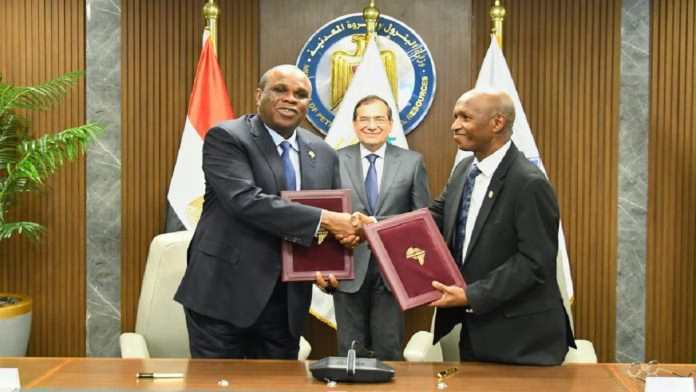
African Export-Import Bank (Afreximbank) and Africa Petroleum Producers’ Organisation (APPO) have signed the Establishment Agreement and the Charter of the Africa Energy Bank (AEB).
The agreement was signed at a ceremony held at the Ministry of Petroleum and Mineral Resources of the Arab Republic of Egypt.
The event was hosted by Tarek El Molla, Egyptian Minister of Petroleum and Mineral Resources, a statement issued by Vincent Musumba, Manager, Communications and Events, Afreximbank, said on Tuesday.
Musumba said Prof. Benedict Oramah, President and Chairman, Board of Directors, Afreximbank, and Dr Omar Ibrahim, Secretary-General, APPO, signed the Establishment Agreement and the Charter of the Africa Energy Bank on behalf of their respective institutions.
He said the signing ceremony concluded two years of negotiations and preparations by the two parties, having signed a Memorandum of Understanding in May 2022 toward the establishment of the AEB.
Musumba said the AEB was created to address the impending funding crisis in the African oil and gas industry, triggered by the global energy transition.
“Traditional financiers, on whom Africa has relied for decades, are withdrawing support, particularly in Africa, citing climate change concerns as the primary reason.”
He said while the AEB’s focus would be funding oil and gas projects, it would not close its doors to renewable energy projects.
Musumba said AEB would strive to harness all forms of energy to ensure that Africa’s energy poverty was eradicated.
“Although started by Africa, shareholding is open to all investors who share the mission and vision of the bank”.
He said the AEB had been structured as an independent and supranational Pan-African energy development bank with an initial five billion dollars capital.
“With the signing of the establishment documents by the two founding institutions, at least two member countries now need to sign and ratify the establishment documents for the bank to take off.”
He said El Molla, who is also a member of the APPO Ministerial Council, was quoted as saying, “It is a great honour to witness the establishment of the AEB.
“This moment marks a significant milestone in our continent’s journey towards energy independence and sustainable development.
“By harnessing our collective resources and expertise, we are paving the way for a brighter, more prosperous future for all Africans”.
El Molla said the collaboration between Afreximbank and APPO was a testament to the two institution’s unwavering commitment to powering Africa’s growth and ensuring energy security for generations to come.
“ I am confident that this newborn institution shall grow to serve the cause of Africa and its people. I commend the negotiating team and on behalf of the APPO Ministerial Council, I congratulate the team.’’
Musumba quoted Oramah as saying, “today marks a historic day for our continent and we are honoured to have collaborated with APPO towards the establishment of the AEB.
“These are challenging times when we must strive to find the right balance between the imperatives of mitigating climate change.
“Also the urgency of averting social upheavals as a result of increasingly difficult economic and financial conditions in Africa.
“For us at Afreximbank, we are proud to be co-investing in this new vehicle and for taking the lead role in advising on the management and implementation process with the operational launch set to commence in July,” Musumba quoted Ibrahim as saying.
“The AEB is Africa’s response to the imminent funding challenge that the global paradigm shift from fossil fuels to renewable energies, euphemistically called the energy transition poses to the oil and gas industry in Africa”.
Ibrahim said for too long, Africa’s oil and gas industry had been dependent on extra-African funding.
“We came to take foreign financing of our oil and gas projects for granted until the advent of energy transition made us realise that those on whom we have depended for many decades have decided to abandon us.”
The Secretary-General argued that Africa cannot afford to abandon oil and gas in a hurry when it has the largest proportion of its population living without access to energy.
Ibrahim commended Oramah for his exemplary leadership and commitment to the cause of the African continent.
Source: https://energynewsafrica.com
Uganda, South Korea Collaborate On Nuclear Power Plant In Buyende

Uganda and South Korea have initiated plans to construct a Nuclear Development Plant in Buyende District in eastern Uganda.
This announcement was made by Vice President Jessica Alupo, highlighting the project’s primary goal of supplementing the country’s electricity supply.
Uganda’s energy sector has predominantly relied on hydropower resources.
However, with a national target of generating 54,000 megawatts (MW) of electricity, there is a clear need to explore alternative energy sources.
VP Alupo noted that achieving this target would require developing nuclear energy capabilities, specifically aiming to generate 24,000 MW of nuclear power in a planned and systematic manner.
The revelation came during a bilateral meeting between Vice President Alupo and Han Duck-Soo, the prime minister of Korea, in Seoul.
The meeting was part of the preparatory discussions ahead of the Korea-Africa Summit, scheduled for June 4-5
Representing President Museveni, Vice President Alupo said Museveni had already reached out to the South Korean President, inviting a team to visit Uganda for further engagement on this nuclear development initiative.
Premier Han Duck-Soo underscored the longstanding diplomatic relations between South Korea and Uganda, which date back to 1963.
He expressed optimism that these friendly ties would continue to flourish, commending President Museveni for his efforts in fostering development not only in Uganda but across Africa.
The Prime Minister also emphasised that the upcoming Korea-Africa Summit would enhance cooperation between the two nations.
The meeting was attended by notable figures including the State Minister for Foreign Affairs Henry Oryem, Ambassador Elly Kamahungye, Deputy Principal Private Secretary to the Vice President Vincent Musubire, and officials from the South Korean government.
The Korea-Africa Summit, under the theme, “The Future We Make Together: Shared Growth, Sustainability, and Solidarity”, marks a pivotal moment for strengthening Korea-Africa relations.
South Korea extended invitations to all African Heads of State and Government, encouraging them to propose their preferred modes of cooperation during the summit in Seoul.
Officially, the summit reflects President Yoon Suk-Yeol’s vision of fostering a mutually beneficial and strategic long-term partnership with Africa.
This initiative aligns with Korea’s goal of becoming a Global Pivotal State.
However, underlying these diplomatic gestures is a strong focus on business opportunities and economic collaboration.
Chung Byung-won, South Korea’s Deputy Minister for Political Affairs in the Ministry of Foreign Affairs, spoke to African journalists ahead of the summit, promising a renewed commitment to Africa.
He emphasised that Korea aims to enhance both the quantity and quality of its assistance to the continent, tailoring support to meet the specific needs and conditions of each African nation.
Targeting strategic investments and trade
One of South Korea’s primary goals is to create a conducive environment for Korean companies to collaborate seamlessly with their African counterparts.
This strategic approach is expected to facilitate greater business integration and mutual growth.
Additionally, South Korea aims to leverage the African Continental Free Trade Area agreement, addressing trade barriers through technical support.
This includes helping rebuild African customs systems by implementing advanced Korean electronic customs clearance systems.
The collaboration on the nuclear plant in Uganda is a testament to the broader strategic interests shared by both countries.
It signifies a step towards not only meeting Uganda’s growing energy needs but also enhancing bilateral relations through sustainable and technologically advanced projects.
As Uganda and South Korea embark on this ambitious nuclear energy project, the partnership exemplifies how international cooperation can drive development and innovation.
The success of this initiative could serve as a model for other African nations seeking to diversify their energy sources and achieve sustainable growth through strategic international alliances.
Source: https://energynewsafrica.com
South Korea To Develop “Large” Offshore Oil And Gas Discovery Holding Up To 14 Bbbl Of Oil

South Korean oil and gas shares surged Monday after President Yoon Suk Yeol approved a plan to develop a fossil fuels offshore discovery off the country’s southeastern coast.
State-run Korea Gas Corp. closed up 30%, the most on record, and Posco International Corp. advanced 19% following Yoon’s televised speech on the discovery.
SK Gas Ltd settled almost 7% higher on Monday, after jumping as much as 29% earlier, and SK Innovation Co., an oil refiner, rose more than 6%.
Fossil fuel importers like South Korea have been looking to boost energy security after Russia’s invasion of Ukraine upended markets, briefly sending gas prices to an all-time high and triggering shortages.
Developing domestic resources is one way to reduce dependence on overseas suppliers and normalize subsidized prices at home.
Geophysical exploration indicated there’s a “high possibility” the discovery offshore the port city of Pohang holds as much as 14 Bbbl of oil and gas, Yoon said.
The estimated volume could be worth more than four years of oil consumption and as much as 29 years of gas demand for the country, he added.
While the president called the offshore oil and gas discovery “large,” the estimated amount of fuel still pales in comparison to reserves in major exporting countries like the U.S. or Saudi Arabia.
The energy ministry said the reserves are estimated to hold as much as 1.29 billion tons of natural gas and up to 4.22 Bbbl of oil.
Drilling, which will be carried out by Houston-based exploration and production consultant Act-Geo, will begin at the end of this year to evaluate the actual level of reserves, with results due by the first half of 2025, Yoon said.
It typically takes seven to 10 years before production can take place, and the expected life of the resource is about 30 years, according to the energy ministry.
Source: Worldoil.com
Komi: Two Killed At A Refinery Operated By Russia’s Lukoil

Two persons have been killed following a fire outbreak at a refinery that is being operated by Russia’s Lukoil in the northern Komi Republic, according to the head of the Komi Republic revealed in a report filed by Reuters.
Russian Environmental regulator said in the report that the fire was not caused by a drone attack but by “failure to comply with safety rules.
“According to revised data, it was established that a fire occurred during routine technical works by a contracting company,” the Russian Ministry for Emergencies said.
This year, Ukraine has intensified attacks on oil refineries in Russia, which have reduced Russian refining capacity, and which, reportedly, have the White House concerned about rising international prices.
The United States has repeatedly urged Ukraine to halt its drone attacks on Russian oil refineries due to Washington’s assessment that the strikes could lead to Russian retaliation and push up global oil prices, the Financial Times reported last month, citing sources familiar with the exchange.
The drone attacks from Ukraine on Russian refineries could disrupt fuel markets globally, the International Energy Agency said in April, estimating that up to 600,000 barrels per day (bpd) of Russia’s refinery capacity could be offline in the second quarter.
To protect against drone attacks, one local oil company, Rosneft subsidiary Bahsneft, earlier this year, installed metal mesh over its refining facilities.
“We don’t stop there. There are several solutions there, which I won’t talk about yet. They are classified. But believe me, we worry about this very much,” the governor of the Bashkortostan region where Bashneft is based said at the time.
Earlier, there were suggestions to protect refineries with missile systems, but some military experts point out that this would be an unwise decision.
“It doesn’t make a whole lot of sense to have those systems laid out like polka dots on the interior of your country, especially one as vast as Russia. You intercept these sorts of threats at the borders of your airspace, not the interior,” George Barros from the Washington Institute for the Study of War told Radio Free Europe last week.
Source: https://energynewsafrica.com
Kenya: Gas Tanker Explodes, Causes Injuries

A Liquefied Petroleum Gas (LPG) tanker has exploded at an area popularly known as Pipeline in Embakasi, Nairobi County, in the Republic of Kenya.
The explosion occurred around noon on Monday, according to a local report.
One person who was passing by reportedly sustained injuries and has already been rushed to hospital for treatment.
Firefighters arrived at the scene on time and managed to douse the fire.
Report suggests that ‘Embasavva’ 14-seater ‘matatu’ and the tanker were burnt to bare metal.
“The matatu did not have any passengers only the driver who was moving the vehicle after being stuck that is when it exploded. Both drivers for the matatu and truck are unharmed,” said an eyewitness.

 Source: https://energynewsafrica.com
Source: https://energynewsafrica.com Ghana: Energy Commission’s Head Of Public Affairs Called To The Bar

The Head of Public Affairs at the Energy Commission, Ghana’s technical regulator for electricity, Ms Ethel Linda Mensah, has been called to the Ghana Bar, energynewsafrica.com can report.
Ms Mensah was among 182 BL graduates who were called to the Bar last Friday.
Linda started her legal education in 2014 at the Ghana Institute of Management and Public Administration (GIMPA) Faculty of Law and earned an LLB in 2017.
She then entered the Ghana School of Law, Makola, that same year.
With persistence and perseverance, she has finally gained a place on the Roll of Lawyers during the Mini Call held last Friday, 31st May 2024.
A product of Wesley Girls’ High School, Linda has worked with the Ghana Energy Commission since September 1999.
Before embarking on her legal education journey, she held a Masters in Governance and Sustainable Development from the University of Cape Coast and a second Masters in Public Sector Management from GIMPA.
Source: https://energynewsafrica.com
Nigeria: Abuja Electricity To Disconnect Federal Government Agencies Today Over Unpaid Bills

Abuja Electricity Distribution Company (AEDC) in the Federal Republic of Nigeria has served notice of disconnection to over twenty government agencies and individual customers owing the company.
The company intends to begin the disconnection from today, June 3, 2024.
In a notice issued by the management, the company mentioned the Nigeria Army, Power House, Ministry of Trade, Ministry of Education, Ministry of Finance, Federal Ministry of Works, Federal Ministry of Interior and Nigeria Police Force Headquarters as some agencies it would disconnect.
It is not clear how much these agencies owe.
The company underscored the need for customers to make timely payments of electricity bills to continue delivering efficient and reliable service.
 Source: https://energynewsafrica.com
Source: https://energynewsafrica.com