


Ghana: CBOD Welcomes Directive On A Single Unified Measurement System

The Chamber of Bulk Oil Distributors’ (CBOD) has welcomed the Ministry of Energy’s directive mandating all entities involved in revenue assurance measurements within the oil and gas sector to comply with the new standard.
This standard was primarily developed collaboratively by the Ghana Standards Authority (GSA) with the Ministry of Trade and Industry and other stakeholders.
According to the CBOD, it believes that a single unified measurement system certified by the GSA is sufficient to ensure accurate and reliable data.
It emphasised the importance of a streamlined and well-regulated oil and gas sector.
It therefore advocated for a system where the private sector plays a more prominent role in managing specific aspects with the government maintaining an overarching regulatory framework and enforcing standards.
“The Chamber proposes a standardized approach, where meters mandated by the GSA could be installed by either the Depot, the National Petroleum Authority (NPA), or the Ghana Revenue Authority.
“The GSA would be responsible for the regular calibration of the meters. This system aligns with international best practices, where standard authorities handle meter calibration, eliminating the need for duplication by several entities, which comes at a cost to the consumer”, it said
“The role of the GSA in ensuring and maintaining standards is in the best interest of the state. All regulations within the sector should ultimately serve the national interest and be subject to state/regulatory oversight”, it added.
The Chamber acknowledged GRA’s quest to ensure revenue assurance for government.
Nevertheless, it said any institution, whether private or public, mandated to undertake that on government’s behalf, should do so in compliance with standards set by both the GSA and the Ministry of Trade Industry to ensure a transparent and efficient measurement system within the oil and gas sector
It welcomed initiatives by the Ministry of Energy to lead further dialogue with relevant stakeholders and to ensure a transparent and efficient measurement system within the oil and gas sector.
Source: https://energynewsafrica.com
Nigeria: Fire Outbreak Occurs At Dangote Refinery
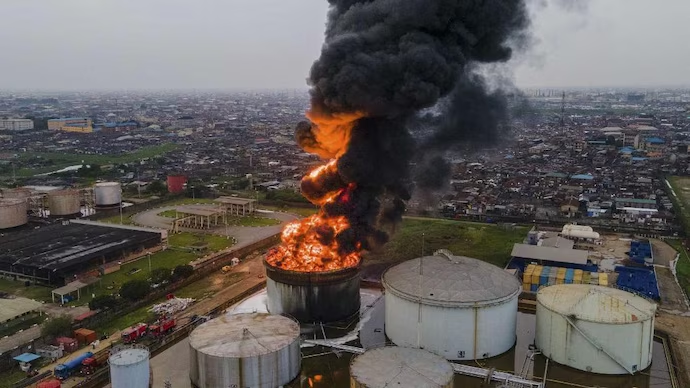
Fire outbreak has occurred at Africa’s largest crude oil refinery in Lagos, Nigeria, on Wednesday.
The fire outbreak occurred at an effluent treatment plant at the refinery, the company said in a brief statement without stating the cause.
The company said the minor fire was swiftly contained.
“There is no cause for alarm as the refinery is operating and there is no recorded injury or body harm to all our staff on duty,” Anthony Chiejina, Group Chief Branding & Communications Officer for Dangote Industries Limited, said.
Source: https://energynewsafrica.com
Morocco: Chariot To Partner With Vivo Energy To Commercialise Loukos Licence

Chariot Ltd has has signed a heads of terms agreement with Vivo Energy Ltd.
The Africa-focused transitional energy group said the agreement relates to future natural gas offtake from the Loukos onshore licence in Morocco, in which Chariot holds a 75% interest as operator.
Chariot will sell volumes of up to 3 million standard cubic feet per day to the midstream business under a long-term gas sales agreement from the potential future production from Loukos.
In addition, Vivo will design, fund, construct, and operate a CNG plant and virtual distribution network to transport the gas across Morocco.
This midstream CNG business would be operated through a special purpose vehicle in which Chariot can acquire 49% interest.
Chariot Morocco Managing Director Pierre Raillard said: ‘This agreement sets out a path where we can look to rapidly commercialise future production from Loukos, potentially unlocking the development of pre-existing gas discoveries as well as the OBA-1 well and enabling organic growth through future exploration.
‘It will also leverage our gas production to support Vivo’s wider development of CNG virtual pipeline infrastructure and, as part of a potential midstream partnership.’
Chariot shares were up 2.2% to 7.55 each in London on Monday afternoon.
Source: Natural Gas World
Kenya: ATIDI Supports Globeleq’s 35 MW Menengai Geothermal Project With RLSF Cover

The African Trade & Investment Development Insurance (ATIDI) and Globeleq Africa Limited, have jointly announced the former’s support for the 35 MW Globeleq Menengai Geothermal Project with liquidity cover via the Regional Liquidity Support Facility (RLSF).
RLSF, a joint initiative of ATIDI, the KfW Development Bank and the Norwegian Agency for Development Cooperation (Norad), is a credit enhancement instrument available to renewable energy Independent Power Producers (IPPs) that sell the electricity generated by their projects to state-owned power utilities.
RLSF is offered in ATIDI member countries that sign the RLSF Memorandum
of Understanding.
The project, the first to be considered for RLSF cover in Kenya, is valued at USD117 million with financing being provided by the African Development Bank (AfDB), the Eastern and
Southern African Development Bank (TDB), the Finish Fund for Industrial Cooperation
(Finnfund), and equity from the project owners, Globeleq.
The proposed RLSF policy will cover the risk of payment default by the national utility, Kenya Power & Lighting Company (KPLC) and Geothermal Development Corporation (GDC) – a government-owned company formed to accelerate the development of geothermal resources in Kenya.
Steam will be supplied to the project by GDC under the terms of a 25-year power implementation and steam supply agreement, whilst the electricity generated will be sold exclusively to KPLC under a power purchase agreement for the same duration.
The Project Company also benefits from a Letter of Support from the Government of Kenya.
Kenya, the host country of ATIDI’s headquarters, became the tenth ATIDI member state to
sign the RLSF MoU after Benin, Burundi, Côte d’Ivoire, Ghana, Madagascar, Malawi, Togo, Uganda and Zambia.
To date, RLSF policies have been approved in support of seven (7) renewable energy projects in Burundi, Malawi, Uganda and now in Kenya; enabling total financing of USD 323.7 million and a total installed electricity generation capacity of 171.3 MW, courtesy of USD 20.6 million worth of cover under the RLSF portfolio – achieving an impressive leverage or mobilization ratio of 16 times.
Kenya’s power sector benefits from an active private sector and boasts abundant renewable
energy resources with hydro, wind, and geothermal projects dominating its energy mix.
Furthermore, the Government of Kenya has outlined ambitious plans to increase the country’s electricity generation capacity from 3,078 MW in 2023 to 5,000 MW by 2030.
Geothermal projects are therefore expected to play a significant role in achieving this target and in advancing the nation’s renewable energy goals.
Thanks in part to ATIDI’s RLSF initiative which ensures the stability and the viability of
renewable energy projects, Kenya is on its way to meeting its goal of transitioning to 100 percent clean energy by 2030.
Manuel Moses, CEO of ATIDI commented: “We are proud to collaborate with Globeleq, KPLC, GDC, and the Government of Kenya on this transformative project. This partnership, coming so soon after the signing of the RLSF
“MoU in February 2024, underscores our commitment to fostering sustainable development
and promoting renewable energy solutions across Kenya and the region.
“Together, we are driving positive change and advancing Kenya’s energy transition. Given Globeleq’s huge and growing portfolio of renewable energy projects across the continent, we look forward to building on this partnership.”
Commenting Mr. Jonathan Hoffman, Interim CEO, said: “The Regional Liquidity Support Facility is a critically important product that gives companies the comfort around payment from customers that they need in order to invest in major renewable power projects in Africa such as our Menengai geothermal project in Kenya.
“This imaginative product from ATIDI, KfW and Norad provides critical liquidity support against payment default allowing companies like Globeleq to invest with confidence.
“I congratulate ATIDI on today’s signing ceremony at aef and look forward to continuing to work with them and their partners on future energy projects.”
Source: https://energynewsafrica.com
Russian Oil And Gas Revenues Surge By 50% In June

Russia’s oil and gas revenues for June are projected to increase by over 50% year-on-year, reaching $9.4 billion, according to new Reuters calculations.
This surge comes after a reduction in refinery subsidies, highlighting Russia’s resilience in the face of Western sanctions aimed at its energy sector.
The redirection of oil exports to India and China has played a crucial role in maintaining financial inflows, essential for a budget under pressure from increased defense spending.
Despite the ongoing conflict in Ukraine and subsequent economic sanctions, Russia’s ability to adapt its export strategies has been pivotal.
The projected increase in June revenues, up from 794 billion rubles in May and 529 billion rubles in June 2023, underscores the robustness of Russia’s energy sector.
The Finance Ministry’s anticipated report on July 3 will provide detailed insights into these financial trends.
The 2024 federal budget anticipates oil and gas revenues to rise by 21% from 2023, following a year marked by lower oil prices and reduced gas exports.
Despite the economic strains, Russia has continued to sustain its defense expenditures, resulting in consecutive annual budget deficits of over 3 trillion rubles, approximately 2% of GDP.
These deficits have been managed through internal borrowing and the National Wealth Fund.
President Vladimir Putin has emphasized the country’s economic growth, which stood at 3.6% in 2023 after a 1.2% contraction in 2022.
However, local economists caution that this growth is driven largely by increased production in the defense sector, which offers limited benefits to the broader population.
As Russia navigates its economic challenges, the resilience of its oil and gas sector remains a critical factor in its financial stability.
Source: Oilprice.com
Nigeria: Lagos High Court Restrains Ikeja Electric, NERC From Applying New Tarif

A High Court in Lagos in the Federal Republic of Nigeria has restrained Ikeja Electric Plc and the Nigerian Electricity Regulatory Commission (NERC) from applying, administering or implementing the purported tariff stipulated in the 2024 Supplementary Order on tariff increase on “Bank A” Feeders.
The court presided over by Justice Chukwujekwu Aneke on Tuesday held that the tariff comprised those published by Ikeja Electric on April 4, 2024 and/May 2024 Supplementary Order on Tariff Increase on “Band A”, published on May 6, 2024 on a firm, Rida National Plastics Limited.
The presiding judge made the interim injunction after hearing an ex-parte application filed by Rida National Plastics’ lawyer, Dr. Kemi Pinheiro SAN.
The judge ruled that the order subsists pending Ikeja Electric and NERC’s full compliance with Section 51 of the Electricity Act, 2023 and the hearing and determination of the Motion on Notice for Interlocutory Injunction.
Rida National Plastics is the plaintiff/applicant while Ikeja Electric Plc and NERC are the 1st and 2nd defendants/respondent in the suit marked FHC/L/CS/1051/2024.
Justice Aneke also temporarily restrained the 1st & 2nd defendants from imposing the payment of the sum of N20 million on the plaintiff being the balance payable on the purported electricity bill dated 4th of May 2024 calculated on the basis of the April 2024 Supplementary Order on Tariff Increase on “Band A” Feeders and/or the May 2024 Supplementary Order On Tariff Increase on “Band A”.
In addition, the Interim Injunction also restrained Ikeja Electric and NERC “from intimidating and threatening to disconnect or actually disconnecting” Rida National Plastics’ electricity supply for non-compliance with the purported tariff.
He adjourned the suit till July 9, 2024 “for hearing of the motion on notice filed contemporaneously with the instant ex-parte application.”
Source: https://energynewsafrica.com
Niger: Military Junta Revokes Mining Licence Of French Nuclear Fuel Producer

Niger has revoked the operating licence that was issued to Orano, a French firm, to explore uranium at the Imouraren uranium mine, one of the world’s largest uranium deposits, amid rising tensions between France and Niger’s ruling junta.
The decision was taken on Monday, 24th June 2024, according to a top journalist in the West African nation who spoke to this portal.
The Nigerien government had warned of the revocation if work had not begun by June 19, which Orano claims to have complied with.
The company, which has been in Niger since 1971, said it is open to dialogue with the government but maintained that it reserves the right to contest the decision in national or international courts.
Niger, a key uranium supplier to Europe, has turned against France since the junta took power in July last year, favouring ties with Russia and Iran.
Source: https://energynewsafrica.com
Ghana: It Is Illegal To Move Our Meters To A New Location—ECG

The Electricity Company of Ghana (ECG) has cautioned the public against moving the company’s meters from one geographical area to another.
According to the ECG, it is illegal to change the location of a meter per PURC (Consumer Service) Regulations, 2020 (LI2413).
Section 4 (e) of the LI2413 states that a customer shall “not change the location of a meter.
“Any customer who flouts the above regulation is liable for imposition of a fine determined by the Public Utilities Regulatory Commission (PURC) under section 44(d) of the LI2413.”
Speaking during a recent media training programme for selected journalists in Accra, the capital of Ghana, the Director of Communications, William Boateng, explained that when a prospective applicant applies for a meter, a Geocode is assigned to the meter, showing the area where the meter will be fixed.
He said information on the applicant’s Ghana Card is entered into the ECG’s system.
According to William Boateng, the meter is for a specific location and is not transferrable without their knowledge.
He said if for some reason a customer is relocating to another area, the customer has to inform ECG.
He said if the customer removes the meter to his or her new location, it will be considered illegal.
“So come to us for us to discuss. If it is possible, we will let you know,” Mr Boateng advised.
Source: https://energynewsafrica.com
Lithium Battery Factory Blaze In South Korea Claims 22 Lives

Twenty-two workers were killed in a fire that followed a series of explosions at a lithium battery factory just outside of Seoul, South Korea on Monday, with authorities not yet clear on what caused the disaster.
Citing a local fire official, the Associated Press reported that the fire started when battery cells exploded inside the warehouse, though authorities are still investigating the cause of the explosion.
The victims were reportedly foreign workers, the majority of whom are Chinese laborers.
The blaze started at 10:30 a.m. local time and was extinguished in six hours, Reuters reports.
“The fact that there were so many casualties when this was on only the second floor is because of the toxic materials and not so much because of burns,” Reuters quoted Park Chul-wan at Seojeong University as saying.
South Korea is a key producer of lithium-ion batteries and a leading exporter. The company, Aricell, manufactures lithium batteries for sensors and radio communication devices.
Company executives can be held accountable, with prison terms, in South Korea for fatal industrial accidents based on new legislation passed two years ago, according to Reuters.
Lithium-ion batteries are energy-dense, with highly flammable materials that could lead to fire, explosion, radiation, heat and chemical exposure.
They can develop thermal runways that lead to high temperatures causing batteries to vent combustible gas or to ignite, though some experts argue that these occurrences are extremely rare.
In February, a fire broke out in a warehouse storing lithium-ion batteries in southern France, causing no casualties, but requiring 70 firefighters to extinguish.
In late May, the New York State Senate passed a legislative package to enhance safety standards for lithium-ion batteries following a series of public safety incidents.
At the same time, the U.S. House approved legislation in May mandating federal safety standards for lithium-ion batteries to prevent fires.
Source: Oilprice.com
South Africa: Eskom Wants To Hike Electricity Prices By 44%

South Africa’s power utility company, Eskom has asked the National Energy Regulator of South Africa (NERSA) for a 36.15% electricity tariff hike for the customers it directly supplies and charges.
However, customers supplied by local power utilities could be harder hit, with Eskom requesting an increase of 43.55% for these customers.
A report by mybroadband.co.za which cited Daily Maverick mentioned that a confidential draft document, dated May 2024, reportedly revealed details about the electricity price increases the state-owned power utility wants and plans to submit to NERSA for its financial years from 2026 to 2028.
It asked NERSA for a standard tariff increase for non-municipal customers of 36.15% for the 2025/26 financial year, 11.81% for 2026/27, and 9.10% for 2027/28.
Those supplied by municipal power utilities could face increases of 43.55% in 2025/26, 3.36% in 2026/27, and 11.07% in 2027/28.
The first set of increases would be implemented on 1 July 2025, and the draft document was the first step in the application process.
The proposed electricity price hikes must still undergo an extensive public comment and hearing process.
Eskom hopes that through the price increases, it will generate revenue of R446 billion, R495 billion, and R537 billion in 2026, 2027, and 2028, respectively.
The state-owned power utility said the delayed implementation of South Africa’s renewable energy programme means it is under pressure to increase its generation capacity.
It noted that between 2019 and 2023, over 8,000MW of capacity that was primarily meant to come from solar and wind generation was not available as intended in the Integrated Resource Plan of 2019.
As a result, its coal-fired stations have to fill in the generation gap.
Eskom’s electricity tariff increase of 12.54% for its direct customers kicked in on 1 April 2024, while the tariffs it charges for electricity sold to local authorities like municipalities increased by 12.72% from the same date.
Source: https://energynewsafrica.com
Spain: ATIDI, Globeleq Set To Announce Exciting Collaboration At Africa Energy Forum

The African Trade & Investment Development Insurance (ATIDI) and Globeleq will be hosting a signing ceremony today, Tuesday, to announce their collaboration on a
geothermal project in an East African country on the sidelines of aef2024 in Barcelona, Spain.
This event marks a pivotal moment in the collaboration between ATIDI and Globeleq and underscores their joint commitment to advancing renewable energy solutions in the region.
“Over the last years, we’ve worked tirelessly with our various partners to ensure that RLSF cover is available to eligible IPPs in ATIDI member countries.
“Thanks to the support of various stakeholders: we are quite excited to be in a position to make this announcement alongside our partners at Globeleq,” said Obbie Banda, Underwriter & Acting RLSF Coordinator, ATIDI.
ATIDI predominantly provides Political Risk, Credit Insurance and Surety Insurance.
Since its inception, ATIDI has supported USD85 billion worth of investments and trade into Africa.
For over a decade, ATIDI has maintained an ‘A/Stable’ rating for Financial Strength and Counterparty Credit by Standard & Poor’s (S&P), and in 2019, ATIDI obtained an A3/Stable rating from Moody’s, which has now been revised to A3 Positive.
ATIDI and the German Development Bank, KfW Development Bank, with financing from the German Federal Ministry for Economic Cooperation and Development (BMZ), launched the RLSF in 2017.
The facility was created to help tackle climate change and attract investments by supporting renewable energy projects in ATI’s member countries.
In 2022, the Norwegian Agency for Development Cooperation (Norad) committed additional funding towards the continued implementation of RLSF.
RLSF has a capacity of USD153.7 million and supports small and mid-scale renewable energy projects with an installed capacity of up to 100 MW (larger projects can be considered on a case-by-case basis) by protecting the projects against the risk of delayed payments by public off-takers; in turn improving project bankability and ensuring that more projects reach financial close.
Source: https://energynewsafrica.com
Lesotho: Lesotho Electricity Company Plunged Into Financial Woes

The Lesotho Electricity Company (LEC) is in financial difficulties due to the high costs of importing electricity from South Africa and the huge debts it owes to service providers.
The company’s situation is so dire that it has no funds to pay employees’ annual bonuses which are due at the end of this month, according to a report by Lesotho Times.
The report said the company has agreed on a payment plan with its staffers to stagger the bonus payments and ward off an industrial action they had contemplated.
The power utility will pay M38 million to Eskom for 24 Megawatts of power at the end of this month and pay M2 million to the Lesotho Highlands Development Authority (LHDA) for the same amount of power from ‘Muela Hydropower Station in Butha-Buthe.
Speaking about the company’s financial situation, the Managing Director of Lesotho Electricity Company, Mr Mohlomi Seithleko, confirmed that Eskom’s high has contributed to the utility’s current financial problems.
He said Muela was currently only producing 48MW as only two turbines were working.
“It costs us M2.42 to render electricity services to customers whom we charge M1.41 on average, which means we are running at a huge loss, thus, struggling to meet obligations due to the tariffs that are not cost reflective,” Mr Seitlheko said.
“Electricity usage reaches its peak between June and August each year due to the cold winter season. Therefore, the Muela turbines are expected to be in full swing during this period. However, one is still down.
“They (LHDA) promised it will be up in early July. Now that it was not working in June, we are going to pay Eskom M38 million compared to the M2 million we would have paid the LHDA. During this peak season, we buy a unit at M5.89 from Eskom whereas an LHDA unit costs us M0.12 throughout.
“We are already working on the plan to supply the country during the six months from October to March when the Muela plant will be under maintenance.
“Eskom has already promised to meet our demands. We are already in talks with the government to chip in as we would need to import more electricity then. The Ramarothole plant is not helping much because it only produces during the day.”
Mr Seitlheko said they were going to pay the workers’ bonuses in intervals from this month-end due to the financial problems.
“I will not lie. Yes, we do have financial problems. It is a policy issue to pay employees bonuses at the end of June each year but our finances are not allowing us to do so. We had proposed to the employees to pay them in December when our cash flows would be better as operating costs are not that high in summer. However, they refused.
“We had to negotiate and find common ground. The decision reached this morning was that we will pay them in intervals, starting from the bottom staff layers this month-end.
“The supervisors to middle management will be paid in July, while senior management will be paid in the two months of August and September. This will enable us to manage the cash flows whilst also avoiding the industrial action which was on the cards.”
Source: https://energynewsafrica.com
Nigeria: Dangote Refinery Accuses Downstream Petroleum Regulator Of Sabotage

Africa’s largest refinery, Dangote Refinery, is accusing the Nigerian Midstream and Downstream Petroleum Regulatory Authority (NMDPRA) of being reckless by issuing fuel importation licences indiscriminately.
The Nigeria-based refinery claims holders of fuel importation licences are importing dirty diesel and jet fuel into the country, thereby, compelling them to export 3.5 billion litres of products, representing 90 per cent of their production.
“The decision of the Nigerian Midstream and Downstream Petroleum Regulatory Authority (NMDPRA), in granting licences indiscriminately for the importation of dirty diesel and aviation fuel has made the Dangote refinery expand into foreign markets.
“The refinery has recently exported diesel and aviation fuel to Europe and other parts of the world.
“The same industry players fought us for crashing the price of diesel and aviation fuel, but our aim, as I have said earlier, is to grow our economy,” said Devakumar Edwin, Vice President of Oil and Gas at Dangote Industries Limited, said during a training programme for selected journalists in Lagos at the weekend.
According to Edwin, despite Dangote’s effort to meet ECOWAS’s standards, the authority gives licences to traders to import high-sulfur petrol from Europe into the country.
He explained that since the US and UK have issued a cap on Russia’s petroleum products, these products are now dumped in Nigeria’s market by various traders.
“Even though we are producing and bringing out diesel into the market, complying with ECOWAS regulations and standards, licences are being issued, in large quantities, to traders who are buying the extremely high sulphur diesel from Russia and dumping it in the Nigerian Market.
“Since the US, EU and UK imposed a Price Cap Scheme from 5th February 2023 on Russian Petroleum Products, a large number of vessels are waiting near Togo with Russian ultra-high sulphur diesel and, they are being purchased and dumped into the Nigerian Market.
“Some of the European countries were so alarmed about the carcinogenic effect of the extra high sulphur diesel being dumped into the Nigerian Market that countries like Belgium and The Netherlands imposed a ban on such fuel being exported from its country, into West Africa, recently.
“Sadly, the country is giving import licences for such dirty diesel to be imported into Nigeria when we have more than adequate petroleum refining capacity locally,” Edwin said.
In addition, Edwin said the reason why Dangote can export to foreign countries is because its products meet international oil standards.
He said this indiscriminate licensing by NMDPRA would only frustrate the refinery’s adherence to standard quality, making it easy for traders to import low-quality petroleum products into the country.
Source: https://energynewsafrica.com
Ghana: NEDCo Undertakes Revenue Mobilisation And Loss Control Exercise Today

The Northern Electricity Distribution Company Ltd (NEDCo) has commenced revenue
mobilisation and loss control exercise across its operational areas effective June 24, 2024.
The exercise will cover all categories of customers in arrears including both privately owned
and state-owned accounts apart from a selected critical few.
A statement issued by the Corporate Communications Manager of NEDCo, Maxwell Kotoka, said significant attention would be given to loss-inducing activities such as illegal and/or unauthorized connections of all forms.
According to him, special security arrangements would be put in place to arrest and prosecute anyone who interfered with the exercise.
He said any person identified to be engaged in illegal connections or re-connections would equally be dealt with by the law.
NEDCo’s Head Office and Area Offices will be closed temporarily to allow for the full engagement of all staff, including top management in this exercise.
“Our customer service centres, zonal offices and third-party vendors will, however, remain open to address customer concerns including re-connections,” he said.
Mr Kotoka said the exercise would not interfere in any way with ongoing prosecution processes.
Also, customers in NEDCo’s operational arrears are entreated to pay their bills immediately to avoid disconnection and payment of re-connection fees.
Similarly, those involved in various forms of illegal and unauthorised connections are advised to stop and desist forthwith from such actions to avoid any brush with the law.
“NEDCo urged all to cooperate for the exercise to be successful, bearing in mind that we can only serve you well when you use power decently and pay for same,” he concluded.
Source: https://energynewsafrica.com