


Sudan: Minister Of Energy And Oil Heralds Approaching Repumping Southern Sudan Oil

Sudanase Minister for Energy and Oil, Dr. Mohieddin Naeem Mohamed Saeed, has heralded the near completion of work on re-pumping South Sudan’s oil.
This came during his inspection visit on Wednesday to the fifth pumping station from Jebel Um Ali in the Nile River State, affirming that work has reached about 80% so far.
He appreciated the efforts of the workers at Bashair Pipeline Company (BAPCO) who continue to work day and night until the dawn of Eid in order to accelerate the pace in dealing with the stoppage of pumping to avoid economic and technical losses to the country and South Sudan.
The Minister inspected the valve at the station and was briefed on the alternative plans.
For his part, Engineer Ibrahim Adam, General Manager of Bashair Pipelines Company (BAPCO), stressed that the work is taking place according to the plans drawn up by the company, indicating that the company’s employees continue to work without stopping even during the blessed Eid Al-Adha holiday, stressing that their Eid is in the fields of work and the effort has been crowned with success, adding that soon Sudan and South Sudan will be heralded with the return of pumping.
Source: https://energynewsafrica.com
Ghana: Three Suspects In Police Grips For Killing Student Of University Of Energy And Natural Resources In Sunyani

The Ghana Police Service has arrested and detained three suspects in connection with a robbery of students and lecturers of the University of Energy and Natural Resources (UENR) that resulted in the killing of Abdul Aziz Issah, a Renewable Energy Engineering Student, in April this year.
Some students of the university and their lecturers were on a trip to the Bui Generation Station operated by the Bui Power Authority when armed robbers attacked them on the stretch of Odomase-Badu in the West Sunyani Municipality at about 1900 hours on Tuesday, April 16, 2024.
A report by Ghana News Agency (GNA) indicated that the Bono Regional Police arrested the three suspects through police intelligence.
The report said investigations were still ongoing.
The police retrieved several mobile phones and other valuables from the suspects who were arrested in their hideouts, according to the report.
Source: https://energynewsafrica.com
Zambia: Cabinet Directs Zesco To Suspend Power Export Amidst Power Crisis

Zambia has announced plans to recall about 100 Megawatts of power being exported to its neighbours in a bid to meet local demand.
The East African nation is struggling to keep the lights on due to low water levels in its hydropower generation dams, occasioned by severe drought.
The Minister for Information and Media and Chief Government Spokesperson, Hon. Cornelius Mweetwa, with the Minister for Energy, Hon. Peter Kapala, revealed the decision of the government at a press conference.
Hon. Cornelius Mweetwa said Zesco, the national electricity supplier, has been directed to implement the Cabinet decision as soon as possible.
Negotiations are also ongoing to recall an additional 195MW, considering contractual obligations and the severe drought impacting the region.
Zesco has contracts to supply power to Botswana, Zimbabwe, Namibia and the DRC.
However, the shortfall in power generation has compelled the country to import about 165MW of power to mitigate the shortage.
Speaking about the current power situation, Victor Mapani, Managing Director of Zesco Limited, said: “Zesco understand the adversities and challenges the load shedding poses and we sincerely regret that and wish things were different but as we are there is very little we can do about the water shortage.”
Meanwhile, the government, in collaboration with the private sector, is mobilising resources to open a second plant at Maamba Collieries, expected to produce around 300MW.
This project, requiring approximately US$80 million, has reached the final stages of financial closure.
Additionally, the government plans to install solar energy systems in public universities and colleges to free up energy for other uses.
Public institutions such as universities, hospitals and water processing plants, along with essential service providers like police stations, will not be subject to load-shedding.
Source: https://energynewsafrica.com
Ghana: ECG Is Not Shedding Load–Energy Minister

Ghana’s Minister for Energy Dr Matthew Opoku Prempeh has stated that the Electricity Company of Ghana (ECG) is not carrying out a load-shedding exercise.
The power transmission company, GRIDCo and ECG, in a joint statement last week, hinted that the reduction in the volume of gas from Nigeria as announced by the West African Gas Pipeline Company (WAPCo) is likely to result in load-shedding management.
Answering questions in Parliament on Wednesday about recent power outages across the country, the Energy Minister, Dr Opoku Prempeh, explained that the erratic power supply in the country is not a result of load shedding.
“No, ECG was not undertaking load-shedding as of the time the question was asked about two months ago. Consumers were experiencing outages due to several factors including localised outages caused by overloaded lines and transformers,” he stated.
Dr Opoku Prempeh highlighted the rapid development in certain areas as a contributing factor.
“There are certain areas in this country where all of a sudden, the number of residents and businesses have increased. Parts of East Legon, which was purely a residential area, have now become a business district, increasing power consumption,” he noted.
“This surge in demand has strained existing infrastructure, necessitating upgrades to transformers and power lines,” he added.
He also pointed to specific incidents affecting the power supply.
“At the time the question was asked, CenPower had an emergency shutdown, resulting in an immediate loss of 40 megawatts. Additionally, maintenance work on the Amandi Power plant was ongoing,” Dr Opoku Prempeh explained.
Further compounding the issue were emergency outages requested by GRIDCo.
“These were myriads of factors that had unfortunately happened, causing power outages at different times,” he added.
Dr Opoku Prempeh emphasised that the ECG did not implement load-shedding because most outages were unplanned, preventing a pre-announced schedule.
“The reason ECG said they were not load-shedding is that most of the incidents were not planned, and so they couldn’t have come out with a pre-programme to say they were load-shedding,” he concluded.
Source: https://energynewsafrica.com
Mozambique: Gov’t Extends Pipeline Concession For Matola Gas Company

The Mozambican government has extended, for a further period of 15 years, the gas pipeline concession held by the Matola Gas Company (MGC) for the transport of natural gas from the administrative post of Ressano Garcia, on the border with South Africa.
The decision at a meeting of the Council of Ministers (Cabinet), which took place on Tuesday, in Maputo.
According to a statement from the Council of Ministers, the extension aims to allow for new investments estimated at 300 million dollars, with work due to start this year.
The investment aims to set up new infrastructures and connect MGC’s existing facilities to receive volumes of Liquefied Natural Gas (LNG) regasified by the Beluluane Gas Company (BGC).
MGC is dedicated to the transport, distribution and sale of natural gas produced in Mozambique, which is used as an energy source for the operation of various industrial units in Maputo province.
Founded in 2004, MGC is owned by the Mozambican government through the National Hydrocarbons Company (ENH) and by the South African energy company, Gigajoule International.
MGC operates a natural gas transmission and distribution pipeline with a length of around 100 kilometers, under a concession agreement with the government for distribution in Maputo province.
The MGCs pipeline starts in Ressano Garcia where it is connected to the main gas pipeline running from the Pande and Temane gas fields, in the southern province of Inhambane, to Secunda in South Africa.
MGC currently supplies natural gas to the Mozal aluminium smelter, to the cement factory, Cimentos de Moçambique, and to 18 other companies located in Maputo province.
Source: Aimnews.com
Nigeria: IBEDC Achieves Supply Milestone For Band A Customers For Two Consecutive Months

The Ibadan Electricity Distribution Company (IBEDC) has successfully provided a cumulative minimum of 620 hours of electricity supply to its Band A customers over the past two months.
This achievement was confirmed during a performance evaluation period monitored by the Regulator, the company said in a statement.
Starting with an initial 30 Band A feeders in April, IBEDC received approval from the Regulator to upgrade an additional 30 feeders later in April, another 30 in May, and 15 more feeders subsequently, bringing the total to 83 feeders. These feeders are categorized as follows: 34 11kV and 49 33kV.
The Acting Managing Director, Engr. Francis Agoha, stated, “IBEDC remains committed to meeting the service delivery expectations of all our customers across various tariff bands.
We continue to enhance our network upgrades within our coverage areas to ensure consistent and reliable electricity supply, in addition we are working assiduously to ensure power supply to other bands improve significantly”.
“IBEDC’s dedication to service excellence and continuous improvement underscores our mission to provide reliable and efficient electricity to our valued customers.
“We appreciate the support of our customers and the Regulator in achieving this significant milestone,” he concluded.
Source: https://energynewsafrica.com
Zambia: Electricity Will Be Restored To Muchinga, Luapula Northern, Eastern, And Central Provinces Late Night-Zesco Limited

Zambia’s power utility company Zesco Limited says it will restore power supply to Muchinga, Luapula, Northern, Eastern, and Central provinces of Zambia by 22:00 today due to some unforeseen circumstances.
Power supply to the provinces was disrupted on Wednesday, 19 June 2024, at 06:00 hours to facilitate the second phase technical commissioning of the second 330kV Kabwe Step Down – Pensulo Transmission Line.
The first phase of the technical commissioning was successfully completed on Sunday, 16 June 2024.
Zesco anticipates to restore power supply to the affected provinces by 22 hours this evening, the company said in a statement.
The Corporation sincerely apologised to its customers for the inconvenience caused by the delayed power supply restoration.
Zesco urged the public to treat all power supply lines to be live at all times, as power supply could be restored earlier than stated.
The 330kV Kabwe Step-Down to Pensulo Transmission Line is an added power transportation corridor to the northern part of Zambia, and is part of the Zambia – Tanzania – Kenya interconnector, the much anticipated power trading corridor between Southern and East Africa.
Zambia is to benefit from power imports from Tanzania and other East African countries once the interconnector is complete.
Source: https://energynewsafrica.com
Angola: Chevron Signs Contracts For Ultra-Deepwater Blocks Amid Attractive Policies

Multinational energy corporation Chevron has signed two Risk Service Contracts (RSC) for Block 49 and Block 50, located in the ultra-deep waters of Angola’s Lower Congo Basin.
The company – through its Angolan subsidiary Cabinda Gulf Oil Company Limited – was initially awarded the concessions by way of Presidential Decree in January 2024.
The signing of the RSCs kicks off exploration and lays the foundation for the development of the blocks.
As the voice of the African energy sector, the African Energy Chamber (AEC) commends the recent signing by Chevron in Angola.
Chevron’s rich history of exploration and production in the country – covering 70 years – could not have been possible without Angola’s strong regulatory environment and the AEC supports the ongoing efforts by the multinational to expanding Angola’s oil and gas market.
Representing the company’s first operated assets outside of the existing Cabinda concessions, Block 49 and 50 are situated in close proximity to producing concessions such as Block 17 – one of the first deep-offshore blocks to be licensed in Angola.
As such, the blocks hold substantial potential for strong returns and further expand Angola’s portfolio of producing ultra-deepwater assets.
Earlier this year, Chevron signed an agreement with Angola’s national concessionaire – the National Oil, Gas & Biofuels Agency – to conduct seismic surveys in Blocks 49 and 50.
These studies will improve the geological understanding of the concessions and advance the exploration agenda.
The RSCs add to Chevron’s strong asset portfolio in Angola.
The company currently has a 26% market share in the country, with interests in Block 0 and 14 – which produce an average of 70,000 barrels of liquids per day and 259 million cubic feet of natural gas per day.
Block 0 – whose concession has been extended to 2050 – is comprised of 21 fields, while Block 14 contains nine fields.
An agreement signed between Chevron and the government in 2020 combined all of Block 14’s development areas, providing improved fiscal terms while extending the production sharing contract to 2028.
Additionally, in 2023, Chevron signed a production sharing agreement to manage operations within the Block 14/23 concession area.
The concession is situated in the Zone of Common Interest shared by Angola and the Democratic Republic of the Congo, with the agreement seeing Chevron act as operator with a 31% stake in the block.
Chevron’s operations in Angola transcend oil and gas exploration, with the company holding non-operating interests in the Angola LNG plant – Angola’s inaugural LNG facility.
Angola LNG processes gas from offshore concessions, generating critical revenue for the country through LNG exports. In 2023, the facility reached a milestone of delivering its 400th LNG cargo.
Going forward, the development of new concessions aims to bolster LNG production at the facility.
Specifically, the Chevron-operated Sanha Lean Gas Connection Project – valued at $300 million – comprises the development of a platform that ties into the existing Sanha Condensate complex and features pipelines connecting Block 0 and 14 to the Angola LNG facility.
The project reached a final investment decision in 2021 and aims to address a supply gap at Angola LNG.
Beyond exploration and production, Chevron is spearheading low-carbon solutions across Angola’s oil and gas industry.
The multinational signed an agreement with the government in October 2023 to explore low-carbon business opportunities, with the goal to utilize nature-based and technological carbon offsets – alongside lower-carbon intensity fuels such as hydrogen – to enhance the country’s production.
This will be undertaken in conjunction with oil and gas initiatives and showcases Chevron’s future-oriented approach to energy development in Angola.
“Chevron’s recent signing of two RSCs further underscores the value of implementing a strong regulatory and fiscal environment in Africa.
“When governments open up the market through attractive fiscal terms, the industry will respond positively.
“This is clearly evident in Angola where a commitment to creating an enabling environment for doing business has and continues to attract foreign companies.
“Other countries in Africa should learn from this and adopt proactive measures to attracting foreign capital,” states NJ Ayuk, Executive Chairman of the AEC.
Source: https://energynewsafrica.com
Ghana: Moroccan Energy And Customs Managers Understudy NPA’s Operations

A four-member delegation from the Moroccan Ministry of Energy Transition and the Customs and Indirect Administration is in the Republic of Ghana to understudy the National Petroleum Authority’s petroleum distribution system relative to tax administration.
The team is seeking to have a better insight into the implementation of the Unified Petroleum Price Fund (UPPF), the Bulk Road Vehicle (BRV) Electronic Cargo Tracking System, and the Petroleum Product Marking Scheme (PPMS) in providing revenue assurance to the government.
An arrangement has been made for the delegation to visit the Marker Warehouse and Storage; the Depot Marking operations; the BRV Operations and Sealing of Trucks; the NTL Laboratory, and also observe the testing of petroleum products at selected retail outlets to have hands-on experience in their operations.
The delegation is led by the Director of Customs and Indirect Taxes Administration, Mr. Chafik Essalouh, with Mr. Montassir Laksiri, Customs Division; Mr. Mohsinne Zaydi of the Ministry of Energy Transition, and Mr. Elmoutadikic Ahmed, a representative of the petroleum companies in Morocco as members.
Welcoming the delegation at the NPA in Accra on Monday on behalf of the NPA Chief Executive, Dr. Mustapha Abdul-Hamid, a Deputy Chief Executive of NPA, Mr. Perry Okudzeto, said the NPA was ready to share its experiences with Morocco.
He said the country depended on the importation of petroleum products as only three refineries were operational in the country at the moment.
He said if Sentuo Refinery with 40,000 barrels per day capacity settles down, and the Tema Oil Refinery (TOR) resumes operations, their productions would cater for about 40 percent of the country’s demands.
Mr. Okudzeto said the NPA and the Ghana Revenue Authority (GRA) had deployed officers at the petroleum facilities to test the quality of products, check the volumes, and ensure that all petroleum products are accounted for and the right taxes and levies are calculated.
Mr. Okudzeto said the NPA and the GRA had integrated their systems so that whatever is done in the NPA’s system is seen by the GRA and vice versa.
Mr. said the PPMS, which has to do with the marking of petroleum products, ensures the integrity of petroleum products. At the same time, the BRV Electronic Cargo Tracking System tracks the movement of fuel tankers to prevent diversion.
Responding, Mr. Essalouh said the delegation was ready to learn about Ghana’s tax regime on petroleum products and consider the possibility of integrating into the Moroccan tax system.
Source: https://energynewsafrica.com
Iran Says U.S. Can No Longer Obstruct Its Oil Production And Exports

Any future U.S. administration cannot prevent Iran from boosting its oil production and exports, Iranian Petroleum Minister Jawad Owji said on Wednesday.
“With the measures that have been taken in President Raisi’s government in the field of the oil industry, I should announce that any government that comes to power in the US cannot prevent the export and production of Iranian oil,” Iranian media quoted Owji as telling Parliament today.
Over the past three years, Iran has increased its crude oil production by 1.4 million barrels per day (bpd), the petroleum minister said.
During this period, Iran launched 150 oil industry projects, worth a total of $34 billion, according to the minister’s remarks from a few days ago carried by the news service Shana.
The oil industry grew by 20% last year, the highest growth rate of any Iranian sector of the economy, Owji was quoted as saying.
Last month, the minister said that Iran would soon launch 32 oil industry projects worth a total investment of $ 4.6 billion.
Iran plans to increase its crude oil output to 4 million bpd, the country’s Tasnim news agency reported at the end of May, as cited by Reuters.
No specific sources for the plan were provided but the original report in Tasnim said that “An economic council headed by Iran’s interim president Mohammad Mokhber has approved a plan to raise the country’s oil output from 3.6 million barrels per day to 4 million barrels per day.”
Iran has been eager to increase its oil production despite U.S. sanctions that have significantly reduced the market for Iranian oil.
Even so, Iran reported an increase in exports of crude recently, with the average daily for the first quarter hitting the highest in six years at 1.56 million bpd according to Vortexa data. Last year, the country exported 1.29 million bpd on average, which was 50% more than a year earlier.
Source: Oilprice.com
Tanzania: UK Development Arm Funds Its First Tanzania Green Energy Project

British International Investment Plc, the UK government’s development-finance arm, is providing its first support for renewable energy in Tanzania.
The firm has agreed to lend an initial $15 million to Meridiam SAS’s Rift Valley Energy to develop 7.6 megawatts of wind and small-scale hydro projects, said Nick O’Donohoe, BII’s chief executive officer.
That amount may rise to $25 million.
“The new installations will provide power to 170,000 consumers, with many of them not having been connected to the grid before,” O’Donohoe said in a report by Energy Connects.
BII’s investment plans come as a host of finance institutions jostle to provide the finance needed to boost access to electricity in Africa, meet climate change challenges and develop infrastructure.
The African Development Bank, the continent’s leading multilateral lender, estimates that the region needs between $130 billion and $170 billion for infrastructure development annually.
Just 37% of Tanzania’s 66 million people have access to electricity, according to BII.
Rift Valley already operates some small hydro power projects and Tanzania’s sole wind farm, Mwenga.
Meridiam acquired the company, which is developing projects that may generate 30 megawatts of power, last year and separately has invested in 100 megawatts of assets in neighboring Kenya.
Source: https://energynewsafrica.com
Rwanda: Gov’t Will Require $1.5bn To Achieve Universal Energy Access By 2029

Rwanda will require about $1.5bn investment in the power sector to achieve universal energy access by 2029 after missing the 2024 target, Rwanda Energy Group (REG) has said.
Access to electricity currently stands at 77.7 per cent, up from 34.4 per cent in 2017 under the National Strategy for Transformation (NST1) which ran from July 1, 2017, to June 30, 2024.
Twenty-five districts out of 30 have an access rate exceeding 70 per cent while the remaining five districts have access rates ranging from 61 to 69 per cent.
The East –Central African nation had targeted to increase energy generation capacity from 208 MW in 2017 to 556 MW by 2024, by developing a mix of hydropower, thermal methane, solar, and other renewable energy projects.
The strategic objective of the project was to build a balanced and cost-optimised generation mix sufficient to meet growing demand.
According to Armand Zingiro, CEO of Rwanda Energy Group (REG), the key factors that contribute to the expansion of electrification are numerous, one of which is developing internal capacity to address gaps, particularly when contractors fail to meet expectations.
“On our journey to universal access, one of the approaches/strategies we took with the support of the government is that we started by extending the national grid in all the provinces, then we went in all districts, and after that, all sectors got electricity, now we are at the village level,” Zingiro explained in a report filed by Newtimes.co.rw.
According to Zingiro, the failure to achieve the universal energy access goal was impeded by funding shortages, procurement challenges, Covid-19-related material supply chain disruptions, as well as other political crises.
Moreover, households residing in dispersed communities and lacking the capacity to maintain off-grid solutions were identified as contributing factors.
Zingiro said there are projects in the pipeline to connect 1.3 million households between 2024 and 2029.
The projects to expand the energy mix through increased use of renewable sources involve the Nyabarongo II Hydropower Project, aiming to produce 43.5 MW of power.
Located at the Nyabarongo River, the Nyabarongo II Multipurpose Dam is currently being built on the Northern and Southern provinces’ border, between Kamonyi and Gakenke Districts.
The dam will measure 59 metres high and 363 metres long, creating a reservoir with a storage capacity of 803,000,000 cubic metres.
Source: https://energynewsafrica.com
Ivory Coast: Gov’t Expects Threefold Oil Output Increase By 2027

The Republic of Ivory Coast is expecting more than threefold increase to its oil output by 2027, boosted by recent oil and gas discoveries at the West African nation’s Baleine and Calao offshore fields, President Alassane Ouattara said on Tuesday.
The world’s top cocoa-producing nation is hoping to become a major regional oil and gas producer and regional energy hub.
Ouattara told a joint session of parliament that more than $15 billion is expected to be invested in the country’s oil sector, adding that output would grow to about 200,000 barrels per day (bpd) from 60,000 bpd by 2027.
“It will be a spectacular leap,” Ouattara said in a report by Marinelink.com.
Italy’s Eni has said it would invest $10 billion in developing the Baleine field, which will take place in three phases from 2023 to 2027.
Certified reserves of the Baleine field, discovered by the Italian energy group in 2021, are estimated at 2.5 billion barrels of oil and 3.3 trillion cubic feet of natural gas.
The group announced its Calao discovery in March, with preliminary assessments indicating potential resources ranging between 1 billion and 1.5 billion barrels of oil.
Ivory Coast’s economic growth is forecast around 7% between 2024 and 2027, President Alassane Ouattara also said, adding that the country is expected to remain the economic powerhouse of the French-speaking West Africa region.
Source: https://energynewsafrica.com
Fire Continues To Burn After Drone Attack On Russian Oil Depot
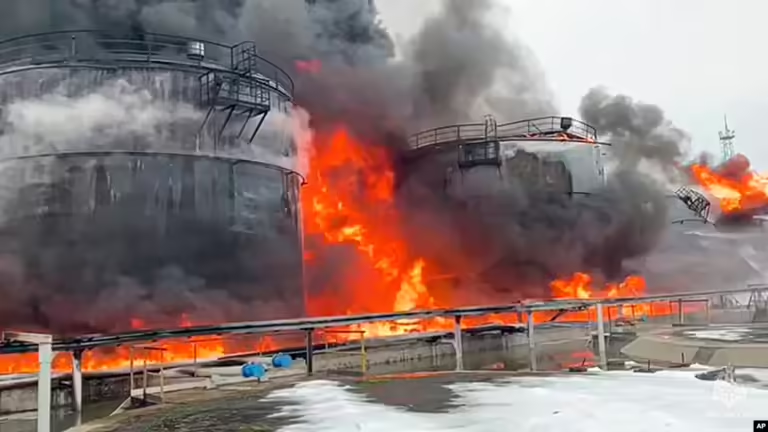
A fire ignited by a drone attack on an oil depot in the southern Russian region of Rostov has gone into its second day with local emergency services still trying to put it out.
According to a Reuters report, the drone attack had been carried out by the Security Service of Ukraine.
Ukrainian attacks on Russian refineries and other energy infrastructure have become a fixture this year, with drones the weapon of choice for conducting the strikes.
The series of strikes has affected Russia’s refining capacity and earlier this year led the U.S. to call on the Ukrainians to stop targeting refineries in order to avoid a fuel price spike ahead of the November elections.
This week’s attack on the oil depot is the second since the start of the month in the region of Rostov. In early June, Ukrainian forces struck an oil refinery in Novosakhatinsk, causing another fire and prompting the suspension of work at the facility.
They also attacked an oil depot in the Belgorod region on the border with Ukraine.
“The Ukrainian Armed Forces, using a kamikaze drone, attacked an oil depot on the territory of the Stary Oskol urban district. As a result of the explosion, one of the tanks caught fire. Four fire crews quickly extinguished the fire.
“The blast wave blew out the windows in the security building. There were no casualties,” the governor of Belgorod said at the time.
The amount of refining capacity affected by Ukrainian drone attacks since the start of the year was estimated at around 600,000 barrels daily in April by Gunvor, the commodity trading major. According to JP Morgan, the amount was much higher, at 900,000 barrels daily.
Repairs are ongoing at many sites but it seems the Ukrainians are not heeding the Biden administration’s advice to stop targeting oil infrastructure.
Source: Oilprice.com