




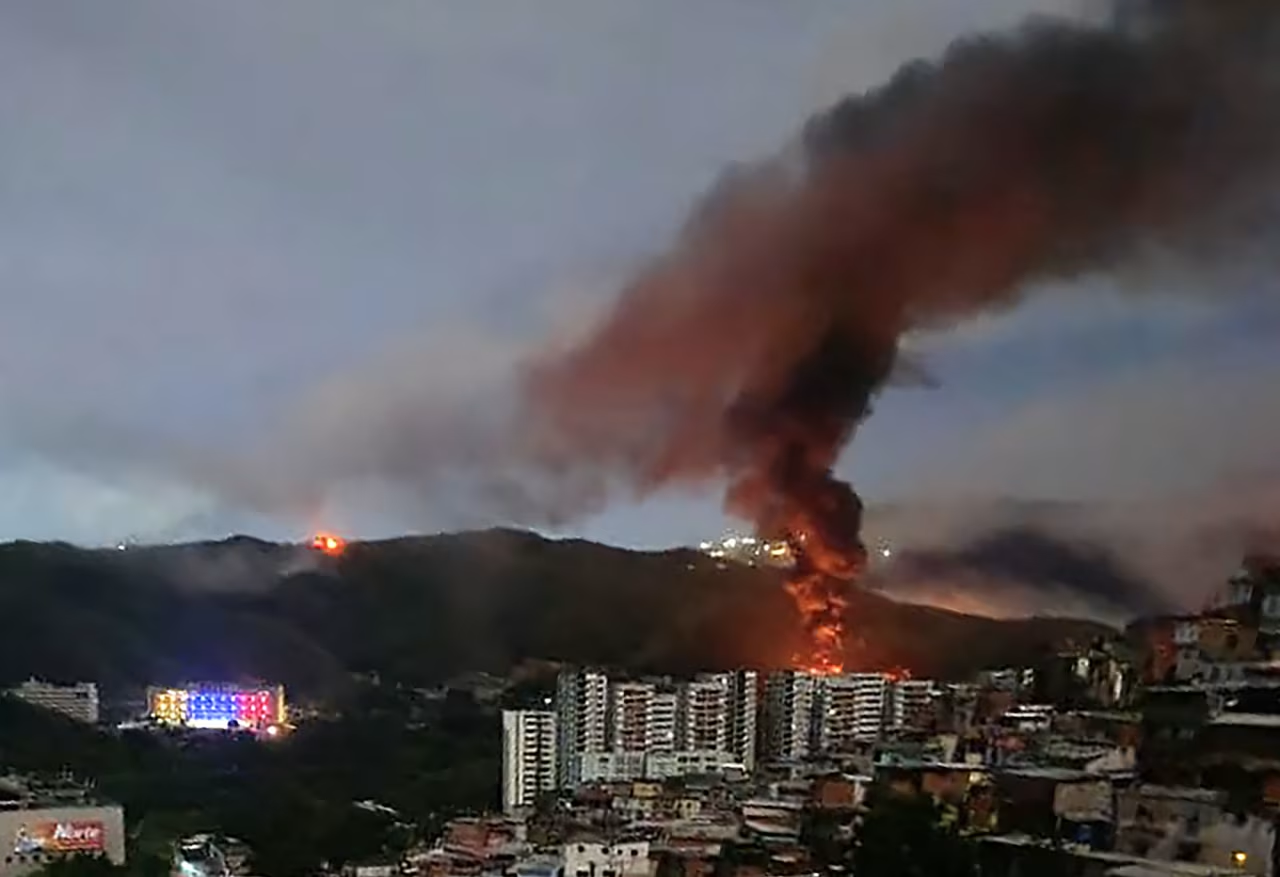
The United States on Saturday launched a large-scale air strike on Caracas, the capital of Venezuela, after its military reportedly captured President Nicolás Maduro and his wife and took them to an undisclosed location.
U.S. President Donald Trump confirmed the operation on Saturday, describing the mission as a “successful large-scale strike against Venezuela.”
He added that the operation was conducted “in conjunction with U.S. law enforcement.”
“The United States of America has successfully carried out a large-scale strike against Venezuela and its leader, President Nicolás Maduro, who has been, along with his wife, captured and flown out of the country. This operation was done in conjunction with U.S. law enforcement,” President Trump wrote on social media following the operation.
The United States and Venezuela have had a long-standing, fraught relationship shaped by disputes over oil, politics, sanctions and security concerns.
Venezuela holds the world’s largest proven oil reserves, estimated at 303 billion barrels (Bbbl) as of 2023.
Saudi Arabia ranks second with 267.2 Bbbl, followed by Iran at 208.6 Bbbl and Canada at 163.6 Bbbl. Together, these four countries account for more than half of global oil reserves.
By comparison, the United States holds about 55 Bbbl, placing it ninth globally. Venezuela’s reserves are therefore more than five times larger than those of the U.S.
Analysts view the U.S. attack and the reported capture of President Maduro as part of Washington’s broader plan to take control of Venezuela’s oil resources.
U.S. Attorney General Pam Bondi said Maduro has been indicted in New York on drug trafficking and weapons charges and will “face the full wrath of American justice on American soil in American courts.”
U.S. Secretary of State Marco Rubio anticipates no further action against Venezuela, according to a Republican senator.
Venezuela has declared a national emergency, denouncing what it described as “extremely serious military aggression.”
Venezuelan Vice President Delcy Rodríguez said the government is unaware of the whereabouts of President Maduro and First Lady Cilia Flores, adding that the U.S. attack has resulted in the deaths of government officials, military personnel and civilians across the country.
Several explosions were reported in Caracas, with parts of the city experiencing power outages. The first blast was recorded at approximately 1:50 a.m. local time on Saturday (12:50 a.m. ET).
The U.S. operation appears to have been carried out with “impressive speed,” likely involving special operations forces, according to a munitions and intelligence specialist.
N.R. Jenzen-Jones, director of research firm Armament Research Services, told CNN that the operation “appears at first blush to have been carried out with impressive speed and precision.”
“The mix of visible aircraft, the known presence of certain U.S. vessels, and the nature and volume of the reported strikes in imagery circulating online immediately suggested that a raid using special operations forces (SOF) was underway,” he said.
“In addition to at least a dozen helicopters, the operation would have been supported by a robust air package comprising both fixed-wing and rotary-wing assets, including specialist aircraft,” Jenzen-Jones added.
He noted that while the operation would have required extensive planning, the “number and nature” of reported strikes suggest a limited target set.
Venezuela maintains “robust air defence systems and locally distributed military, paramilitary and law enforcement forces” in Caracas, which should have made such a raid difficult, Jenzen-Jones said.
“In practice, corruption, poor training, lack of maintenance and other factors significantly reduce this threat,” he added.
Discover more from Energy News Africa
Subscribe to get the latest posts sent to your email.