


ADNOC To Buy 35% Stake In ExxonMobil’s Blue Hydrogen Plant
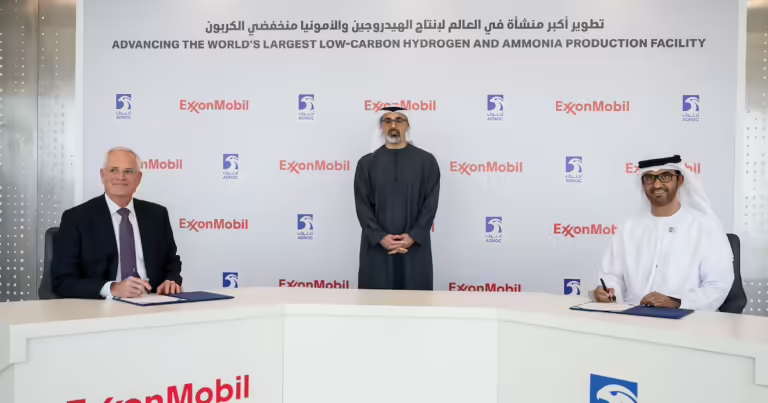
Abu Dhabi-based energy company Adnoc has agreed to acquire a 35% equity stake in Exxon Mobil’s (NYSE:XOM) proposed low-carbon hydrogen and ammonia production facility in Baytown, Texas, according to various media reports.
The project is set to become the “world’s largest” of its kind, with a production capacity of up to 1 billion cubic feet daily of blue hydrogen, with about 98% of carbon dioxide removed, as well as more than 1 million tonnes of low-carbon ammonia per year, Adnoc revealed in a statement on Wednesday.
The company will reach a final investment decision for the project in 2025, with operations expected to kick off in 2029.
“This strategic investment is a significant step for Adnoc as we grow our portfolio of lower-carbon energy sources and deliver on our international growth strategy,” said Dr Sultan Al Jaber, Adnoc managing director and group chief executive, as reported by Reuters.
“This is a very significant investment and the partners it is attracting give a sense for the momentum that’s building around this project,” Exxon President of Low Carbon Solutions Dan Ammann told Reuters.
Blue hydrogen is primarily produced from natural gas through a process known as steam reforming, involving combining natural gas with steam with hydrogen generated as the main product while carbon dioxide is produced as a by-product and captured.
Currently, the vast majority of hydrogen demand is supplied by fossil fuel-based steam methane reforming without carbon capture aka gray hydrogen.
The Baytown plant will have access to “cheap” gas from the U.S. Gulf Coast via pipelines.
Blue hydrogen demand is expected to see robust growth in the coming years, a trend likely to continue driving natural gas demand.
According to McKinsey, by 2050, blue hydrogen production could require as much as around 500 billion cubic meters of natural gas (between 10 and 15 percent of global natural gas demand), and capacity to capture and store 750 to 1,000 megatons of CO2.
Nearly all hydrogen consumed today (approximately 90 million tons per annum) is gray hydrogen.
However, demand for gray hydrogen is projected to decline as demand for clean hydrogen rises and the cost of green hydrogen declines.
Source: Oilprice.com
Ghana: VRA Workers Group Mount Opposition To Merger With Bui Power Authority

The Staff Groups of the Volta River Authority (VRA), a state-owned power generation company, have expressed strong opposition to the government’s plan to restructure the power sector, which will lead to the merger of the two hydropower generation companies—VRA and Bui Power Authority.
The plan will also lead to the merger of the Electricity Company of Ghana (ECG), which supplies power in the southern part of Ghana, with the Northern Electricity Distribution Company (NEDCo), which is responsible for power supply in the Northern Regions of Ghana.
There will also be the establishment of an independent Thermal Power Authority to take over the running of VRA’s thermal plants.
The groups argue that these decisions are not in the best interest of Ghanaians and could have severe consequences for the VRA and the nation.
The groups emphasised that the proposed changes could undermine the VRA’s contributions to the national grid and security.
In a statement issued on Wednesday, they recalled a meeting with the VRA Board Chairman in May 2024, when assurances were given that there were no plans to privatise the Thermal Assets of the Authority.
However, recent media reports about the proposed bills have raised concerns among the staff who feel excluded from the decision-making process.
They also noted that at a Joint Consultative Committee (JCC) meeting on August 29, 2024, the VRA management admitted to being part of a Technical Committee that worked on a report for the Ministry of Energy, proposing the VRA as a Holding Company.
Despite this, there had been no official communication about the mergers or the creation of a Thermal Power Authority.
The staff groups believe that the proposed actions are a scheme to privatise the Thermal Department, making it easier for private entities to take over valuable Ghanaian assets.
They argue that VRA was established to generate electrical power through various sources, not just hydro and that restricting its operations could lead to its collapse.
The VRA staff is calling for immediate action to address these issues and ensure that the interests of Ghanaians and the VRA are protected.
“The Volta River Authority was built for the people and not the highest bidder. There is an existing Memorandum of Understanding between the VRA and NEDCo that guarantees the VRA’s continuous support in terms of power supply and the expansion of other infrastructure.
“The MOU has expired, requiring a renewal, but management has been rendered powerless and has no interest in the renewal to guarantee continuous support to NEDCo for no apparent reason.
“The support the VRA gives to the NEDCo is to ensure that our brothers and sisters in the NEDCo catchment areas of the country enjoy electricity consistently without any hindrance.
“The separation of NEDCo from the VRA can affect the supply of power and cash inflows for the VRA since the ECG is not consistent with its payment obligations to the VRA.
“We see this attempt as ‘A GRAND SCHEME TO SELL VRA ASSETS TO CRONIES’.
“The Staff of VRA, with the support of Ghanaians, shall fearlessly resist and use all legitimate means at our disposal to ensure that the people of Ghana are not robbed of affordable electric power and energy security under the guise of mergers and privatisation,” they further stated.
Source: https://energynewsafrica.com
Ghana: Ignore Audio Citing Some Of Our Fuel Stations Of Cheating—GOIL

Ghana’s largest Indigenous Oil Marketing Company, GOIL, has urged the public to disregard audio purporting to cite some of its retail outlets as allegedly involved in adjusting fuel pumps to the detriment of customers.
In a statement issued on Wednesday, GOIL said the audio in question dates back to 2019, noting that the issue being mentioned had already been thoroughly investigated and actions were taken to resolve the matter.
“Specifically, misunderstandings regarding pump deliveries were addressed and resolved five years ago,” the company said.
It added that subsequent verifications by the Ghana Standards Authority (GSA) have confirmed the accurate delivery of fuel at its stations and, therefore, advised the public to disregard the audio being mischievously re-circulated on social media.
Source: https://energynewsafrica.com
Nigeria, China Sign Nuclear Energy Pact

Nigeria and China have signed a nuclear power cooperation agreement at the 2024 Summit of the Forum on China-Africa Cooperation (FOCAC) in Beijing.
The agreement will enhance collaboration in the Belt and Road Initiative, human resource development, and nuclear energy.
The alliance is expected to bolster development, stability, and security in the West African sub-region.
Nigeria has been discussing the creation of its own nuclear energy industry for more than a decade.
China, Nigeria’s largest bilateral lender, has already invested heavily in the country’s infrastructure, with $5 billion in loans at the end of March 2024.
The partnership between the two countries has included critical projects, including a deep sea port and extensive rail lines under the Belt and Road Initiative since their cooperation intensified in 2018.
President Bola Tinubu, who attended the summit alongside leaders from 50 African nations, highlighted the potential for this strategic partnership to drive growth not only in Nigeria but also across Africa, emphasizing the importance of stability and security.
Chinese President Xi Jinping stated that the enhanced strategic coordination between China and Nigeria would inject fresh momentum into China-Africa relations and promote collective progress among Global South countries.
During his visit, President Tinubu toured the Huawei Research lab, securing a commitment from the tech giant to establish a joint solar PV test lab in Nigeria.
Another Chinese company pledged to build an assembly plant for electric tricycles and train Nigerians in technology and renewable energy development.
This agreement comes as China is poised to embark on a record-breaking nuclear expansion that will see it build more nuclear power plants than any other country in the world in what will make it the world’s biggest nuclear generator by 2030.
For Nigeria, the partnership offers a promising avenue for advancing its own energy infrastructure and sustainable development goals.
Source: https://energynewsafrica.com
Shell, Turkey Sign 10-Year LNG Supply Deal In Regional Gas Hub Push

Turkey and Shell signed a 10-year liquefied natural gas (LNG) supply deal with an option to redirect shipments to Europe, the latest step in Ankara’s push to become a regional hub for the fuel.
Shell will sell Turkey’s state-owned Botas the equivalent of around 4 Bcmg per year starting in 2027, Energy Minister Alparslan Bayraktar said at a signing ceremony in Ankara.
That’s about 8% of the country’s total gas demand in 2023, data from the national energy regulator show.
The contract includes an option for the gas to be delivered to European terminals outside Turkey, Bayraktar said, adding that it will give Botas “critical capabilities” in LNG shipping.
The announcement hints at plans for a more active international trading role for the national energy company, which has traditionally imported cargoes for domestic consumption.
Turkey aims to become a gas hub and supplier to the European Union and has invested heavily in excess LNG import capacity as well as domestic production in the Black Sea.
It already exports small volumes to the bloc, but flows are constrained by pipeline capacity at the western border with Bulgaria.
Botas buys pipeline gas from Russia, Azerbaijan and Iran, while Algeria and the US dominate its LNG imports.
In May, the company signed a 10-year LNG supply deal for up to 2.5 million tons per year with US major Exxon Mobil Corp.
Source: World Oil
Ghana: Krapa, Joe Dadzie To Showcase Investment Opportunities In Ghana At The Africa Oil Week

Ghana’s Minister of State at the Energy Ministry, Herbert Krapa, will be leading a high-powered delegation of Ghana’s energy leaders to showcase a range of significant investment opportunities in the country’s oil and gas sector at the upcoming Africa Oil Week in Cape Town, South Africa.
AOW is scheduled at the Cape Town International Conference Centre (CTICC) from October 7 to 12, 2024.
Mr Herbert Krapa, Minister for Energy, Republic of Ghana, and the Ghana National Petroleum Corporation CEO, Joe Dadzie, will provide invaluable insights into Ghana’s burgeoning oil and gas sector, and host private meetings with interested operators in an exclusive showcase themed: ‘Why Ghana matters: A New Era of Exploration’.
The engagements are expected to be among the most promising at the event, which has million-dollar networking opportunities as one of its unique selling points.
AOW describes itself as “the meeting place for the global community of African energy stakeholders committed to enabling a prosperous energy outlook for Africa.”
West Africa has long been one of the continent’s hottest regions for oil and gas exploration. Recent discoveries in Cote d`Ivoire surrounding the Calao and Baleine basins have emphasised the region’s importance.
Now, ongoing discoveries in the Tano Basin off Ghana have become a focus for industry experts.
“It is no surprise that Ghana is one of the hottest topics in the African oil and gas narrative,” said Yemi Ibidunni, Event Director for AOW.
“The industry has matured rapidly since discoveries in the Jubilee field in 2006, with upstream and downstream development.
“Now, new offshore finds have boosted interest in Ghana’s prospects. We are proud to be hosting a session to delve into what makes Ghana an attractive investment and exploration destination.”
Key topics to be covered in the session will include: the resurgence of interest in the Tano Basin, and how recent discoveries are reshaping the West African oil and gas landscape; open-acreage offshore opportunities, and the potential for future discoveries; and a first look at the hugely anticipated Volta and Keta basins, and their significance to African exploration.
AOW is acknowledged as the premier meeting point for the global private sector and balance-sheet holders with the capital and technology to drive major projects.
The exclusive Ghana Showcase will give attendees the chance to engage with key Ghana energy stakeholders, gain strategic insights, and stay ahead of the curve on upstream trends and opportunities in the territory.
“In particular, this session will offer an in-depth look at the re-emergence of the Transform Margin as one of Africa’s most promising areas.
“This event promises to be a game changing moment for the industry given Ghana’s huge potential,” said Sinclair.
Source: https://energynewsafrica.com
Algeria Exports Locally Manufactured Electric Vehicle Charging Stations To Italy, Libya

SAIEG, a subsidiary of Sonelgaz Group, an Algerian-based company, has exported its first batch of electric vehicle (EV) charging stations to Italy and Libya, Algerian News Agency has reported.
The shipment included 433 EV charging stations, each with a 60KW power capacity and a fast-charging capability of 322KW.
SAIEG is manufacturing the products locally, aligning with the Algerian government’s strategy to advance the energy transition and diversify export revenues by increasing the production and monetisation of non-oil products.
SAIEG plans to expand its production capacity for EV chargers and is in negotiations to export to additional European and Middle Eastern markets.
Source: https://energynewsafrica.com
Ghana: PETROSOL Commended For Fuel Quality And Accuracy

The consumer advocacy group, Chamber of Petroleum Consumers (COPEC) Ghana, has commended PETROSOL Platinum Energy for its unwavering commitment to delivering high-quality fuel and accurate quantities to consumers.
In a congratulatory message marking PETROSOL’s 10th anniversary, COPEC’s Executive Secretary, Mr. Duncan Amoah, hailed the company as a shining example of excellence in the industry.
Mr. Amoah noted that PETROSOL’s triple International Organization for Standardization (ISO) certification for quality management, health and safety management, and environmental management systems is a testament to its dedication to meeting international standards.
He also praised the company’s reputation for delivering the right quantities of fuel to customers, saying COPEC has never received a customer complaint about PETROSOL’s products or services.
PETROSOL’s pioneering “Full Quantity Campaign” launched in 2016, which educated consumers on how to ensure they receive the right quantities of fuel at the pump, was also highlighted by Mr. Amoah.
The campaign’s success in promoting transparency and accountability in the industry earned it the Marketing Campaign of the Year award at the 2017 Ghana Oil & Gas Awards.
The National Petroleum Authority (NPA) has also recognized PETROSOL’s commitment to excellence, with its Chief Executive, Dr. Mustapha Abdul-Hamid, praising the company’s leadership and team for upholding high standards of integrity.
With a network of 115 fuel stations nationwide, PETROSOL remains a trusted brand among consumers, known for its high-quality fuels and lubricants, as well as its focus on customer satisfaction.
Source: https://energynewsafrica.com
IAEA Steps Up Nuclear Safety Assistance To Ukraine

The International Atomic Energy Agency (IAEA) says it will further expand its assistance to Ukraine by taking a more proactive stance to protect the status of vital energy infrastructure to ensure it does not impact nuclear safety.
This follows a number of missile attacks that have either directly caused the disconnection of several nuclear power reactors, or led to dangerous instability of the national grid, Director General Rafael Mariano Grossi said after meeting President Volodymyr Zelensky in Kyiv.
An IAEA expert team will soon travel to some of the damaged Ukrainian sub-stations – electrical switchyards forming the backbone of the grid – that have been identified as essential for nuclear safety, a statement issued by IAEA said.
They will assess the situation at these sites and report back to headquarters for possible follow-up actions.
“The safety of operating nuclear power plants is dependent on a stable and reliable connection to the electricity grid.
As a result of the war, the situation is becoming increasingly vulnerable and potentially even dangerous in this regard.
“I agreed with President Zelensky that the IAEA will widen its determined activities to help prevent a nuclear accident during the conflict and look closer at this important aspect of nuclear safety and security,” Director General Grossi said.
“Our experts will apply the Agency’s nuclear industrial safety and critical infrastructure protection expertise to assess these sub-stations,” he added.
The IAEA already has specialist teams stationed at all of Ukraine’s nuclear power plants (NPPs) to help maintain nuclear safety and security during the military conflict.
The sub-stations essential for nuclear safety are located in different parts of the country, making the evaluation of these facilities also relevant.
Increased pressure on Ukraine’s energy infrastructure over the past six months have caused instability in the grid, posing serious problems for Ukraine’s NPPs.
Access to reliable supplies of off-site power forms part of the Seven Indispensable Pillars for maintaining nuclear safety and security during an armed conflict outlined by Director General Grossi in March 2022.
On 26 August, widespread strikes targeting Ukraine’s energy infrastructure caused major fluctuations in the power supply and led to the temporary shutdown or disconnection of reactor units at the Rivne and South Ukraine NPPs, one of which has still not returned to full operation.
The off-site power situation at the Khmelnytskyy NPP and Chornobyl site was also affected.
The Zaporizhzhya Nuclear Power Plant (ZNPP), located on the frontline of the conflict, has suffered eight complete loss of power events during the conflict, forcing it to temporarily rely on diesel generators.
Just this week, the plant on Monday evening lost its connection to its sole remaining 330 kilovolt (kV) back-up power line, leaving it dependent on one single 750 kV line.
Director General Grossi will later this week travel to the ZNPP for the fifth time during the conflict, but he also underlined the nuclear safety and security risks at Ukraine’s other sites.
“The heightened vulnerability of Ukraine’s energy infrastructure is deeply concerning for nuclear safety at Ukraine’s nuclear power plants, as we saw last week when several reactors stopped operating because of damage to the energy infrastructure elsewhere in the country,” Director General Grossi said.
“Ensuring that the sub-stations can operate normally for safety related purposes is also of paramount importance for energy security in Ukraine, as the country to a large extent relies on the nuclear power plants for much of its electricity generation,” he said.
In Kyiv, Director General Grossi also agreed with President Zelensky that the IAEA will provide technical support and nuclear safety advice for Ukraine’s plans to purchase equipment from the interrupted Bulgarian project in Belene for the Khmelnytskyy NPP.
This will help Ukraine ensure that this ongoing project continues in accordance with safety standards.
Source: IAEA
African Institutions Converge In Abidjan To Shape Climate Agenda For COP29

The African Development Bank, the African Union Commission (AUC), the United Nations Economic Commission for Africa (ECA), and the Pan African Climate Justice Alliance (PACJA), brought together key stakeholders in Abidjan to align Africa’s climate action priorities ahead of the COP29 conference.
The meeting, the Twelfth Conference on Climate Change and Development in Africa, opened on 30 August on the sidelines of the Tenth Special Session of the African Ministerial Conference on the Environment (AMCEN).
Cote d’Ivoire’s Minister for Environment, Sustainable Development, and Ecological Transition welcomed participants.
In his opening remarks, he stressed the disproportionate impact of climate change on Africa despite its minimal contribution to global emissions.
“Africa emits less than 4 percent of total global greenhouse gas emissions, yet it is the most affected by the harmful consequences of climate change,” the minister noted.
He urged participants to develop concrete outcomes during the conference, which should serve as a platform for actionable recommendations to strengthen Africa’s participation in upcoming international negotiations including COP29.
Ambassador Josefa Sacko, AUC Commissioner for Agriculture, Rural Development, Blue Economy, and Sustainable Environment made opening remarks.
She said, “Without urgent adaptation and mitigation efforts, climate change will lead to an equivalent of 5 percent annual loss in GDP on the continent by 2040, with the poor, women, and the most vulnerable and marginalised populations, predominantly in Africa, bearing the brunt of the impacts.”
She urged participants to join forces ahead of COP29, with an emphasis on mobilising climate finance at scale for the continent.
“We must anchor our negotiations, deliberations, and common position on securing grants rather than debt or loans, scaling finance for projects, and enhancing carbon markets,” Sacko added.
Prof. Anthony Nyong, African Development Bank Director for Climate Change and Green Growth, called on meeting participants to do more.
“We need to continuously increase our support and financing for Africa to address the growing impacts of climate change on national economies, societies, and ecosystems,” he said.
Nyong said that Africa faces a significant climate financing gap.
“The current global climate finance falls far short of African countries’ needs and expectations, with less than 3 percent reaching sub-Saharan Africa annually.”
He reaffirmed the African Development Bank’s commitment to doubling climate finance to reach $25 billion by next year and increasing Africa’s share of global climate finance from 3 percent to 10 percent.
The Twelfth Conference on Climate Change and Development in Africa is expected to build consensus around African countries’ position on climate action and align priorities with the outcomes of the 2023 global stocktake, a key process under the Paris Agreement that assesses global progress on climate goals to guide future actions and policies.
Key objectives include developing robust frameworks for nationally determined contributions (NDCs) and identifying financing needs for climate adaptation and resilience-building.
The Tenth Special Session of AMCEN and UNCCD COP 16 Regional Consultation(link is external) will be held in Abidjan, Côte d’Ivoire, from 30 August to 6 September 2024, under the theme “Raising Africa’s Ambition to Reduce Land Degradation, Desertification, and Drought.
Source: https://energynewsafrica.com
Ghana: Bui Power Authority To Add 30 MWp Solar Onto National Grid

Ghana’s second largest state-owned power generation company, Bui Power Authority (BPA), will next month (October 2024) add 30 megawatts more of solar power from Yendi onto the national grid.
This will bring to a total of 85 megawatts of solar power that BPA generates onto the national grid.
The 30 megawatts will be the phase I of the 50 MWp solar power project being executed by BPA at Yendi in the Northern Region.
Speaking at the 2024 Annual General Meeting (AGM) in Accra last Friday, the Chief Executive Officer of BPA, Samuel Kofi Ahiave Dzamesi, said his outfit was committed to the development of Solar PV in northern Ghana.
Touching on the Yendi project, Mr Dzamesi said his outfit was making an effort to acquire lands around sub-stations at Bawku, Sawla, Tumu, Buipe and Zebila for similar projects.
Apart from the solar power projects, Mr Dzamesi revealed that feasibility studies for run-of -the-river hydro schemes on the three western rivers, namely Pra, Ankobra and Tano, and small/mini hydro schemes on the Wli Falls.
According to him, this study would provide the needed consideration for possible future development.
Ghana’s total solar energy portfolio is currently around 187 MW.
Source: https://energynewsafrica.com
Nigeria: New Petrol Price Will Push More Nigerians Into poverty-Economic Expert

The Executive Director for Africa International Trade and Commerce Research, Dr. Sand Mba-Kalu says the fuel price hike by NNPC Ltd. from N617 per litre to N897 litre will push more Nigerians into poverty.
He said the sudden increase in Premium Motor Spirit, PMS, pump price the Nigerian National Petroleum Company Limited (NNPC Ltd.) was beyond a simple fuel price adjustment.
He said that it would have a far-reaching impact on Nigeria’s private sector, trade and the already suffering Nigerian masses.
He was speaking to News Agency of Nigeria on Tuesday in Abuja while reacting to the development.
NNPC Retail Management has approved upward review of the pump price from N617 per litre to N897 llitre, effective from Sept. 3, amidst economic hardship and persistent fuel scarcity.
Consequently, NNPC retail stations adjusted their pumps and totems (price boards), reflecting new PMS price of N897 against N617 per litre while independent marketers who are selling between N930 to N1,200.
Mr Mba-Kalu said without government interventions, the economic and social repercussions of this price hike could be severe and long-lasting, pushing more people into poverty.
“What we will witness is the immediate high cost of transport, which will lead to higher costs of food and inflation.
“In the long term, it could pose challenges for small and medium-sized enterprises (SMEs) and the agricultural sector,” the expert said.
He urged the Federal Government to acknowledge these implications and consider measures to reduce the impact, such as targeted incentives for energy efficiency, stopping wasteful spending, and reducing cost of governance.
“Without such interventions, the economic and social repercussions of this price hike could be severe and long-lasting, pushing more people into poverty,” he warned.
Chris Nzeh, a motorist, who condemned the development, describing it as crazy, said what had been going on in Nigeria under the current government would only suffocate Nigerians.
“How do they want the average man to survive?
“We were told that with the removal of fuel subsidy, fuel will be available everywhere in Nigeria, but today, it appears NNPC Ltd. is scamming Nigerians.
“They are the sole importer of petroleum and they have refused to make refinery work and you ask yourself what is going on in Nigeria.
“Nigerians should rise and save this country from collapse,” he said.
Source: https://energynewsafrica.com
Libya Declares Force Majeure On El-Feel Oil Field Amid Production Shutdown

Libya’s state oil firm declared force majeure on key field El-Feel amid a widening shutdown of production triggered by a power struggle in the OPEC member.
The force majeure, a legal clause that allows companies to suspend contractual obligations due to circumstances beyond their control, came from National Oil Corp.
After authorities in the east stopped all output and exports in a dispute with rivals over control of the central bank.
The country’s production has more than halved since then. El-Feel was pumping about 70,000 bpd.
The eastern and western governments are in a standoff over the bank, the custodian of billions of dollars of energy revenue.
Eastern authorities ordered the freeze after the internationally recognized government in the capital, Tripoli, replaced Governor Sadiq Al-Kabir.
The nation was pumping about 1 MMbpd before the halt order, with the vast majority of that coming from the east. Daily production in the past week plunged to about 450,000 bpd.
Oil prices in London jumped above $80 a bbl when the production halt was announced last week. They’ve slipped since on concerns about global demand.
Al-Kabir, who’s feuding with Tripoli-based Prime Minister Abdul Hamid Dbeibah and has allies in the east, rejected the order to step down, prompting western authorities to take over the bank’s headquarters.
Source: World Oil
Ghana: Tema ECG Loses Transformer

The Tema Region of the Electricity Company of Ghana has lost a transformer to thieves who vandalised and made away with some components of the transformer and associated items.
The transformer, a 100KVA, 33/0.433KV, valued at about GHC75,000, was discovered to have been vandalised on the morning of Saturday, 31st August 2024 during a routine patrol to check on the network to fix a power outage situation.
The transformer, located at the Asutsuare Junction, had been brought down, some parts removed and taken away while other components lay scattered around it.
The ECG officials who made this discovery made a report on this to the Doryumu Police Station.
Speaking on this, the Regional Engineer for ECG Tema Region, Ing Michael Buabin, indicated that “the damages to these transformers cause inconveniences to customers as some had been without supply due to the damage.”
He added that “it also causes the company as resources meant for other projects have to be re-chanelled into replacing the stolen transformer.”
He indicated that “the damaged transformer guy itself would cost about GHC75,000 while the associated components needed will likely raise the cost to over GHC100,000, an amount which could have gone into other developmental projects by the organisation.”
Ing Buabin made a plea to the public, asking that “they should support the ECG, and to report any persons seen damaging or trying to sell off such items to the police as that can help to hopefully prevent such occurrences in the future.”
Source: https://energynewsafrica.com