


The Gambia: Gov’t Invites Solar Developers To Submit Application For 50MW Solar Project

The Government of The Gambia, through the Ministry of Petroleum and Energy (MoPE) and the National Water and Electricity Company (NAWEC), has issued a public notice to invite applications from solar power developers for a World Bank-supported 50MWp Regional Solar Project on a site with excellent solar irradiation in Soma–Lower River Region, The Gambia.
The preliminary design and planning model concluded that the capacity of the solar power park could be up to 150MWp with storage at the Soma substation and could be built in two phases.
The first phase of this project is 50MWp with a Battery Energy Storage System to meet (and not exceed) the national needs of energy consumption.
To this effect, The Government of The Gambia, through MoPE and NAWEC, intends to select an Independent Power Producer (IPP) under a Public-Private Partnerships (PPP) approach.
The IPP will be responsible for the financing, construction and operation of the solar power park in the first phase of 50MWp with a Battery Energy Storage System for 25 years (the Project).
In this regard, interested firms are invited to submit Applications to participate in this tender.
A complete set of Request for Qualification documents can be purchased by interested firms upon payment of a non-refundable fee of USD500 (Five Hundred US Dollars) to the National Water and Electricity Company, Project Implementation Unit Emporium III Building, Fajara.
“Please contact Haddy Njie by email at [email protected] and copy to [email protected], [email protected] for the account details and access to the Request for Qualification document.
“Please tender the receipt and collect the Request for Qualification document from:
“National Water and Electricity Company (NAWEC) Project Implementation Unit Emporium III Building, 114 Kairaba Avenue, Fajara Banjul, The Gambia
Telephone: +220 3664125/ 9967791/ 7009342.
“The Submission Deadline for Applications is the 14th of November,2024 noon Banjul Time.”
Source: https://energynewsafrica.com
Ghana: Oil And Gas, Power Sector Players Gather Under Local Content Conference & Exhibition In Takoradi

Ghana’s Minister of State at the Ministry of Energy, Mr Herbert Krapa, on Wednesday, opened the three days ‘Local Content Conference and Exhibition (LCCE) organised by the Petroleum Commission, Ghana’s regulator for the upstream petroleum sector.
The event, under the theme: ‘Attracting Exploration and Production Investments To Boost Local Content–New Pathways’, underway in Takoradi, has attracted several players in the upstream petroleum and power sector players, both locally and outside Ghana.
Key industry players include Ghana National Petroleum Corporation (GNPC), Tullow, Eni, Kosmos Energy, Volta River Authority (VRA), Nigerian Content Development and Monitoring Board (NCDMB) and Proscovia Nabbanja of Uganda.


 Source: https://energynewsafrica.com
Source: https://energynewsafrica.com
Chevron Restarts Gas Production In Israel After Brief Halt During Iran’s Attack

Chevron has resumed natural gas production and supply from two platforms offshore Israel, where output was briefly suspended as a precaution due to the Iranian missile attack on Israel on Monday.
Iran yesterday fired more than 100 ballistic missiles into Israel after the United States warned Israel on Monday morning that an attack was imminent.
Oil prices jumped after news of the attack broke, amid concerns that oil and gas supply from the region could be affected in case of a wider conflict directly involving Iran, which sits close to the most important oil route in the world, the Strait of Hormuz.
“Chevron Mediterranean Limited (CML) can confirm that we have resumed production at both our Tamar and Leviathan facilities and are supplying natural gas to our customers in Israel and the region from both reservoirs,” the U.S. supermajor said in a statement carried by Russian news agency TASS.
“Any questions regarding the current security situation should be addressed to the appropriate Israeli governmental authorities,” Chevron added.
A year ago, Chevron also shut down the Tamar gas field after Hamas’s attack on Israel in early October 2023, which ignited the ongoing conflict in the region.
Chevron Mediterranean Limited operates Tamar and has a 25% stake in the field. At Tamar, six production wells produce volumes of natural gas ranging from 7.1 to 8.5 million cubic meters per day each.
Most of the natural gas processing takes place on the Tamar platform situated 24 kilometers (15 miles) west of Ashkelon. Tamar supplies 70% of Israel’s energy consumption needs for electricity generation, Chevron says.
Chevron has an interest in another gas field offshore Israel, the Leviathan gas field, the biggest energy project in Israel ever, after it bought Noble Energy.
The Leviathan gas reservoir was one of the world’s largest deep-water gas discoveries of 2000s and its development is the largest energy project in Israeli history.
The gas field is located deep in the Mediterranean Sea, 130 kilometers (81 miles) west of Haifa.
Source: Oilprice.com
Nigeria: FG Grants UTM Offshore Ltd License To Construct First Floating LNG Facility

Nigeria has officially granted UTM FLNG Limited “License to Construct” Nigeria’s first Floating Liquefied Natural Gas (FLNG) facility, opening a new economic chapter for Nigeria, Africa’s largest crude oil producer, in the global gas market.
The UTM Offshore Limited Floating Liquefied Natural Gas (FLNG) plant with a capacity of 2.8 million tons per annum (MTPA), will produce Liquefied Natural Gas (LNG), Liquefied Petroleum Gas (LPG), and condensate from re-injected gas at the OML 104 Yoho Field.
The issuance of the LTC to UTM Offshore Limited by the Nigerian Midstream and Downstream Petroleum Regulatory Authority (NMDPRA) fulfils the assurance by President Tinubu in July 2023 to give all necessary support to the Nigerian firm to ensure the actualization of the landmark gas project.
The President had, during an audience with the management of the company and its foreign partners at the State House, Abuja pledged to remove all impediments to the timely completion of the facility.
The project represents a significant step forward in Nigeria’s energy sector, enhancing the country’s ability to harness its untapped 209 trillion cubic feet of natural gas for both export and domestic consumption.
This is expected to leapfrog the national economy by ensuring availability of gas at lower cost, generate massive employment, and multi-million Naira business opportunities for Nigerians and other nationals.
Speaking at the event at the NMDPRA headquarters in Abuja on Friday, which was attended by key industry players, including the Minister of State for Petroleum Resources (Gas), Ekperikpe Ekpo, Chief Executive Officer of NMDPRA, Farouk Ahmed, said the LTC signing ceremony “marks a significant milestone and aligns with the gas expansion ambitions of the government” as contained in the Petroleum Industry Act (PIA) 2021.
Ahmed noted that the FLNG is a yield of President Tinubu’s effort in the expansion of the Midstream Gas Sector adding that the Federal Government under Tinubu administration will continue to give all necessary support and conducive environment for the firm to operate.
In his speech, Group Managing Director of UTM FLNG Limited, Dr. Julius Rone, OFR, ROI expressed profound gratitude to President Tinubu for his “unwavering support to the gas sector and the UTM FLNG project in particular.
Rone stated that the project aligns with the President’s promise to develop Nigerian gas resources as a source of sustainable energy and economic development for the country.
He acknowledged the collaborative efforts of the NMDPRA and the dedication of all stakeholders involved in bringing this project to fruition.
He also thanked the GCEO of the Nigeria National Petroleum Company Limited (NNPCL), Mallam Mele Kyari, for the support from NNPCL for believing in UTM Offshore to deliver on the project.
“This achievement is not just a License to Construct; it is a testament to the collaborative spirit and commitment to excellence shared by our teams.
“The guidance and thorough review process by NMDPRA have been instrumental in navigating the complexities of this endeavour, ensuring compliance with industry standards and fostering a productive partnership” Rone said.
The UTM FLNG boss stated that the journey toward this milestone began with concept studies in 2019, followed by the pre-FEED phase in June 2021 and the successful completion of the FEED phase in October 2023.
He said, “UTM Offshore Limited, the main sponsor of the UTM FLNG Project, signed the Head of Terms with NNPC Limited in July 2023 and finalized the Shareholders Agreement with NNPC Ltd and the Delta State Government in December 2023.
“As UTM FLNG Limited moves forward into the Engineering, Procurement, and Construction (EPC) phase, the company remains committed to conducting operations with integrity, sustainability and respect for the communities and environment in which it operates.”
The UTM FLNG Plant which is located offshore Akwa Ibom State in the oil-rich Niger Delta of the South-South region of Nigeria is expected to be completed and commissioned in 2028 with gas production projected to commence the following year.
Source: https://energynewsafrica.com
Zambia: Maamba Power Plant Resumes Full Operation After Maintenance Work

Zambia’s largest Independent Power Producer, Maamba Energy Limited, has announced the completion of its annual maintenance works on the 300MW eco-friendly coal-fired power plant.
The company said it has since resumed full capacity operations and is supplying the full contracted power to Zambia Electricity Supply Company (ZESCO).
“The shutdown on the two units was essential to allow maintenance works that are vital to ensure the safety and long-term operational efficiency of the critical equipment of the Thermal Power Plant,” the company said in a post on Facebook.
The 300MW coal-fire power plant was shut down in September for maintenance.
The shutdown of the plant and severe drought that affected power generation from the Kariba Dam forced ZESCO to implement load-shedding, with some Zambians either receiving power for few hours in a day or days without power.
The resumption of the Maamba Power Plant is likely to improve power supply in the southwestern African nation.
Source: https://energynewsafrica.com
Ghana: PETROSOL Launches “Energizing Dreams Promo” To Reward Customers

PETROSOL Platinum Energy Ltd, a leading energy company in the Republic of Ghana, has launched a nationwide promotional campaign dubbed “Energizing Dreams Promo” to commemorate its 10th anniversary.
The six-month-long promo aims to reward its loyal customers for the trust in and loyalty to the brand over the past 10 years and to also usher them into the company’s new phase as a brand that seeks to energize the dreams and aspirations of its customers better.
The sales promotion was launched jointly by Mr. Duncan Amoah, the Executive Secretary of the Chamber of Petroleum Consumers (COPEC), who was the Guest of Honour; Mr. Kwabena Agyekum, the Chief Executive Officer of the Chartered Institute of Marketing Ghana, who was the Chairman for the occasion; and Michael Bozumbil, the Chief Executive Officer of PETROSOL.
The event also had representatives from the Ghana Private Road Transport Union (GPRTU), the Tanker Owners Union, the Tanker Drivers’ Union, some dealers of PETROSOL, among others.
Speaking about the promotion, Mr. Bozumbil unveiled PETROSOL’s decision to give away exciting prizes, including fuel vouchers, lubricants vouchers, tricycles, motorcycles, TVs, fridges, phones, and ultimately 2 brand new Suzuki S-Presso cars.
He also added that the company has invested in procuring over 100,000 pieces of PETROSOL branded souvenirs such as irons, T-shirts, umbrellas, power banks, standing fans, tissue boxes, exercise books, school bags, among others, to be given to its customers.
To participate, customers must register at any of PETROSOL’s over 100 stations or register online at www.petrosolcrm.com
Customers will be categorized based on their segment (taxis, trotros, Uber/Bolt/Yango, motorcycle/tricycle, trucks, B2B, etc.) and must meet a purchase threshold to qualify for the monthly draws for the major items, which will be conducted by the National Lottery Authority, to ensure transparency.
As for the souvenirs, customers will be taking part in daily draws at the various stations, irrespective of the amount purchased.
According to Mr. Bozumbil, PETROSOL has come a long way since its inception, and they are grateful to their customers for their unwavering support, which has made the company survive, in the midst of the challenges.
“Therefore, the Energizing Dreams Promo is our way of saying thank you in tangible terms to our customers and also energizing their dreams, especially in these times of economic difficulties when our customers are finding it difficult to buy such products or items.”
The monthly promo draws will be done in each of the six business territories of PETROSOL, culminating in two grand finale events in the Southern Sector and the Northern Sector.
Customers’ progress in the promo will be tracked digitally through PETROSOL’s Customer Relationship Management (CRM) platform, and they will receive SMS alerts for transactions and points earned.
Mr. Duncan Amoah praised PETROSOL for its consistency in placing the needs of its customers as top priority as it has consistently delivered high-quality petroleum products in full quantity and also at fair prices.
He said PETROSOL was a model of excellence in the industry and a signing example of indigenous private ingenuity and thus should be supported to grow even beyond the shores of Ghana.
He therefore entreated all petroleum consumers to take advantage of this sales promotion and patronize their products for the longevity of their vehicles and also stand the chance of winning prizes.
Source: https://energynewsafrica.com
Equatorial Guinea: Oil And Gas Production To Be Boosted After ExxonMobil Exit

Equatorial Guinea, OPEC’s smallest producer, plans to boost oil and gas output following the exit of ExxonMobil from the Central African nation earlier this year, according to its oil minister.
Crude production in Equatorial Guinea has dropped by half over the last five years from as much as 140,000 bpd to 70,000 bpd in August, according to data compiled by Bloomberg. Exxon left the country earlier this year, transferring assets to state-owned company GEPetrol.
“Our national oil company will be moving into a new stage of production and exploration, that shall include the important redevelopment of the Zafiro Field,” Equatorial Guinea’s Minister of Hydrocarbons and Mineral Development Antonio Oburu Ondo said in a statement on Monday.
Zafiro was Exxon’s key asset, producing more than 1 Bbbl of oil over a period of more than 20 years. The field had been pumping about 45,000 bpd before it was shut in 2022 due to a safety incident.
Equatorial Guinea has bolstered the work of its national oil company with a $350 million contract award to Petrofac in April. It also plans to rely on other producers operating in the country including Chevron, Marathon Oil and Kosmos Energy to raise output. It recently held talks with oil trader Trafigura Group over financing.
Chevron paid $1.15 billion in taxes and shared oil production to Equatorial Guinea in 2023, more than all US counterparts, according to SEC filings compiled by Bloomberg. Marathon Oil paid $230 million, Exxon $189 million and Kosmos $145 million to the government.
The Zafiro redevelopment will start in 2025 and involve three phases within the year, Ondo said. Equatorial Guinea is also focusing on expanding an offshore Gas Mega Hub, which produces liquefied natural gas and methanol, with some feedstock coming by pipeline from Nigeria.
Reductions this year in corporate income taxes and dividend taxes are part of the government’s efforts to draw investment, Ondo said.
Source: https://energynewsafrica.com
Japan Maintains Energy Policy Focused On Boosting Nuclear And Renewables

Japan aims to continue restarting nuclear power plants and boost renewables capacity, the new industry minister said on Wednesday, signaling that the new government will not alter materially the country’s current energy policy.
“We can use renewable power to the maximum, and we will restart nuclear power, the safe one, as much as possible,” Industry Minister Yoji Muto, appointed by the new Prime Minister Shigeru Ishiba, told reporters in the first press conference as minister, as carried by Reuters.
Ishiba, who won the leadership race of the ruling Liberal Democratic Party, and by default became the new prime minister, had opposed reviving nuclear in the early stages of his campaign
However, Ishiba stopped calling for ending nuclear power shortly after winning the race to be Japan’s new prime minister.
Currently, Japan is bringing back nuclear power as a key energy source, looking to protect its energy security in the wake of the energy crisis that led to surging fossil fuel prices.
The resource-poor country which needs to import about 90% of its energy requirements, made a U-turn in its nuclear energy policy at the end of 2022, as its energy import bill soared amid the energy crisis and surging costs to import LNG at record-high prices.
At present, fossil fuels account for about 70% of Japan’s electricity, which would clash with its net-zero goal.
Earlier this year, a government projection showed that Japan would need to increase its electricity output by between 35% and 50% by 2050 to meet a proportionate surge in demand.
In May, Japan launched the most important energy policy discussions in its post-World War Two history, aiming to strike a balance between the need to boost its energy security with conventional sources and its pledge to become a net-zero economy by 2050.
Source: Oilprice.com
FTC Bars HESS CEO From Joining Chevron Board After $53 Billion Deal On OPEC Collusion Accusations
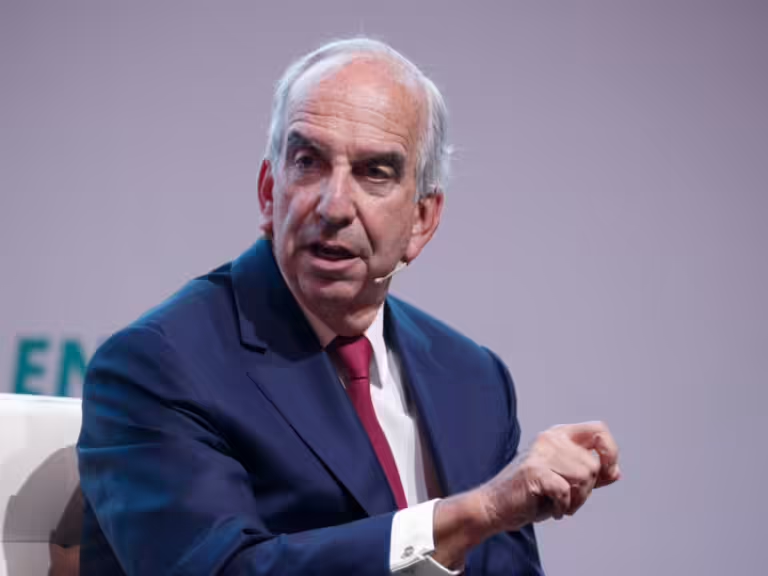
U.S. regulators will allow Chevron to move forward with its $53 billion acquisition of Hess but are barring Chief Executive Officer John Hess from joining the supermajor’s board, saying he improperly communicated with OPEC.
The U.S. Federal Trade Commission said in a statement Monday that Hess communicated with members of the group and its allies, encouraging them in some cases to stabilize oil production and draw down inventories.
“Mr. Hess’s communications with competitors about global oil output and other dimensions of crude oil market competition disqualify him from serving on Chevron’s Board of Directors,” said Henry Liu, Director of the FTC’s Bureau of Competition.
Chevron and Hess didn’t immediately comment. The FTC voted 3-2 in favor of the agreement.
The Hess family’s stake in the company founded by John Hess’ father almost a century ago is worth about $5 billion under the terms of the takeover agreement announced in October. Hess, 70, stands to become one of Chevron’s biggest shareholders upon closure of the deal.
The agreement marks the second time this year the FTC has barred a senior oil executive from joining a suitor company’s board.
The agency reached a settlement with Exxon Mobil Corp. in May that blocked Pioneer Natural Resources Co. Founder Scott Sheffield from obtaining a directorship, citing texts and emails that it claimed amounted to “collusive activity” with OPEC officials.
Sheffield has denied any wrongdoing, and accused the FTC of “publicly and unjustifiably vilifying” him.
For Chevron, the end of the antitrust review clears a key hurdle for the company’s biggest transaction since its 2001 acquisition of Texaco Inc.
To close the Hess deal, Chevron still needs to prevail in arbitration over claims of rights of first refusal by Exxon Mobil Corp. and Cnooc Ltd. to Hess’ most important asset — a 30% stake in a huge Guyanese oilfield.
The FTC conducted similar probes of Occidental Petroleum Corp.’s acquisition of Texas shale driller CrownRock LP, and Diamondback Energy Inc.’s purchase of Endeavor Energy Resources LP, opting in both cases against challenging the transactions.
The agency also declined to challenge Chesapeake Energy Corp.’s takeover of Southwestern Energy Co.
Source: World oil
Japan To Keep Nuclear, Boost Renewables In Its Energy Mix, New Industry Minister Says

Japan plans to continue safely restarting nuclear power plants and will use as much renewable energy as possible, Industry Minister Yoji Muto said on Wednesday, indicating no major shift in policy under newly appointed Prime Minister Shigeru Ishiba.
Before he won the leadership race of the ruling Liberal Democratic Party, Ishiba, who was sworn in on Tuesday, had pledged to do his utmost to cut out nuclear power.
He was the only candidate to oppose nuclear power usage in Japan, which relies on fossil fuel imports for two thirds of its electricity.
But shortly before becoming party leader, and by default prime minister, Ishiba stopped advocating for zero nuclear power, instead calling for the use of more renewable energy, including hydropower, and for more energy conservation.
“We can use renewable power to the maximum, and we will restart nuclear power, the safe one, as much as possible,” Muto told reporters at his first media event as the minister for economy, trade and industry (METI).
As demand for electricity is projected to grow as more data centres and semiconductor factories are set up, Muto said securing energy will be “the most important part of Japan’s growth”.
Renewable energy, driven by solar, wind and hydropower, accounted for more than a quarter of Japan’s power generation mix last year, with coal and liquefied natural gas (LNG) making the bulk of up the rest, according to consultants WoodMackenzie.
earthquake and tsunami triggered a meltdown at the Fukushima nuclear plant, creating the world’s worst nuclear disaster since Chernobyl.
Japan now runs eleven nuclear power reactors, or a fifth of what it had before the meltdown, providing it with nearly 11 gigawatt of electricity. Reactor restarts contributed to an 8% fall in LNG imports last year to their lowest in 14 years.
However, imports of LNG and coal used in thermal power plants cost 12.4 trillion yen ($86 billion) last year alone, accounting for 11% of its total import bill and adding to living costs, an issue Ishiba must deal as prime minister.
Tokyo Electric Power Co (9501. (TEPCO) is looking to restart its Kashiwazaki-Kariwa nuclear power plant, the world’s biggest, but lacks approval from the eastern Niigata prefecture whose governor is pushing for more safety assurances.
Muto said TEPCO had yet to address all the community safety concerns, but added that it was important to restart nuclear plants to balance supply, manage power prices and decarbonise.
Mika Ohbayashi, director with Renewable Energy Institute in Tokyo, said that the upcoming House of Representatives election on Oct. 27 and the dynamics within the ruling LDP party will determinate the future of discussions about the nuclear energy.
“In terms of energy supply, it (nuclear power) can be reduced to zero,” Ohbayashi said, referring to the period more than a year after the Fukushima disaster when Japan stopped all its 54 reactors.
Source: Reuters
Hydrogen Project Investments Are Accelerating But Uncertainty Remains, IEA Says

Final investment decisions for hydrogen projects have doubled over the last 12 months, dominated by China, but installed capacity and demand are low as the industry faces uncertainty, the International Energy Agency (IEA) said in a report on Wednesday.
The investment decisions represent a five-fold increase of current low-emission hydrogen production by 2030, with China covering more than 40% over the last 12 months, which would eclipse solar expansion at its fastest rates, the group said.
Demand targets, however, are only just over a quarter of the production projects, and progress made so far in the hydrogen sector is not sufficient to meet climate goals, the IEA added.
Most projects are also at early stages, the IEA said, and the project pipeline is at risk due to unclear demand signals, financing hurdles, incentive delays, regulatory uncertainties, licensing and permitting issues and operational challenges.
“Policymakers and developers must look carefully at the tools for supporting demand creation while also reducing costs and ensuring clear regulations are in place that will support further investment in the sector,” said IEA Executive Director Fatih Birol.
Global hydrogen demand could grow by around 3 million tonnes (Mt) in 2024, concentrated in the refining and chemical sector, but that should be seen as a result of wider economic trends rather than the result of successful policies, the IEA said.
Demand is currently largely covered by hydrogen produced by unabated fossil fuels, with low emissions hydrogen still only playing only a marginal role, it added.
Technology and production cost pressures remain a large factor, with electrolysers in particular slipping due to higher prices and tight supply chains, while cost reduction relies on technological development and achieving economies of scale.
Source: Reuters
South Africa: Mantashe To Address Delegates At Africa Oil Week Next Week

South Africa’s Minister of Mineral and Petroleum Resources, Mr Gwede Mantashe has committed to attend the four-day AOW energy event in Cape Town from 7 – 10 October.
AOW: Investing in African Energy brings together industry leaders to develop policy, share discoveries, secure investment, and shape Africa’s energy future.
This year’s event will feature more than 1 600 senior delegates, 80 ministers and officials from 70+ countries and representatives of more than 760 companies.
Announcing Mantashe’s confirmed attendance, Chief Executive Officer of Sankofa Events, Paul Sinclair said that the presence of the host nation’s two most senior energy leaders confirmed that Africa was committed to taking ownership of its own energy destiny.
“We are excited to welcome Mr Mantashe to AOW, where he will share stages and attend sessions with ministers from many other countries, as well as senior players from energy businesses and multilateral forms,” said Sinclair.
“We are proud to provide an environment where Africa’s energy leaders can discuss the latest industry trends, and how the continent can help to shape them.”
Mantashe has been a regular keynote speaker at previous AOW events, and the announcement of his attendance comes as lucrative energy opportunities open across the continent – in responsible oil exploration and production, in renewable energy, and in the trade of natural gas as a high-demand future fuel.
Ongoing major oil-and-gas discoveries in the Orange basin, offshore South Africa and Namibia, have highlighted the scale and importance of these opportunities – for African governments, their people, and energy businesses.
“The world’s energy markets are in the midst of a dynamic transition,” said Sinclair.
“Navigating that transition requires industry partnerships. Africa is showing that not only does it have massive resources, it also has the networks, the financial innovation and the commitment to develop those resources for Africa’s people, and all stakeholders.”
This year marks 30 years of the industry-leading AOW event. The four-day conference, exhibition and investment forum brings together governments, regulators, global operators, power producers, investors and service providers.
Source: https://energynewsafrica.com
South Africa: Ramokgopa Calls For Integration Of SA’s Renewable Energy Sources

Energy and Electricity Minister Kgosientsho Ramokgopa has called for a concerted effort to integrate the country’s renewable energy sources, to mobilise resources to fund the country’s Just Energy Transition.
Ramokgopa delivered a keynote address at Standard Bank’s 4th annual climate summit in Johannesburg.
The country is looking at integrating its energy sources and to move from its reliance on coal power stations.
Ramokgopa has encouraged the private sector to cooperate with government.
“Our own targets suggests that we will need R1,5 trillion for us to achieve the kind of ambition we’ve set for ourselves. So, we welcome the fact that for the 4th year running, Standard Bank has occasioned this conversations so bringing into the fore the fraternity to say how best can they support this net zero path.
So, it’s important that in this conversations we don’t leave anyone behind and all the major players are able to take a position and see how best they can contribute towards, it’s a country effort led by government.”
Source: https://energynewsafrica.com
Ghana: Hubtel Clarifies ECG PowerApp Deal…Says ACEP’s Claim Of PowerApp Costing US$25M Is False

Hubtel, a leading Ghanaian IT solution provider that developed a PowerApp for the Electricity Company for revenue collection, has denied a claim by the African Centre for Energy Policy (ACEP) that it reported being paid US$12 million (Gh¢151 million) out of the total cost of US$25 million (Gh¢315 million) for developing the PowerApp.
According to Hubtel, the $25 million was the amount the ECG Board of Directors set out as the cost limit at the start of the project and not money that would be paid to them.
In a statement, Hubtel explained that with their guidance and other third-party service providers, ECG spent only about $12 million (GHS171 million) out of the $25 million.
“Hubtel has NOT been paid $25 million,” the company said.
“Hubtel has NOT quoted anywhere that we have received $25 million from ECG.”
It noted that the $12 million was spent on replacing old and obsolete systems that were causing severe revenue losses and frequent downtimes, and not just on the power app.
“These included the upgrading of ECG’s core databases from Oracle 10G to Oracle 19C, a new balance management and accounting system, hybridization of metering infrastructure, an overhaul of staff systems for commercial operations, an overhaul of customer self-service systems, an overhaul of revenue protection systems and others.
”The new ECG PowerApp is only one of the cost lines within these expenditure,” the statement said.
Again there were allegations that Hubtel gets three per cent of every electricity unit purchased by customers of ECG.
However, the company categorically debunked that allegation, saying, “Hubtel does NOT get 3% of electricity bought by ECG customers.”
It explained that for all merchants and retailers using Hubtel’s platform, the company charges a fee of 1.95 per cent on all transactions processed through their payment platform, and further explained that “one per cent of this 1.95% (more than 50%) is typically retained by the mobile money and card scheme providers, and Hubtel receives 0.95% as our fees.
”This is no different in ECG’s case. Hubtel’s fee is 0.95% and not 3%.”
The company further explained that other fees which are not part of its fees include fees retained by upstream payment providers such as mobile money providers, Visa and MasterCard, provision for metering cloud infrastructure, bank transfer charges and next-day settlement fees to meet ECG’s demand to receive all collections within one day of processing regardless of the settlement period by the upstream payment scheme provider, all of which have nothing to do with Hubtel.
Hubtel also flatly debunked the allegation that its contract with ECG is for 30 years, saying the contract is only for five years.
The critics of the Hubtel contract also claimed that Hubtel’s involvement has not yielded any revenue improvements for ECG, but the company laid out figures to debunk that allegation.
According to Hubtel, as of the time of putting out this statement, a monthly average revenue growth of over 210 per cent (compared to the revenues of August 2022) has been achieved as a result of the work being done by Hubtel and the new commercial system providers.
This, it said, is the longest-sustained record of monthly revenue growth in ECG’s collection history.
”Even factored for the recent average increase in tariff of about 80%, there is still a significant net monthly revenue growth of about 72%; which is a record growth since the year 2001.
”This significant jump in monthly revenues has enabled the ECG to become self-sufficient to meeting its obligations to key suppliers in the short-term,” it said.
Hubtel also pointed out that “for the avoidance of doubt, the new commercial systems designed, developed, and implemented by Hubtel and other service providers have only been involved in ECG’s operations since March 2023. Therefore, attempts by some CSOs and media commentators to link our work to ECG’s past financial performance and legacy matters are completely misleading.”
On the claim that ECG could have purchased APIs from Hubtel to cut cost, the company said that suggestion is tantamount to saying that each company has to purchase mobile money APIs off telcos just to save cost, but things don’t work like that in the payment service industry both in Ghana and around the globe.
Hutbel again debunked allegations that it is owned by some politicians, saying, “At no point since the founding of Hubtel have any of the company’s shares been held or owned, directly or indirectly, by an official of any government institution or any person affiliated with any political party in Ghana.
”Also, at no point since the founding of the company has it had any contract with the Government of Ghana.”
Hubtel said they are very proud of the work they have done at ECG and for the people of Ghana, adding that it remains a company deeply rooted in the ideals of good governance, transparency and an unyielding determination to contribute to the development of the digital economy in Ghana.
“We wish to assure the general public that our service at ECG has been guided by these principles at all times,” it said.
Source: https://energynewsafrica.com