


White House To Host Big Tech In Pledge To Rein In Power Costs
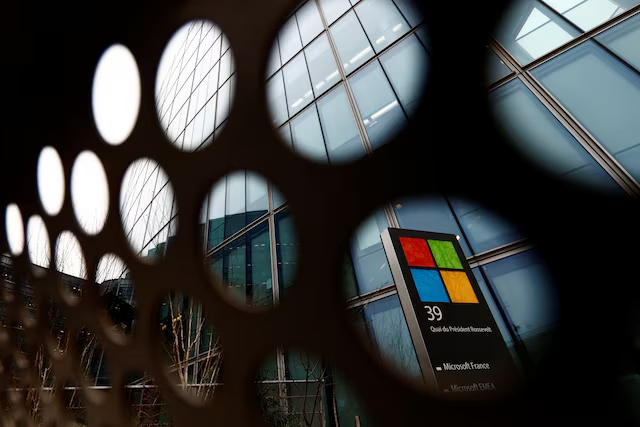
The White House plans to host leading data center and artificial intelligence companies including Microsoft , Anthropic and Meta Platforms in early March to formalize a deal to shield consumers from rising electricity costs, according to two sources familiar with the plans.
The meeting is expected to advance an initiative President Donald Trump unveiled during his State of the Union address on Tuesday, in which he said he had told major technology firms they must build their own power plants to run the rapidly-expanding fleet of data centers and other artificial intelligence infrastructure.
The pledge under discussion is expected to resemble commitments already offered earlier this year by Microsoft to invest in new electricity generation and efficiency measures, the sources said.
“We appreciate the Administration’s work to ensure that data centers don’t contribute to higher electricity prices for consumers,” said Brad Smith, Microsoft’s Vice Chair and President.
The company did not say whether it would be in attendance next week or whether it would sign any new pledge.
The White House did not immediately respond to requests for comment.
A spokesperson for Meta declined to comment and Anthropic did not immediately respond to a request for comment.
Trump has made the global AI race, and securing the vast amounts of electricity needed to power it, a primary focus of his second term.
That agenda, however, has become politically precarious ahead of the midterms as energy demand growth from data centers pushes up power bills over a wide swath of the country.
The recent proliferation of giant data center projects — needed for the expansion of artificial intelligence technologies — has been met with increasing local and state protests over concerns of rising bills and pollution tied to the developments.
OPEC+ To Increase Oil Output By 137,000 bpd For April

OPEC+ is likely to consider increasing oil output by 137,000 barrels per day (bpd) for April 2026, ending a three-month pause in hikes as they prepare for peak summer demand and navigate market share strategies, Oilprice.com reported on Wednesday citing Bloomberg ahead of a scheduled cartel meeting on March 1.
The group had previously implemented 137,000 bpd hikes in late 2025 before pausing increases for the first quarter of 2026 in a bid to avoid creating a supply surplus.
Unwinding previous output cuts will allow key members such as Saudi Arabia and the UAE to claw back some market share at a time when oil prices are supported by ongoing tensions between the U.S. and Iran.
Oil prices have been surging in response to growing U.S.-Iran tensions, with Brent crude jumping to a seven-month high above $71 per barrel.
Fears of military action and potential supply disruptions have triggered volatility despite broader, ongoing concerns about a global oil surplus.
The tensions have added a $3–$4 per barrel risk premium to U.S. crude prices; however, analysts have warned that oil prices could move higher if conflicts move from rhetoric to action.
Analysts from Barclays see prices jumping to the $80 per barrel range in a scenario where the U.S. targets military or government leadership but avoids strikes on Iran’s oil infrastructure.
Rystad Energy sees a temporary spike of $10 to $15 per barrel in a wider but not catastrophic conflict if an attack is short-lived and does not cause major supply interruptions.
Barclays, however, has predicted that strikes targeting Iranian production fields or export terminals could drive prices towards $100 per barrel.
Last year, JPMorgan predicted an oil price spike to $130 in a “worst-case scenario” if Iran blockades vital chokepoints such as the Strait of Hormuz. The Strait of Hormuz is considered the world’s most critical oil chokepoint, with ~20-30% of global seaborne oil passing through it everyday.
The chokepoint is the only direct maritime link from the Persian Gulf to the open sea, making it vital for exporting oil from Saudi Arabia, Iran, Iraq, Kuwait and the UAE to Asia and the rest of the world.
Ghana: Energy Minister Gives Energy Commission, PURC, And ECG 7-Day Ultimatum To Investigate Rapid Depletion Of Prepaid Credit

Ghana’s Minister for Energy and Green Transition, Dr. John Abdulai Jinapor, has given the Energy Commission, the Public Utilities Regulatory Commission (PURC), and the Electricity Company of Ghana (ECG) a seven-day ultimatum to investigate the alleged rapid depletion of prepaid electricity credits, following widespread complaints from consumers across the country.
The Minister directed the three institutions to conduct an impartial and thorough assessment of prepaid meters and billing systems to determine the root cause of the issue.
He stressed the need for transparency and accountability in order to restore public confidence in the electricity distribution system.
Speaking to the media in Tema on Wednesday, Dr. Jinapor said his ministry is taking the concerns seriously and has tasked the agencies with “getting to the bottom of the matter” by examining whether technical faults, metering irregularities, or billing errors may be responsible for the reported fast credit depletion.
He assured consumers that should the investigations confirm cases of overbilling or unfair charges, ECG would be required to compensate all affected customers.
In recent months, many prepaid electricity users have complained that their purchased credits are being exhausted much faster than usual, raising concerns about possible meter calibration problems, tariff miscalculations, or system inefficiencies.
ECG, which is responsible for electricity distribution to millions of households and businesses nationwide, has previously faced criticism over billing disputes and service reliability.
The Energy Commission regulates technical standards in the power sector, while the PURC oversees tariffs and protects consumer interests.
The Minister’s directive is expected to bring coordinated oversight among the three bodies to address the complaints and ensure fairness in the billing system.
Nigeria: NUPRC Set To Digitise Operations Within 60 Days, Says CEO

The Nigerian Upstream Petroleum Regulatory Commission (NUPRC) has announced a 60-day programme to fully digitise the Commission’s internal communications and operational processes as part of efforts to enhance transparency, speed, and regulatory efficiency.
Chief Executive Officer, Oritsemeyiwa Eyesan, disclosed this when the Executive Secretary of the Nigeria Extractive Industries Transparency Initiative (NEITI), Musa Adar, paid a working visit to the Commission’s corporate headquarters in Abuja on February 23, 2026.
The initiative is aimed at eliminating paper-based processes and strengthening accountability in Nigeria’s upstream petroleum sector.
“We have set for ourselves a 60-day programme to digitise our interactions and communications within the Commission. I can assure you that once we get to day 60, there will be no paper trail within the Commission. All our transmissions will be electronic, which also means speed is assured. It means we will be able to trace where we have hiccups,” she said.
Eyesan explained that the Commission had already recorded significant gains from previous automation initiatives, particularly in royalty collection and monitoring.
She said, “I can tell you without a shadow of doubt that for royalty payments, the default rate was enormous before 2025 when the Commission went live on the system. Now, compliance has improved.”
The NUPRC boss noted that full digitisation would further strengthen regulatory oversight, improve efficiency, and enhance transparency in the oil and gas industry.
She also stressed the importance of deepening collaboration with NEITI, especially as the country prepares for new licensing opportunities and investment drives.
In his remarks, Adar urged the Commission to strengthen its partnership with NEITI through data sharing and closer institutional coordination.
He said this would enhance transparency, improve investor confidence, and ensure strict compliance with the provisions of the Petroleum Industry Act.
Adar said, “There is a need for the Commission to carry NEITI along in its operations. This will not only enhance transparency but also deepen investor confidence. We also expect the regulator to be firm with operators that run afoul of the law.”
He further encouraged the Commission to actively participate in the 2026 global conference of the Extractive Industries Transparency Initiative to gain deeper insights into evolving transparency standards and best practices.
“We are here to seek understanding, and we must collaborate,” he added.
Nigeria has intensified reforms in the oil and gas sector following the enactment of the Petroleum Industry Act in 2021, which restructured regulatory institutions and emphasised transparency, accountability, and improved revenue generation.
The NUPRC, which regulates upstream activities, has introduced several digital and monitoring tools to curb revenue leakages, improve compliance, and attract investment.
Stronger collaboration between NUPRC and NEITI is critical to boosting investor confidence, ensuring accurate reporting, and strengthening governance in Africa’s largest oil producer as the country seeks to increase production and maximise revenue from its natural resources.
Ghana: GRIDCo Confirms Power Outage In Tema, Assures Public Of Swift Restoration

The Ghana Grid Company Ltd. (GRIDCo) has confirmed an electrical fault at the Smelter II Substation, which resulted in a power outage affecting parts of Tema.
The fault occurred at 22:58 hrs on Monday and disrupted electricity supply to several areas in Tema, causing inconvenience to residents and businesses.
In a statement, GRIDCo said its engineers immediately sprang into action and are working tirelessly to diagnose the cause of the disturbance and restore power.
“We sincerely apologise for the inconvenience caused and assure all affected customers that every effort is being made to resolve the challenge promptly and restore stable power supply,” the statement said.
The cause of the fault has not yet been determined, but GRIDCo assured the public that its engineers are working diligently to restore electricity as soon as possible.
South Africa: Electricity Minister Kgosientsho Ramokgopa Attends SADC Sustainable Energy Week In Zimbabwe

South Africa’s Minister of Electricity and Energy, Dr. Kgosientsho Ramokgopa, has arrived in Victoria Falls, Zimbabwe, to attend the 2026 Southern African Development Community (SADC) Sustainable Energy Week (SEW), an event aimed at enhancing collaboration toward regional and sovereign energy security.
The event is scheduled to take place from February 23 to 27, 2026.
Organised by the Southern African Development Community Secretariat in partnership with Ministry of Energy and Power Development and the SADC Centre for Renewable Energy and Energy Efficiency (SACREEE), this year’s SEW is centred on the theme, “Driving Regional Economic Growth through Clean Energy and Energy Efficiency.”
The forum provides an essential platform for energy sector stakeholders across the SADC region to engage in discussions aimed at addressing critical energy challenges facing member states.
Building on the success of last year’s inaugural event, which resulted in 18 actionable recommendations, this year’s programme emphasises the alignment of policy and regulatory frameworks with regional development objectives, including promoting universal energy access and engaging the private sector through innovative financing solutions.
The agenda includes high-level plenary sessions, thematic presentations, breakout discussions, and technical site visits, with a focus on investment in renewable energy technologies, grid integration, energy efficiency, and clean cooking solutions.
South Africa’s participation highlights its leadership in regional energy initiatives, especially as it prepares to co-host the upcoming SADC Energy Ministers’ Meeting.
This year’s SEW aims to strengthen partnerships and mobilise investments for sustainable energy while addressing pressing issues such as rising demand and the impacts of climate change.
Throughout the event, Minister Ramokgopa will collaborate with fellow ministers, industry experts, and stakeholders to reinforce cooperation among SADC member states and work collectively toward a sustainable energy future.
Ghana Energy Awards Kicks Off 10th Anniversary Activities With Visit To Energy Ministry

Ghana Energy Awards has officially launched activities marking its 10th Anniversary Edition with a high-level courtesy call on the Ministry of Energy and Green Transition, setting the tone for a landmark year for the prestigious industry recognition scheme.
The delegation was led by the Chief Executive Officer of the Awards Secretariat, Ing. Henry Teinor, and the Chairman of the Awarding Panel, Kwame Jantuah, Esq. Other members included Dr. Lawrence Tetteh and Dr. Jemima Nunoo.
The broader Awarding Panel also comprises H.E. Dr. Kwame Ampofo, Ghana’s Ambassador to the Hungary, and Prof. Felix Asante, Pro Vice-Chancellor of the University of Ghana, in charge of Research, Innovation and Development.
The team was received by the Deputy Minister of Energy and Green Transition, Hon. Richard Gyan-Mensah, on behalf of the Minister, Hon. John Abdulai Jinapor.
The meeting, held at the Ministry in Accra, marks the first in a series of activities lined up to commemorate the Awards’ 10th anniversary. Since 2017, the scheme has recognised excellence and innovation across Ghana’s energy value chain.
Among the key items discussed was the formal presentation of the Site Visitation Report from the 9th Ghana Energy Awards, alongside deliberations on theme selection and the roadmap for the 10th Edition. The delegation also exchanged perspectives with the Ministry on strategic priorities for 2026 and areas for collaboration.
Independent Assessment to Support Oversight
Presenting the Site Visitation Report, the Chairman of the Awarding Panel, Kwame Jantuah, Esq., underscored the importance of the exercise as an independent technical assessment of selected project sites visited during last year’s awards process.
“The Site Visitation Report provides an independent, expert assessment of operational sites and projects reviewed by the Panel,” he said. “We believe this document can serve as a useful reference point to support policy refinement and strengthen the Ministry’s oversight responsibilities across the sector.”
He noted that the Awards’ structured evaluation process, including site visits and technical reviews, reinforces credibility and provides actionable insights for both regulators and operators.
Commitment to Excellence
Chief Executive Officer of the Awards Secretariat, Ing. Henry Teinor, reiterated the scheme’s commitment to promoting excellence and strengthening the sector’s long-term development.
“As we mark our 10th anniversary, we remain committed to championing operational excellence, innovation, and good governance within Ghana’s energy sector,” he said. “This anniversary is a renewed pledge to support the advancement of the sector in alignment with national priorities.”
He described the courtesy call as the formal opening of a broader calendar of anniversary activities, including stakeholder engagements, policy dialogues, and commemorative events leading up to the awards ceremony later in the year.
Ministry Reaffirms Strategic Priorities
Deputy Minister Richard Gyan-Mensah commended the execution of the 9th Edition of the Awards and welcomed the roadmap shared for the 10th anniversary.
“The Ministry acknowledges the strategic role the Ghana Energy Awards continues to play in highlighting performance and encouraging healthy competition within the sector,” he said. “The 9th Edition was well executed, and with the roadmap presented, we expect an even more impactful 10th Anniversary celebration.”
He reiterated the Ministry’s openness to collaborative initiatives that align with the government’s broader energy vision.
“We remain open to partnerships that help advance the government’s objectives for the sector and inspire industry players to give their best, champion excellence, and pursue innovation,” he added.
Outlining the Ministry’s key objectives for 2026, Gyan-Mensah disclosed that the government is working “around the clock” to ensure Ghana achieves a 90% electricity access rate by the end of the year.
He further highlighted Ghana’s recent ratification of a $2 billion agreement extending the Jubilee and TEN oilfield licences to 2040. The deal, approved in February 2026 and involving Tullow Oil, Kosmos Energy, PetroSA, and the Ghana National Petroleum Corporation (GNPC), secures investment for up to 20 new wells aimed at boosting production. It also increases GNPC’s stake by 10% from 2036 and is expected to enhance domestic gas supply for power generation.
The Deputy Minister added that Ghana has reached an agreement with Nigeria to increase gas supply to support power generation, while discussions are ongoing regarding the country’s nuclear energy pathway, including whether to pursue small modular reactors or large-scale nuclear facilities.
He also disclosed renewed efforts to ensure malfunctioning streetlights are fixed nationwide to improve public lighting and safety.
The 10th Ghana Energy Awards is expected to reflect a decade of recognising industry leadership and impact. Further details on anniversary activities, stakeholder engagements, and the official theme for the 10th Edition will be announced in the coming weeks.
US Forces Seize Third Sanctioned Oil Tanker In Indian Ocean

U.S. military forces have seized a sanctioned oil tanker in the Indian Ocean after tracking it from Caribbean waters, the United States Department of Defense said on Tuesday, adding that it was the third such interdiction in the region, according to a report by Reuters.
Since the capture of Venezuelan President Nicolás Maduro in a military raid last month in Caracas, Washington has escalated its blockade on vessels under sanctions travelling to and from the South American country, a member of Organization of the Petroleum Exporting Countries (OPEC).
In a post on X, the Pentagon said U.S. forces boarded the Bertha overnight.
It accused the crude oil tanker of attempting to defy Iran-related sanctions.
The Bertha, which flies under a Cook Islands flag, is linked to Shanghai Legendary Ship Management Company Limited and falls under sanctions imposed in January 2020, according to the Office of Foreign Assets Control of the United States Department of the Treasury.
The ship management company could not immediately be reached for comment.
The vessel’s last reported position on AIS ship-tracking systems was on February 24, sailing in the Indian Ocean off the Maldives, according to MarineTraffic data.
“Overnight, U.S. forces conducted a right-of-visit, maritime interdiction, and boarding of the Bertha without incident in the INDOPACOM area of responsibility. The vessel was operating in defiance of President Donald Trump’s established quarantine of sanctioned vessels in the Caribbean and attempted to evade,” the Pentagon said.
“From the Caribbean to the Indian Ocean, we tracked it and stopped it.
“Three boats ran and now all three have been captured,” it added, without providing further details.
The Bertha departed Venezuelan waters in early January as part of a flotilla that has now been almost entirely seized by U.S. forces. The ship was carrying about 1.9 million barrels of Merey heavy crude bound for China, according to shipping reports from Venezuelan state oil company Petróleos de Venezuela S.A. (PDVSA).
Earlier this month, U.S. Defense Secretary Pete Hegseth said American forces had boarded the Suezmax tanker Aquila II in the Indian Ocean. That action was followed by the seizure of the Veronica III.
The vessels seized in recent months have either been under U.S. sanctions or part of a “shadow fleet” of ships that disguise their origins to transport oil from heavily sanctioned producers, including Iran, Russia, and Venezuela.
U.S. forces have intercepted 10 tankers since December, including the latest seizure, and have released at least two of them back to the new Venezuelan government, according to Reuters’ analysis.
“International waters are not a refuge for sanctioned actors. By land, air, or sea, our forces will find you and deliver justice,” the Pentagon said.
Moscow Reroutes Oil To China On Largest Vessels After India Slowdown

The surge in Russian crude sales in China and the simultaneous drop in Indian demand for Russia’s oil have prompted Moscow to turn to using a larger fleet of supertankers—vessels capable of carrying 2 million barrels of crude.
In recent weeks, several smaller tankers that left Russia’s Western ports transferred their cargoes to supertankers, the so-called very large crude carriers (VLCCs), in the Red Sea and then traveled to China instead of India, Bloomberg reported on Tuesday, citing ship-tracking data from Vortexa and Kpler.
The Red Sea hasn’t been known as a major ship-to-ship (STS) transfer site but necessity has apparently prompted Russia to use the area, in view of increased scrutiny offshore Malta and Greece in the Mediterranean, and the growing presence of U.S. military in the Middle East.
The supertankers can also hold more barrels, if Russia’s crude needs to stay in floating storage for a period of time waiting for buyers to emerge, Bloomberg notes.
The shift toward bigger vessels highlights the growing importance of China as Russia’s key crude export market and the diminishing role India could play in buying Russian oil going forward.
A jump in China’s crude oil imports from Russia is more than compensating the withdrawal of the Indian refiners from spot Russian purchases, tanker-tracking data compiled by Bloomberg showed last week.
Up to February 18, deliveries of Russia-origin cargoes at Chinese ports averaged 2.09 million barrels per day (bpd) for the month, up from an average of 1.72 million bpd in the full month of January and 1.39 million for December, the data showed.
Earlier this month, data from Vortexa and Kpler showed that China’s oil imports from Russia are on track for all-time high of more than 2 million bpd this month as India is withdrawing from Russian spot purchases and supply is now heavily discounted for Chinese independent refiners.
Tanzania Commissions Landmark Kishapu Solar Power Project, Set To Inject 50MW Into National Grid By March 1

Tanzania has commissioned the country’s first large-scale solar photovoltaic project in Kishapu District, located in the northwestern Shinyanga Region, marking a milestone in the East African nation’s energy transformation agenda.
The project will inject 50 megawatts of power into the national grid by March 1, 2026.
The facility was executed by the Tanzania Electric Supply Company Limited (TANESCO) through a partnership between the Tanzania and the Agence Française de Développement (AFD) at a cost of TSh 118 billion ($45,953,144.15).
It is expected to strengthen power supply reliability, particularly across the Lake Zone regions, marking a significant step in Tanzania’s renewable energy expansion strategy.
Speaking during a site inspection on Saturday, February 21, 2026, TANESCO’s Chief Executive Officer, Lazaro Twange, said the completion of the project demonstrates the government’s consistent commitment to expanding access to reliable electricity services for Tanzanians.
“This is a new chapter being written in our country’s history. Since independence, we have never had a solar project of this scale. The government, through the Ministry of Energy and TANESCO, has made history, and today you have witnessed electricity being generated,” Mr. Twange told the gathering.
He described the project as a landmark development and the first solar facility of such magnitude since independence.
Peter Masindi, the Kishapu District Commissioner, said the solar plant would serve as a catalyst for local economic growth, particularly benefiting young people engaged in mining and agriculture.
The Acting Plant Manager, Mariana Mrosso, added that the facility will enhance grid stability and improve electricity quality for consumers, especially in Tanzania’s Lake Zone.
Ghana: There Is No Load Shedding, Ongoing Maintenance Is To Ensure Supply Reliability – Energy Ministry

Ghana’s Ministry of Energy and Green Transition has dismissed claims that the country is rationing electricity, insisting that Ghana’s power generation capacity remains stable despite recent outages in some communities.
According to the ministry, the energy sector is currently more stable than what the government inherited.
Speaking on Accra-based Citi FM’s Eyewitness News on Monday, February 23, Richmond Rockson, Spokesperson and Head of Communications at the ministry, said the government has not engaged in load shedding over the past 10 to 11 months.
He explained that although the current administration inherited a power generation deficit of about 700 megawatts in December 2024, the shortfall has since been addressed.
“As a government, we have not been shedding load over the past 10 to 11 months. Our generation capacity has been enhanced. What we are doing as a government is that even though we took over a deficit of 700 megawatts in December 2024, that has been overturned. We’ve managed to ensure that our generation capacity is intact,” he stated.
Mr. Rockson acknowledged that some communities have experienced recent power challenges but stressed that the issues are area-specific and not a result of insufficient generation.
He mentioned Achimota, Dodowa, parts of Akweteyman, Tesano, and Adenta as some of the areas that recorded temporary disruptions in recent days.
According to him, many of the challenges in these communities have largely been resolved, and residents should expect a stable power supply going forward.
“We’ve recognised that there have been a number of issues over the last few days, and those issues are area-specific. As a ministry, we’ve taken notice that areas like Achimota have had some issues. Dodowa has had some issues, parts of Akweteyman, Tesano in the last couple of days—and let me add Adenta to it. The good news is that these challenges have largely been resolved in some of these areas, and so we expect that residents there will have stable power supply,” Mr. Rockson said.
The ministry maintains that the recent interruptions are linked to maintenance and localised technical issues rather than a return to nationwide load shedding.
Nigeria: Customs Seizes Over 159,000 Litres Of Smuggled Fuel

The Nigeria Customs Service has handed over three fuel tankers containing no fewer than 159,000 litres of petrol intercepted recently to the Nigerian Midstream and Downstream Petroleum Regulatory Authority (NMDPRA) for further action.
Deputy Comptroller Abubakar Aliyu, National Coordinator of Operation Whirlwind, performed the handover on Friday in Lagos. He described the seizure as a major breakthrough in the fight against fuel smuggling.
He said the tankers were intercepted along notorious smuggling corridors, including Aso-Odo, Seme, Owode-Apa and Badagry.
“Customs is handing over the seized fuel tankers with registration numbers T21019LA, T9827LA and T3546LA, containing over 159,000 litres, for appropriate sanctions,” he said.
He added that 1,630 jerry cans of petrol intercepted during the operation would be auctioned to the public to ensure transparency and accountability.
“The total Duty Paid Value of the 1,630 jerry cans of PMS is about N40.75 million.
“The interception was intelligence-driven and reflects our uncompromising resolve to safeguard Nigeria’s economic and energy security,” he said.
Mr Aliyu stressed that Operation Whirlwind targets economic sabotage and illicit trade, insisting that strict compliance with petroleum regulations is non-negotiable.
He noted that petroleum transportation is governed by clear regulatory frameworks and Standard Operating Procedures designed to prevent diversion and smuggling. According to him, such illegal activities undermine government policy, distort market stability and deprive the nation of critical revenue.
He described the Owode-Apa, Seme and Badagry border corridors as sensitive economic arteries historically exploited for cross-border petroleum smuggling.
“Under my watch, smuggling will no longer be safe for economic saboteurs,” Aliyu warned.
He said the handover reflected strong inter-agency collaboration in line with established operational frameworks.
Mr Aliyu commended the Comptroller-General of Customs, Bashir Adeniyi, for his leadership and support for anti-smuggling operations.
He urged Nigerians to support enforcement agencies, saying national development thrives when citizens and authorities work together.
In her remarks, Grace Dauda of the NMDPRA reaffirmed the agency’s mandate to ensure petroleum products meant for domestic use are not diverted abroad.
“It is unfortunate that some businessmen attempt to smuggle petroleum products out of the country,” she said.
Mrs Dauda urged the public to collaborate with government agencies to end economic sabotage.
Gambia: NAWEC To Ration Power As Ramadan And Lent Seasons Drive Up Electricity Demand
The National Water and Electricity Company (NAWEC) has announced minimal load shedding across The Gambia due to increased electricity demand during this year’s Ramadan and Lenten seasons.
The company said the measure has become necessary to maintain the stability of the national power system.
In a statement, NAWEC acknowledged the importance of the period for families, worship centres, and communities across the country.
The statement added that a daily load-shedding roster would be published from Wednesday, February 24, 2026, to enable customers to plan their activities accordingly.
NAWEC also sincerely apologised for any inconvenience that may arise during these sacred observances and expressed appreciation for the public’s patience and understanding.
Nigeria: Kano Electricity Distribution Company Invests ₦500 Million To Boost Power Supply In Katsina

The Kano Electricity Distribution Company (KEDCO), one of the power distribution companies in the Federal Republic of Nigeria, is investing ₦500 million to revive the IBB Way Injection Substation and other critical power infrastructure in Katsina.
The investment forms part of a strategic move aimed at boosting supply capacity, improving network stability, and delivering more reliable power to customers across the Katsina metropolis.
Since the acquisition of KEDCO by Future Energies Africa (FEA) in 2024, the company has consistently implemented a special annual Ramadan intervention programme.
This initiative includes redirecting and boosting electricity supply to residential areas by up to 20 percent throughout the holy month, with further improvements typically recorded during the Eid celebration period.
In a statement issued by Sani Bala Sani, Head of Corporate Communication, the company attributed the recent power supply challenges experienced across Kano, Katsina, and Jigawa State largely to failures on the national grid.
The two transmission lines supplying bulk power from Shiroro to these states were affected, resulting in temporary backfeeding from Jos.
KEDCO promptly raised concerns with the Honourable Minister of Power and the Nigerian Electricity Regulatory Commission (NERC).
“We are pleased to report that one of the affected lines has now been restored, leading to noticeable improvements in power supply across the region,” the statement said.
The statement added that other challenges, including a recent fire incident involving a 15MVA TR3 power transformer at the IBB Way Injection Substation, had impeded efforts to provide reliable electricity.
As an interim measure to prevent a total blackout for affected customers, the 11kV GRA feeder was merged with the 11kV Army Barracks and 11kV Low-Cost feeders to ensure continued, though limited, power supply while the damaged transformer is being repaired under the project.
For the Ramadan period, with the partial restoration of the Shiroro–Kaduna transmission line and firm supply increase commitments already secured, residents can expect improved electricity availability throughout the holy month.
KEDCO expressed deep appreciation to His Excellency, the Governor of Katsina State, Dikko Umaru Radda, and his administration, particularly the Special Adviser on Power and Energy, Hafiz Ibrahim Ahmed, for their unwavering commitment and proactive engagement toward improving electricity supply.
KEDCO reassured residents of its continued partnership with the Katsina State Government to ensure sustainable power supply during Ramadan and beyond.